Cash Game Single-Raised Pots
A complete guide to cash game single-raised pots: range advantage, c-bet sizing by texture, high SPR play, and the most common SRP mistakes.
On this page · 6 sections
The single-raised pot (SRP) is the bread and butter of cash game poker — one raise, one or more calls, no 3-bet — and the overwhelming majority of the hands you play will be SRPs. Because there was no 3-bet, stacks are deep relative to the pot: a typical SRP hits the flop around 6.5bb with 100bb behind, giving a stack-to-pot ratio near 15. That high SPR is the defining feature of the format. It means postflop play stretches across all three streets, one-pair hands rarely want to stack off early, and small edges in range construction and bet sizing compound into your win rate more than in any other pot type.
Range advantage is the engine
In most SRPs the preflop raiser holds the range advantage — their opening range is tighter and stronger than the caller’s calling range. That advantage is what licenses the c-bet. On a high, dry flop like A-7-2 rainbow, the raiser hits the top of the board far more often, so a small c-bet at a high frequency is correct — often with the entire range for a third of the pot. The caller cannot profitably continue with much, and the raiser prints. When the board favors the caller instead — a low, connected flop like 7-6-5 two-tone in a blind-vs-button pot — the raiser should slow down, check more, and bet only value and strong draws.
C-bet sizing by board texture
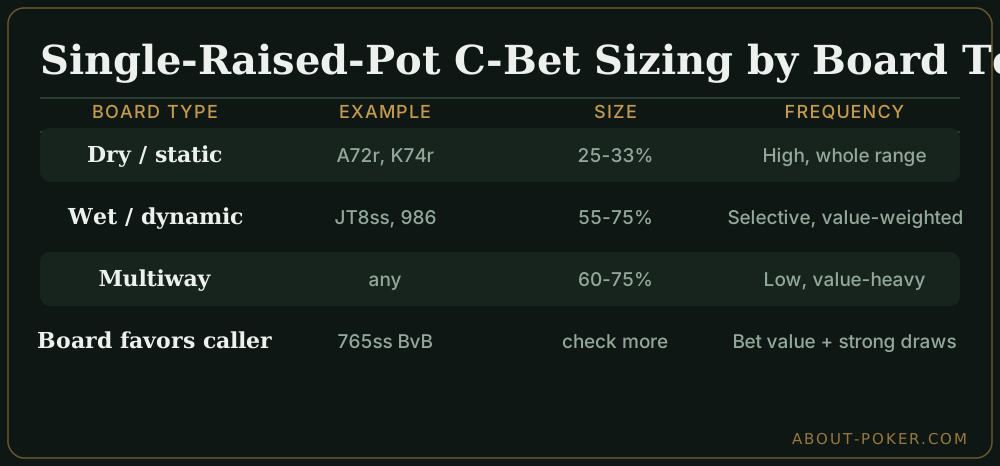
The lever that separates winning SRP players from losing ones is matching bet size to board texture. On dry, static boards where equities are set (A-K-4 rainbow, K-7-2), a small 25-33% bet works because there are few draws to charge and you want to keep your whole range in play cheaply. On wet, dynamic boards where cards can drastically change the hand (J-T-8 two-tone, 9-8-6), bet larger — 55-75% — with a value-weighted range to charge draws and protect equity. Our guide to bet sizing in cash games covers the full framework, but the shorthand is: dry board, small and wide; wet board, big and selective; multiway, big and value-heavy.
A worked example
You open Ac-Qh to 2.5bb from the cutoff and the big blind calls. The flop is Qs-8d-3c — top pair top kicker on a dry, static board, and you have the range advantage. Pot is about 5.5bb, SPR near 17. You c-bet 33% (about 1.8bb), keeping your whole range’s frequency high on a board that hardly favors the caller. He calls. The turn is the 4h, a total blank. Now you bet again, sizing up to about 60% because your hand wants two streets of value and the turn changed nothing. He calls. The river is the 7s. With top pair top kicker you make a thin value bet of roughly half pot — the caller’s range is full of worse queens and floats that will pay a modest bet. Because the SPR was high, you never committed your stack with one pair; you extracted three controlled value bets instead.
High SPR shapes commitment
The high SPR in SRPs is why you should not treat top pair as a stack-off hand by default. With an SPR around 15, getting all the money in requires three big bets, and any opponent willing to put in that much usually beats one pair. This is the same logic behind deep play, and understanding stack-to-pot ratio tells you at a glance whether a hand wants to build the pot or control it. Overpairs and top pair are strong one- or two-street value hands in SRPs — bet them for value, but do not fall in love and shovel your stack in on a scary runout.
Common SRP mistakes
The biggest leak is c-betting one size for every board — usually too big on dry flops (wasting money and folding out worse) or too small on wet flops (letting draws call cheaply). A second is auto-firing the flop out of position on boards that favor the caller and then having no plan for the turn. A third is over-committing one-pair hands at high SPR, turning a controlled value hand into a stack-off disaster. A fourth is ignoring the difference between heads-up and multiway SRPs: multiway pots demand tighter, more value-heavy betting because someone usually has a piece. Fix the sizing leak first — it is worth the most.
SRP checklist
Ask who has the range advantage on this specific board before you bet. Match your c-bet size to texture: small and wide on dry boards, big and selective on wet ones, big and value-heavy multiway. Remember the SPR is high — treat top pair and overpairs as multi-street value, not automatic stack-offs. Have a turn and river plan before you fire the flop, especially out of position. Play more streets of thin value on blanks, and slow down or give up when the board runs out in your opponent’s favor. Master the SRP and you have mastered the pot type that decides your win rate.
Frequently asked
What is a single-raised pot in poker?
A single-raised pot (SRP) is a pot where one player opened with a raise preflop and got called, with no 3-bet. It is by far the most common pot type in cash games and has a high stack-to-pot ratio, which shapes how you play the flop and later streets.
How big should you c-bet in a single-raised pot?
It depends on texture. On dry, static boards a small 25-33% c-bet with a high frequency works well. On wet, dynamic boards a larger 55-75% bet with a more value-weighted range is correct. Multiway pots call for larger, more selective bets.
Who has the range advantage in a single-raised pot?
Usually the preflop raiser, because their opening range is stronger and more condensed than the caller's. That range advantage is why the raiser can c-bet a wide range on many boards, especially high, dry ones like A-high and K-high flops.