Cold 4-Bet Bluffing in Cash
How and when to cold 4-bet bluff in cash games: pick the right blockers, size small, target the right players, and know when to fold instead.
On this page · 6 sections
A cold 4-bet is one of the most intimidating moves in poker: a player who had folded to the action suddenly reraises over an open and a 3-bet, committing a large chunk of a stack with a range that screams strength. Because it comes from a player with no prior investment, the cold 4-bet represents a very narrow, premium range — and that credibility is exactly what makes it such a powerful bluff. When you cold 4-bet as a bluff, you leverage a story that opponents believe, folding out hands that would crush you. But it is high-risk and easy to overdo, so it demands the right hands, the right sizing, and the right targets.
Why the cold 4-bet is so credible
The strength of the move is structural. A 3-bettor is often 3-betting a fairly wide, polarized range, especially against a late-position open. When a cold 4-bet lands from a player who had not entered the pot, both the original raiser and the 3-bettor face a range that looks like a wall of aces, kings, and ace-king. Their calling ranges are capped and their bluff-3-bets have to fold. That is the leverage: you are threatening two players’ worth of chips with a range so tight it forces disciplined folds. Understanding the 4-betting hierarchy — value, bluff, and the ranges that call — is the foundation for adding cold 4-bet bluffs on top.
Choose your bluffs by blocker
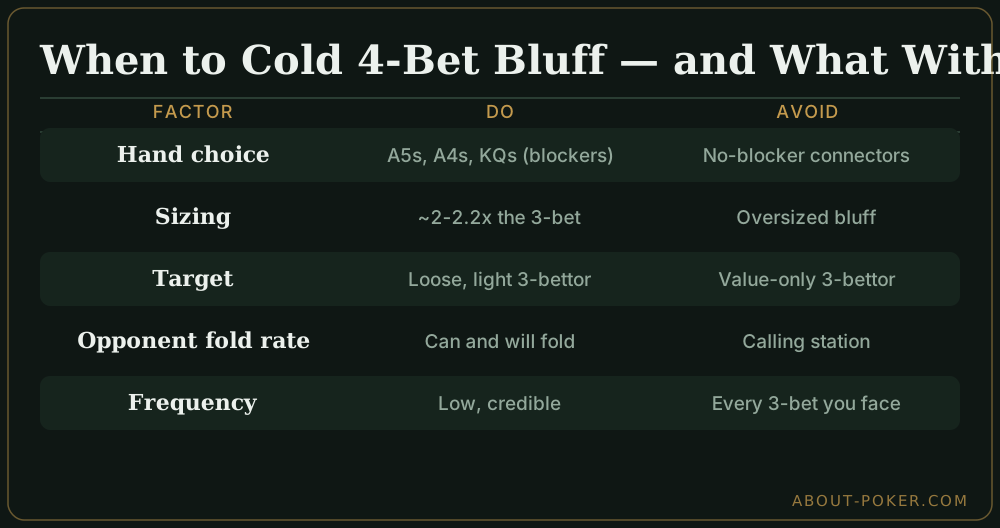
The best cold 4-bet bluffs are chosen for their blockers, not their raw equity. Holding an ace or a king removes combinations of AA, KK, and AK from your opponents’ possible hands, making it far less likely they hold a hand that can continue. That is why A5s and A4s are the textbook cold 4-bet bluffs: the ace blocks the premiums, and the suited wheel card gives you nut-flush and straight potential plus reasonable playability the rare times you get called. Kings-with-a-blocker hands like KQs work similarly. Bluffing a cold 4-bet with a hand that holds no blockers — a middling suited connector, say — is a needless gamble, because your opponents’ premium range is fully intact.
A worked example
It folds to a loose regular who opens to 2.5bb from the cutoff. The button, an aggressive 3-bettor, makes it 9bb. You are in the small blind with Ad-5d, 100bb effective. Both players have wide, believable ranges — the opener is loose, the 3-bettor is a habitual light 3-bettor. You cold 4-bet to 24bb (about 2.2x the 3-bet). Your story is airtight: a small blind cold 4-bet screams QQ+ and AK. The opener folds his loose range, and the button, holding something like KQs or a light 3-bet, has to fold most of the time facing a raise that beats his range and threatens his stack. When you do get called or 5-bet shoved, you hold the Ad blocker (cutting their AA and AK combos) and a suited wheel hand with live equity — you are rarely drawing dead. That combination of fold equity and a blocker-heavy backup is the entire point.
Target the right players
Cold 4-bet bluffing only works against opponents who can fold. Against a loose 3-bettor who bluffs too often, your cold 4-bet prints because their range is full of foldable air. Against a tight, value-only 3-bettor, do not bother — they 3-bet a premium range and will happily get it in. The move also punishes tables where players 3-bet light in position; your cold 4-bet exploits exactly that width. Read the 3-bettor’s tendencies before you fire: the whole play is an exploit of players who reraise wide and then over-fold to further aggression. Against calling stations who never fold to 4-bets, abandon the bluff entirely.
Common cold 4-bet bluffing mistakes
The biggest leak is doing it too often — cold 4-bet bluffing is a low-frequency exploit, not a default line, and overusing it gets you snapped off when opponents adjust. A second is choosing bluffs without blockers, so your opponents’ premium range is fully live. A third is over-sizing the bluff, risking more chips than necessary; a smaller 2-2.2x size applies the same pressure at lower cost. A fourth is bluffing into value-only 3-bettors who cannot fold, or into stations who call everything. A fifth is having no plan for a 5-bet or a flat call — always know your response before you fire. For the balanced-range version of this move, see 4-betting as a bluff.
Cold 4-bet bluff checklist
Only cold 4-bet bluff when both players’ ranges can fold and someone is 3-betting too wide. Pick hands with an ace or king blocker plus some backup equity — A5s and A4s are the gold standard. Size small, around 2 to 2.2 times the 3-bet, to risk less while keeping full leverage. Target loose, light 3-bettors and avoid tight value-3-bettors and calling stations. Keep the frequency low so the move stays credible. Above all, have a plan for the times you get called or shoved on — the blocker and the suited backup are what keep a busted cold 4-bet from becoming a disaster.
Frequently asked
What is a cold 4-bet?
A cold 4-bet is a 4-bet made by a player who had not yet invested in the pot — someone opens, another player 3-bets, and a third player who folded to that point comes over the top with a 4-bet. Because it comes from a player with no prior investment, it represents an extremely strong, condensed range.
What hands make good cold 4-bet bluffs?
The best cold 4-bet bluffs hold an ace or king blocker, which reduces the number of premium hands your opponents can hold. Hands like A5s and A4s are ideal because the ace blocks AA and AK while the suited wheel card retains some equity and playability if called.
How big should a cold 4-bet be?
Cold 4-bets are usually smaller relative to the pot than in-position squeeze raises — often around 2 to 2.2 times the 3-bet, or roughly 22-26bb over a 9-11bb 3-bet at 100bb deep. A smaller size risks less on a bluff and still applies maximum pressure to the capped ranges facing it.