Isolating Limpers in Cash
How to isolate limpers in cash games: correct iso-raise sizing, which hands to attack with, position, multiway adjustments, and a worked KJs example.
On this page · 7 sections
Limpers are the recreational player’s tell, and they are a gift. When someone just calls the big blind instead of raising, they are announcing a weak, capped hand and inviting you to seize the pot. Isolating that limper — raising to play heads-up against them — is one of the most reliable ways to print money in loose cash games. This guide shows how to do it correctly.
Why isolating limpers is so profitable
A player who open-limps almost never has a premium hand; strong hands raise. The limping range is weak and passive — small pairs, weak suited hands, offsuit connectors, and speculative junk. By raising over the limp, you accomplish two things: you build a pot you will often win uncontested when they fold, and when they call, you play against a capped range with position and initiative on your side.
The goal is right there in the name: you want the pot heads-up against the weakest player at the table. Isolating a recreational limper is a cornerstone of exploiting recreational players, because it repeatedly funnels chips from the worst player to you in position.
Sizing: charge the limper
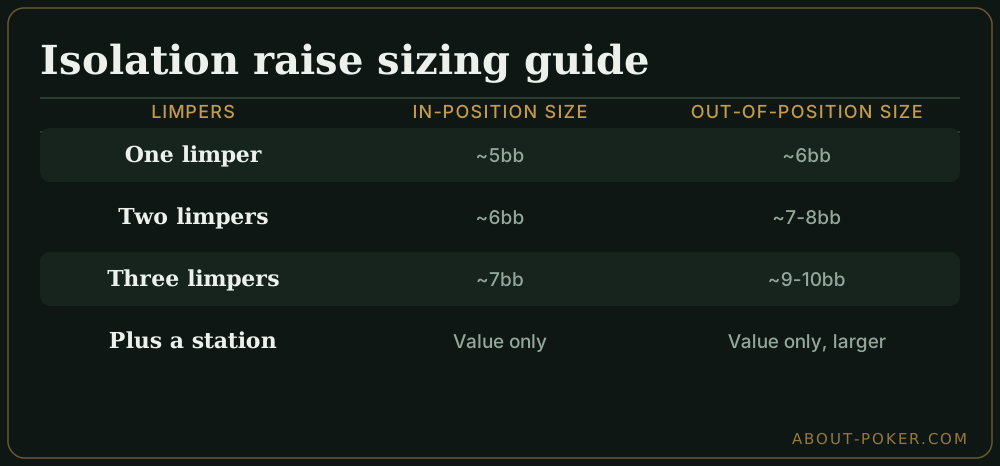
Iso-raises should be larger than a normal open. There are two reasons. First, limpers are sticky — they limped to see a cheap flop, so a small raise barely discourages them. Second, there is already dead money in the pot from the limp and the blinds. A dependable formula is about 4bb plus one big blind for each limper. So over a single limper you raise to roughly 5bb; over two limpers, to about 6bb. Out of position, size up further, because you want fewer players and more fold equity.
Undersizing is the classic mistake. A min-raise over a limper gives everyone a great price and often creates the exact multiway mess you were trying to avoid — see playing multiway pots in cash games for why that hurts your edge. This sizing logic slots directly into your cash game preflop strategy.
Hand selection and position
Isolate with hands that dominate the limper’s weak range and flop well. Strong broadways — AJ, KQ, KJ, QJ — are ideal because they make top pairs that beat the limper’s weaker top pairs. Suited aces add nut-flush potential, and pocket pairs isolate well because they are often ahead and can set-mine cheaply against a passive opponent.
Position widens your isolating range dramatically. From the button or cutoff over a limper, you can attack with a broad range because your position guarantees information and pot control postflop; the button is the most profitable seat for this exact reason, covered in playing the button in cash games. From early position or the blinds, tighten up — you will be out of position against the limper’s call, so you want hands that hold up unimproved.
Adjusting for multiple limpers and multiway risk
Two or three limpers change the math. More players mean you are less likely to win the pot outright and more likely to face a multiway flop where your one pair is vulnerable. Respond by tightening your value range (lean on hands that flop strong, dominating pairs and big broadways) and sizing up more aggressively to thin the field. If a station behind you calls everything, isolate for value and abandon the thin bluffs — you cannot iso-raise a caller off their hand.
Worked example: isolating with KJs
You are on the button with KsJs. A loose-passive recreational player under the gun open-limps, and everyone folds to you. This is a textbook isolation spot.
You raise to 5bb (4bb plus 1bb for the limper). KJs dominates a big chunk of the limper’s range — it beats their weaker kings, jacks, and offsuit junk, and it flops flush draws and straight draws that let you barrel credibly. The blinds, seeing a raise plus a limp-call likely coming, usually fold, and you get the heads-up pot in position you wanted. When the limper calls and checks the flop, you continuation-bet a wide range and pick up the pot often; when you flop top pair or a strong draw, you extract value from their sticky, capped holdings. Compare this to just limping behind: you surrender the initiative and let the blinds see a cheap flop, wasting the edge KJs gives you against a weak player.
Common isolation mistakes
The biggest leak is min-raising over limpers, which fails to charge them and invites a crowd. The second is isolating with weak offsuit hands that get dominated when the limper wakes up with a real hand. The third is trying to iso-bluff a calling station — against someone who never folds, isolate only for value. Finally, do not over-isolate from early position, where you will be stuck playing marginal hands out of position all night.
Quick isolation checklist
- Treat every open-limp as a weak, capped range worth attacking.
- Size ~4bb + 1bb per limper; go larger out of position.
- Isolate with dominating broadways, suited aces, and pairs.
- Widen a lot in position; tighten hard out of position.
- Against a station, iso for value only — you cannot bluff them out.
Frequently asked
What is an isolation raise?
An iso-raise is a raise made over one or more limpers with the goal of playing the pot heads-up against the weakest player. You are isolating the limper so you get to use your positional and skill edge against a single, usually weak, opponent.
How big should an isolation raise be?
Bigger than a standard open because limpers are sticky and there is already dead money. A common size is about 4bb plus one big blind for each limper, and larger still when out of position. Against a very loose caller, size up further to charge them.
Which hands should I isolate with?
Hands that dominate a limper's weak range and flop well: strong broadways like AJ, KQ, KJ, suited aces, and pocket pairs. In position you can widen considerably because your edge and position do the work postflop.