What Is Capped Range in Poker?
A capped range means a player's hands top out at a certain strength — no nutted holdings. Learn how to spot capped ranges and attack them for profit.
On this page · 7 sections
A capped range is a set of hands whose top-end strength is limited — the player simply cannot hold the very best possible holdings for the board. If a player’s line rules out the nuts and every near-nut hand, their range is “capped.” The opposite is an uncapped range, which still contains the strongest hands available. Understanding who is capped and who is not is one of the most profitable reads in No-Limit Hold’em, because it tells you exactly when you can pile on pressure and when you have to respect it.
What Capped Really Means
Every action a player takes narrows their range — the full set of hands they could hold. A range becomes capped when the actions taken would not make sense with the strongest hands. The classic example is calling instead of raising. Players almost always raise their absolute best hands at some point, so a player who only ever calls tends to advertise that the top of their range is missing.
Being capped is about the ceiling, not the average strength. A range can be strong on average yet still capped: a player might hold plenty of good top pairs and overpairs but zero sets, straights, or flushes. The moment big money goes in, that ceiling matters far more than the average.
How Players Cap Themselves
Certain lines cap a range almost automatically:
- Flat-calling a raise preflop rather than 3-betting often caps a player below the very top pairs, since aces and kings usually 3-bet.
- Checking back the flop in position caps that player — they would normally bet their strong hands for value.
- Calling down passively on all three streets says the player never had a raise-worthy monster.
- Betting small on a scary board can cap you, because the nuts would rather bet big.
The player who keeps raising keeps their range uncapped, which is why aggression is so powerful.
A Worked Example
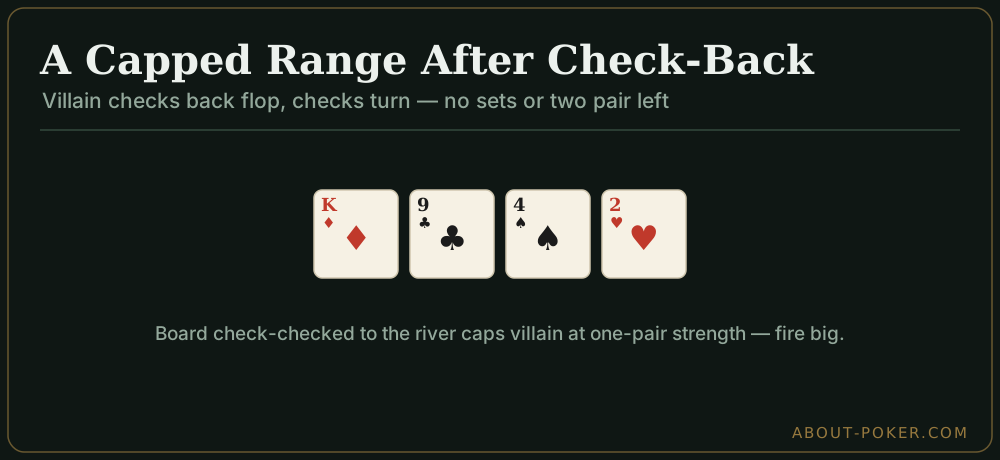
You raise from the button with 8h7h and the big blind calls. The flop comes Kd-9c-4s. The big blind checks, you c-bet, and they call. The turn is the 2h and you both check.
That check-back on the flop and check on the turn tells a story: the big blind called with something like a middle pair, a weak king, or a gutshot — but if they had flopped a set of nines or two pair, they would usually have raised or led out by now. Their range is capped at roughly one-pair strength. On the river, if a blank falls, you can fire a large bet or even an overbet. You are threatening every two-pair-plus hand they cannot hold, and they must fold their capped medium hands or make a nervous, losing call.
How to Attack a Capped Range
Once you have identified a capped opponent, the plan is simple: bet big and bet often. Because they cannot beat your value hands and cannot have the nuts themselves, your bluffs carry enormous fold equity. Overbets shine here — sizing that would be reckless against a strong range becomes near-mandatory against a capped one, since the extra pressure exploits the exact hands they are stuck with.
Reserve this aggression for boards where your own range is uncapped. If both of you are capped, blasting away just spews chips. The edge comes from the asymmetry: you can have the top hands and they cannot.
Protecting Your Own Range
The flip side is not to cap yourself carelessly. Mix a few strong hands into your passive lines so observant opponents cannot pressure you freely. Occasionally check back a set, or flat-call a raise with pocket aces to keep the top of your calling range intact. You do not need to do this often — just enough that a thinking opponent cannot assume you are always capped when you call.
Common Mistakes
- Folding too much when you are the capped one. If you cannot beat a strong hand, don’t invent monsters for your opponent every time — pay off the correct amount and move on.
- Overbetting into an uncapped opponent. Firing huge into a range that still holds the nuts just donates money.
- Never slow-playing. If you always raise your best hands, you become predictable and capped in every line where you just called.
- Ignoring board texture. A capped range matters most on boards where the nuts are possible — a paired or connected board magnifies the edge.
Quick Checklist
Before you pull the trigger on a big bluff, ask: Did my opponent’s line rule out their strongest hands? Is my own range still uncapped here? Does the board let me credibly represent the nuts? If all three are yes, you have found a capped range and the profitable play is pressure.
Frequently asked
What does capped range mean in poker?
A capped range is a set of hands whose maximum strength is limited — the player cannot have the very strongest holdings for the board. If someone just calls instead of raising, they usually cap their range at medium-strength hands and give up the top of it.
What is the difference between capped and uncapped?
A capped range has a ceiling on strength and contains no nutted hands, while an uncapped range still includes the strongest possible holdings. The uncapped player can always represent the nuts, which is a huge advantage in a big pot.
How do you exploit a capped range?
When your opponent is capped, you can apply pressure with large bets and overbets because they can rarely continue with confidence. You threaten the pot with hands they cannot beat, forcing folds from their medium-strength holdings.
Does calling always cap your range?
Usually yes. Choosing to call rather than raise with your strongest hands signals you likely do not hold them, capping your range. Good players sometimes slow-play to stay uncapped, but most opponents cap themselves by only ever raising their best hands.