Playing Against Regs
Regs are your toughest opponents. Learn how to identify them, deny them clean spots, sit for position, and pick your battles instead of leveling wars.
On this page · 7 sections
The single most important thing to understand about regs is that they are not where your money comes from. A reg — a regular you see grinding the same stakes week after week — plays a balanced, technically competent game. They open sensible ranges, continuation-bet with a plan, and fold when they’re supposed to. Against a good reg your edge is thin, so the winning approach is not to outplay them in a spectacular hand but to deny them clean spots, take position, and save your aggression for opponents who actually pay it off.
Identify who is actually a reg
Before you adjust, label correctly. A reg is not just “someone who is winning today.” Watch for consistent bet sizing, standard open sizes, disciplined folds to 3-bets out of position, and a lack of obviously spewy lines. If a player min-defends their big blind, checks back marginal hands to control the pot, and rarely tilts, you’re likely facing a reg. Contrast this with the loud, hands-on styles covered in exploiting recreational players, where mistakes come frequently and cheaply.
Getting the read right matters because your entire game plan flips. Against a fish you widen for value; against a reg you tighten, respect their bets, and stop hero-calling into ranges that are genuinely strong.
Position is your biggest edge
Because a reg won’t hand you chips through raw mistakes, your structural edges do the heavy lifting — and position is the biggest. Acting last lets you realize equity, control pot size, and bluff more credibly. Try to seat yourself to the left of the strongest regs so you have position on them most orbits.
The flip side: when a reg has position on you, tighten up. Flatting out of position against a competent opponent is one of the fastest ways to bleed money, because they’ll barrel your capped range and check back when you’re strong. This is the same seat-selection logic laid out in table and seat selection.
Don’t get into leveling wars
Regs know you’re thinking, and you know they’re thinking. That mutual awareness tempts both players into “I know that you know that I know” spirals that end in a punt. Resist it. Against an unknown or standard reg, default to solid, GTO-adjacent lines rather than fancy exploits. Save the deep exploits for reads you’ve actually earned over many hands.
A practical rule: if you can’t clearly articulate why a bluff or thin call is profitable against this specific reg, don’t make it. Balanced, boring poker beats most regs to a small margin, and a small margin is all you’re realistically fighting for.
A worked example
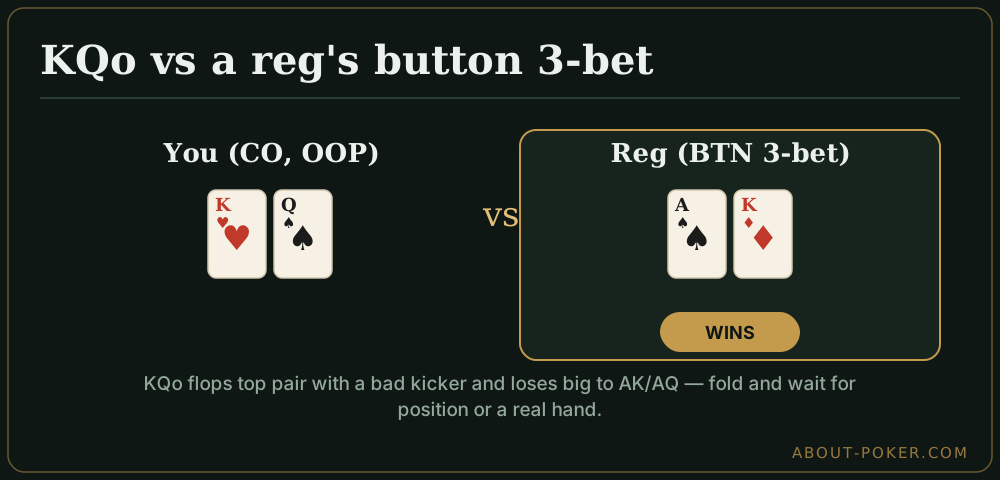
You open KQ offsuit from the cutoff to 2.5bb in a 100bb game. A reg 3-bets to 8bb from the button — a spot where their range is polarized toward premiums and some suited bluffs. Out of position with a dominated, offsuit hand, calling is a trap: you’ll flop top pair with a bad kicker and lose a big pot when they hold AK or AQ.
The disciplined play is to fold. KQo simply doesn’t flop well enough to profitably call a competent 3-bettor out of position. Against a recreational player who 3-bets far too wide you might defend, but against a reg, folding here is not weak — it’s the whole strategy. You concede the small pot and wait for a spot where you have position, initiative, or a genuinely strong hand. For deeper counter-lines when a reg is specifically hyper-aggressive, see adjusting to aggressive regs.
Attack their default lines
Even balanced players have defaults you can nudge against. Many regs c-bet too often on dry boards and then give up on the turn. If you float in position and fire when they check, you can pick up a lot of small pots. Likewise, regs often over-fold the river to large bets on scary runouts because they’re protecting their bluff-catchers — a well-timed overbet on a completed flush or paired board can print.
The key word is default. You’re exploiting tendencies, not making hero plays. Small, repeatable edges against a reg add up more reliably than one dramatic bluff.
When to just leave
Sometimes the correct adjustment to a table of regs is to stand up. If your lineup is all competent grinders, your hourly is thin and your variance is high — you’re essentially fighting for the rake. Winning cash players spend real effort on game selection, and the best “play against regs” is often to find a softer game entirely.
Reg game-plan checklist
- Confirm the read: balanced sizing, disciplined folds, no tilt.
- Take position on the strongest players; tighten when out of position.
- Default to solid lines; avoid leveling spirals you can’t justify.
- Fold dominated offsuit hands to 3-bets rather than calling out of position.
- Attack predictable c-bet-and-give-up and river over-folds.
- If the whole table is regs, consider leaving for a softer game.
Play regs to break even, play recreational players to win, and let position and game selection carry the rest.
Frequently asked
What is a reg in poker?
A reg is a regular — a player you see at the tables consistently who plays a technically sound, balanced game. Regs open reasonable ranges, 3-bet with purpose, and rarely make large fundamental errors, which makes them low-EV opponents compared to recreational players.
How do you make money against regs?
You mostly don't play big pots against them. Your profit comes from position, small edges, and avoiding punt-worthy leveling wars. Reserve your real chip accumulation for the recreational players and treat regs as opponents you fight to break roughly even against.
Should you avoid tables full of regs?
Usually, yes. A table of solid regulars offers a thin edge and higher variance. Good table selection means finding games with at least one or two weak players and sitting to their left, not grinding a lineup of professionals.