Playing Deep-Stacked Cash
How to play deep-stacked cash games (200bb+): implied odds, position, hand selection, stack-to-pot ratio, and a worked suited-connector example.
On this page · 7 sections
When stacks climb past 100 big blinds, the game changes character. More money sits behind on every street, so the decisions that matter most move from preflop to the turn and river. Playing deep well means prizing hands that make the nuts, respecting position, and thinking in terms of stack-to-pot ratio. This guide lays out the adjustments.
Why deep stacks reward the nuts
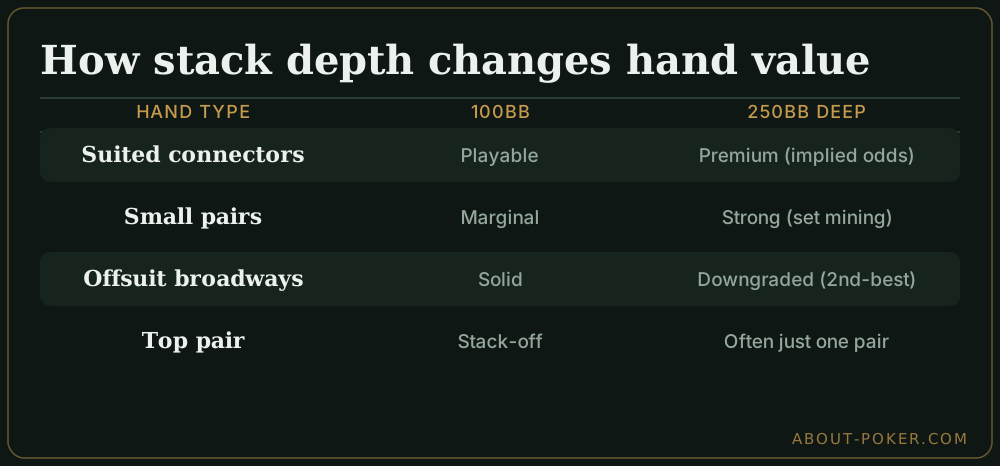
At 100bb, top pair with a good kicker is often worth stacking off. At 200bb or 300bb, it frequently is not, because your opponent needs a big hand to put in that much money — and a big hand beats your one pair. The deeper you are, the more the value shifts to hands that make the absolute nuts or something close to it: straights, flushes, full houses, and sets.
That is why suited connectors, suited aces, and small pairs climb in value while offsuit broadways and unsuited aces fall. A hand like KJo makes a lot of top pairs that are exactly the kind of second-best holding that loses stacks deep. This is the core idea behind our broader deep stack cash game strategy.
Implied odds do the heavy lifting
Implied odds — the money you expect to win on future streets when you hit — are the engine of deep play. When you are 200bb deep, a small pocket pair that flops a set can win an enormous pot, so calling a raise to set-mine becomes far more attractive than it is at 100bb. The rule of thumb is that you want your effective stack to be at least 15x the price of the call to set-mine profitably; deep stacks clear that bar easily. See the mechanics in set mining in cash games.
The same logic elevates suited connectors and suited aces: they make well-disguised straights and nut flushes that get paid off by an opponent’s overpair or top pair. The payoff when you hit justifies a modest preflop investment.
Stack-to-pot ratio and commitment
Stack-to-pot ratio, or SPR, is the effective stack divided by the pot at the start of the flop. Deep stacks create high SPRs, which means you should be slower to commit. With an SPR of 3, an overpair is usually a stack-off; with an SPR of 12, that same overpair is a strong hand you are willing to fold if the action gets huge. High SPR rewards hands with the potential to improve to the nuts and punishes hands that are strong on the flop but cannot get better.
Practically, that means planning the hand backward. Before you call preflop, ask: at this depth, what do I want to happen on the river, and does my hand make a nut-type holding that can win a giant pot? If not, be cautious about bloating the pot early.
Position becomes decisive
Position is always valuable, but deep it becomes decisive. With more streets of large betting to navigate, acting last lets you control the size of the pot, bluff more credibly, and get away from second-best hands. The button is the most profitable seat in poker, and its edge multiplies when stacks are deep — see playing the button in cash games. Out of position, tighten up: playing a 300bb pot from the big blind with a marginal hand is a recipe for tough, expensive spots.
Worked example: suited connectors at 250bb
You are on the button with 8h7h and cover the table 250bb deep. A tight middle-position player opens to 3bb and you call. The flop comes Th 9c 2h — an open-ended straight draw plus a flush draw, giving you around 15 outs and enormous equity.
This is exactly the hand suited connectors are for at depth. Your draw can make the near-nuts, and because you are 250bb deep, the implied odds are huge: if you complete on the turn or river, your opponent’s overpair or top pair may pay off a very large bet. You can call flop bets comfortably and even semi-bluff-raise, knowing that when you hit you win far more than the pot currently holds. The same draw at 40bb would be worth far less, because the stacks cannot reward the payoff. That difference is the essence of deep play.
Common deep-stack mistakes
The biggest leak is over-valuing top pair — stacking off 200bb+ with one pair against a big raise is how deep players go broke. The second is playing too many offsuit hands that make dominated top pairs. The third is ignoring SPR and treating a high-SPR pot like a shallow one. Finally, do not spew off position; deep stacks punish out-of-position marginal hands more than any other spot.
Quick deep-stack checklist
- Prize nut-making hands: suited connectors, suited aces, small pairs.
- Downgrade offsuit broadways and unsuited aces that flop dominated pairs.
- Set-mine freely when effective stacks exceed ~15x the call.
- Respect SPR: high SPR means slow to commit with one pair.
- Play more in position; tighten hard out of position.
Frequently asked
What counts as a deep-stacked cash game?
Anything meaningfully above the standard 100 big blinds. 150bb is moderately deep, 200bb and up is genuinely deep, and some live games play 300bb+. The deeper you go, the more the money on later streets dominates the preflop decision.
Which hands go up in value when deep?
Hands that make the nuts or near-nuts and win big pots: suited connectors, suited aces, and small-to-medium pocket pairs for set mining. Hands that make strong-but-not-nut holdings, like offsuit aces and unsuited broadways, lose relative value.
Why is position more important when deep?
With more streets of large betting to navigate, acting last lets you control pot size, extract maximum value, and avoid getting stacked with a second-best hand. Deep stacks amplify every positional edge across the flop, turn, and river.