Playing Short-Stacked Cash
How to play short-stacked cash games (20-50bb): tighter hand selection, stack-off ranges, reduced implied odds, and a worked 30bb 3-bet-shove example.
On this page · 7 sections
Short stacks flip the deep-stack playbook on its head. With 20-50 big blinds behind, the money is shallow, implied odds shrink, and high-card strength becomes king. Playing short well means tightening your speculative hands, valuing raw equity, and getting comfortable committing your stack preflop and on the flop. This guide covers the adjustments.
Why high-card strength rules when short
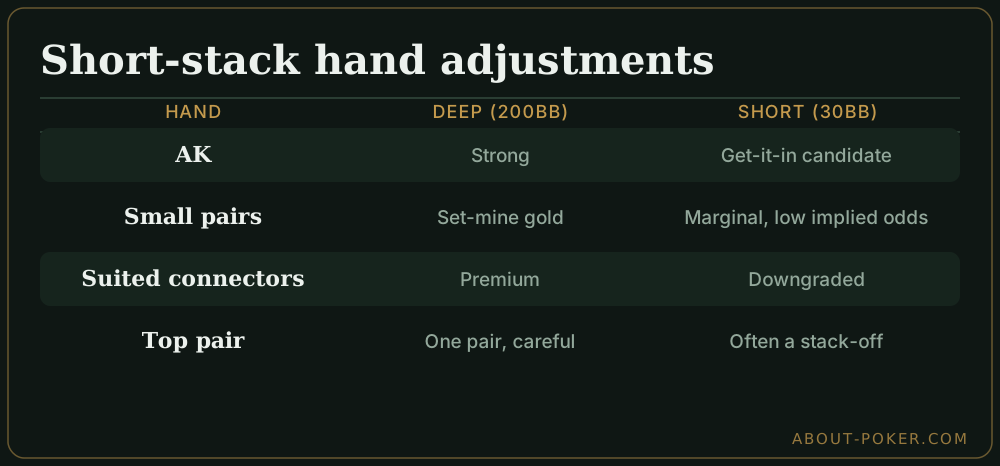
The deeper the stacks, the more the nuts matter; the shorter the stacks, the more raw equity matters. With 30bb behind, you rarely play three streets of big betting, so a hand’s ability to make the nuts on the river is far less important than its ability to be ahead right now. That elevates big pairs, AK, AQ, and strong broadways — hands that flop top pair and can stack off as a favorite or, at worst, a coinflip.
By the same logic, speculative hands lose value. Suited connectors and small pairs rely on implied odds and multi-street payoffs that a short stack cannot deliver. They still play, but from a much narrower position-aware range, an idea that fits naturally into your overall cash game preflop strategy.
Implied odds collapse
Implied odds are the extra money you win on later streets when you hit. Short stacks strangle them. Set mining is the clearest example: the standard rule is that you need your effective stack to be at least 15x the price of the call to profitably chase a set, because you flop one only about 12% of the time and need a big payoff the rest goes wrong. At 30bb, calling a 3bb raise to set-mine gives you only 10x — below the threshold — so small pairs that thrive deep become marginal short. The full math lives in set mining in cash games.
The practical takeaway: stop paying to chase draws and sets when the stacks cannot reward you. Short-stack poker is about being ahead now, not building toward a monster later.
Stack-off ranges get wider
Because you commit a smaller number of big blinds, your stack-off range widens relative to deep play. At 200bb you fold an overpair to a huge raise; at 30bb you happily get it in with an overpair or top pair top kicker, because the SPR is low and folding gives up too much equity. Low stack-to-pot ratios mean you are frequently committed once you put in a raise and a continuation bet, so plan to get the money in with strong-but-not-nut hands that would be too thin deep.
This is why short-stack play feels more binary. Many hands become bet-or-fold and raise-or-fold decisions, with fewer of the delicate turn and river spots that define deep games.
Position still matters, but less
Position remains valuable short, but its edge shrinks because there are fewer streets of large betting to exploit. You still want to open wider in late position and tighten from early position, and you still prefer to be the aggressor. But the deep-stack premium on position — the ability to control a 200bb pot across three streets — largely evaporates. Focus your positional awareness on clean preflop decisions rather than elaborate postflop lines. For a deeper treatment, see our full short stack cash game strategy.
Worked example: 3-bet shoving 30bb
You have 30bb in the cutoff with AhKd. A loose, aggressive hijack — effective stacks 30bb — opens to 2.5bb and action folds to you.
With AK and only 30bb, a 3-bet to 8-9bb bloats the pot and leaves an awkward stack behind if called. A cleaner line at this depth is often to 3-bet to about 8bb and be prepared to get it in, or against an aggressive opener, to 3-bet-shove all 30bb. Shoving denies the opener the chance to realize equity with dominated hands like AJ or KQ, folds out their bluffs, and gets full value when they call with a worse ace or a smaller pair. AK is roughly a coinflip against a pair (about 43%) and a big favorite against dominated broadways, so a shove is comfortable. Trying to play AK “small” and postflop when 30bb deep just invites tricky spots — the short stack rewards decisive commitment.
Common short-stack mistakes
The top leak is set-mining and chasing draws without the implied odds to justify it. The second is over-limping and open-limping speculative hands that need depth to pay off. The third is playing timid with big broadways — short stacks want you to commit AK and big pairs, not fold them to pressure. Finally, do not slow-play; with low SPR you rarely have the streets to trap, so bet your strong hands.
Quick short-stack checklist
- Upgrade high-card hands: big pairs, AK, AQ, strong broadways.
- Downgrade small pairs and suited connectors — implied odds are gone.
- Skip set mining unless effective stacks exceed ~15x the call.
- Widen your stack-off range; low SPR means commit with top pair+.
- Play decisively: bet-or-fold, and shove rather than play awkward postflop.
Frequently asked
What is a short stack in cash games?
Typically anything below the standard 100 big blinds. 40-50bb is moderately short, and 20-30bb is genuinely short. The shorter you are, the more the game becomes about clean preflop and flop decisions rather than deep multi-street maneuvering.
Which hands go up in value when short-stacked?
High-card strength rises: big pairs, AK, AQ, and other strong broadways that make top pair and can get all-in as a favorite or coinflip. Speculative hands like small pairs and suited connectors fall because their implied odds shrink.
Should I set-mine with a short stack?
Usually no. Set mining needs implied odds of at least about 15x the call, and a 30bb stack rarely provides that. Small pairs lose value short because you cannot win a big pot the times you flop a set.