Playing Scared Money
Scared money doesn't make money. Learn how fear distorts your cash game — passive lines, no thin value, folding to pressure — and how to fix each leak.
On this page · 6 sections
There is an old poker saying: scared money doesn’t make money. It is a cliché because it is true. When a player is more afraid of losing the chips in front of them than they are focused on making the best decision, their whole game bends toward caution — and caution, in poker, is expensive. Good opponents can smell it, and they will bleed you dry with pressure you should be calling.
Scared money is not a personality flaw. It is usually a symptom of one fixable thing: you have too much money on the table relative to what you can comfortably lose. Below is how the leak actually shows up, and how to close it.
What scared money looks like at the table
Scared money rarely announces itself. It hides inside “tight” or “solid” play. The tells are behavioral:
- You fold hands that are clearly ahead of a bet because you “can’t be sure.”
- You check back the river with a hand that beats most of villain’s calling range, terrified of a check-raise.
- You never bluff, because a busted bluff feels like real, painful money lost.
- You take passive lines — calling instead of raising with strong hands — to keep the pot small.
- You leave the table the moment you are up, protecting a win instead of playing a good game.
Each of these is a small forfeited edge. Poker profit is the sum of thousands of tiny correct decisions, and a scared player skips the uncomfortable ones — which are often the most profitable ones.
Why fear directly costs you money
Consider thin value. Suppose you hold top pair with a good kicker on a safe river and your read says villain will call a half-pot bet with worse maybe 60% of the time and only beat you 25% of the time. Betting is clearly correct: you get called by worse far more often than you get raised or beaten. The scared player checks, wins a small pot, and quietly gives up money on every single river like this over their career. Betting thin for value is one of the biggest separators between winners and break-even players, which is why we cover thin value betting in its own guide.
Now flip it. When you fold too readily to aggression, observant opponents simply bet more often. If they know you fold your bluff-catchers to river pressure, every bluff they run prints money and every value bet gets paid less. Your fear becomes their strategy.
The real root cause: being over-rolled at the table
Here is the uncomfortable truth. Most scared money is not a mindset problem you can affirm your way out of — it is a bankroll problem wearing a psychology mask. If losing a buy-in genuinely hurts your finances, your brain is behaving rationally by protecting it. The fix is not “be braver.” The fix is to change the stakes so the money stops mattering emotionally.
That means playing within a bankroll where a single buy-in is trivial. For cash games that is at least 20-40 buy-ins for your game, as laid out in our bankroll management guide. If a full stack represents 3% of your roll, calling a river with a marginal bluff-catcher feels like a routine decision. If it represents 40% of your roll, your survival instinct overrides your poker brain every time.
A worked example: the underrolled 2/5 player
A player has $2,500 and sits down at 2/5 with a $500 buy-in. That is a 20% chunk of everything they have on the table. On the river they hold KQ on a Q-high board facing a pot-sized bet. Their read is that villain bluffs enough to make this a clear call, but the call is $300 — 12% of their net worth. They fold. They will fold this spot every time, forever, because the math in their head is not pot odds; it is “can I afford this?”
Move the same player to 1/2 with a $2,500 roll and the story changes. Now a $120 river call is 5% of their roll — annoying to lose, but not scary. They make the correct call, get shown a busted flush draw, and stack a pot they were previously handing away. Same hand, same skill, radically different result. The variable was never courage. It was buy-in sizing, which is exactly what our buy-in strategy guide addresses.
How to rebuild fearless (not reckless) play
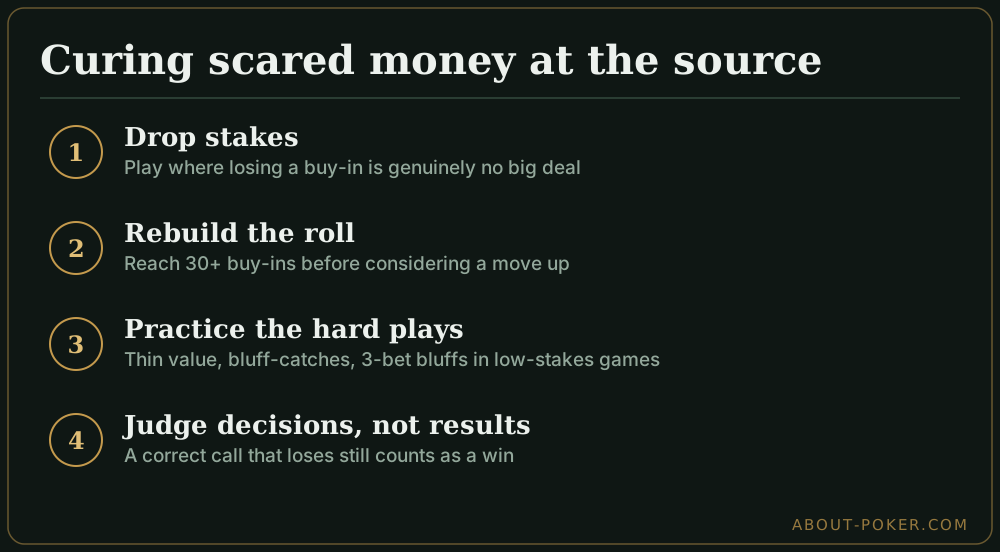
Fixing scared money is not about gambling harder — that is the opposite leak. It is about restoring calm, correct decisions:
- Drop to a stake where losing a buy-in is genuinely no big deal, even if your ego dislikes it.
- Rebuild your roll to 30+ buy-ins before considering a move up.
- Deliberately practice the uncomfortable but correct plays: thin value bets, bluff-catches, three-bet bluffs — in low-consequence games until they feel normal.
- Judge yourself on decision quality, not session results. A correct call that loses is a win.
A quick scared-money self-check
- Do you fold rivers you suspect are calls because the number feels big?
- Do you check back value hands to “keep the pot small”?
- Do you feel physical relief when you leave a session up a small amount?
- Would you play the exact same hand differently if it were half the stakes?
If those ring true, do not work on your nerves first — work on your stakes and your roll. Once the money stops scaring you, the fearless, +EV decisions come back on their own.
Frequently asked
What does 'scared money' mean in poker?
Scared money describes a player who is so afraid of losing the chips in front of them that they play too cautiously — folding good hands to pressure, checking back thin value, and never bluffing. The fear itself becomes the leak, because opponents can push them off hands cheaply.
Why doesn't scared money make money?
Winning poker requires putting chips in with an edge even when you might lose the pot. A scared player avoids every marginal spot, so they forfeit all the small edges that add up to a win rate, while good opponents apply pressure knowing the scared player will fold.
How do I stop playing scared money?
The root cause is almost always being underrolled or playing with money you can't afford to lose. Drop to a stake where a full buy-in is emotionally trivial, rebuild your bankroll, and practice making correct-but-uncomfortable calls and thin value bets until they feel routine.