Blockers Explained for Beginners
Blockers are cards in your hand that make an opponent's strong holdings less likely. A beginner guide to card removal, bluffing, and calling with blockers.
On this page · 6 sections
A blocker is a card in your own hand that makes it less likely your opponent holds a specific strong hand. The logic is simple: there is only one Ace of spades in the deck. If it is in your hand, it cannot be in theirs. So when you hold the Ace of spades, your opponent can never have the nut spade flush. That single fact — the deck has a fixed number of each card — is the engine behind one of the most useful advanced-feeling concepts a beginner can pick up early.
Card removal in one sentence
Every card you can see removes a possibility from your opponent’s range. The board removes cards, and your own two cards remove cards. This is called card removal, and blockers are just card removal pointed at the hands that scare you. If you can hold a card that blocks the exact holding you are worried about, you have quietly tilted the odds in your favor before a single chip moves.
This connects directly to combinatorics, the counting of how many ways each hand can be dealt. When you remove one of the two cards needed for a strong combo, you cut the number of those combos your opponent can have, sometimes dramatically.
Why blockers matter most on the river
Early in a hand, ranges are wide and one blocked hand barely moves the needle. On the river, everything narrows. Your opponent’s range might be just a handful of hand types, and if your blocker kills even one big combo, that is a large share of the remaining possibilities. This is why river bluffs and river calls are where blockers earn their keep, and why strong players agonize over which exact bluffs to pick.
A worked example
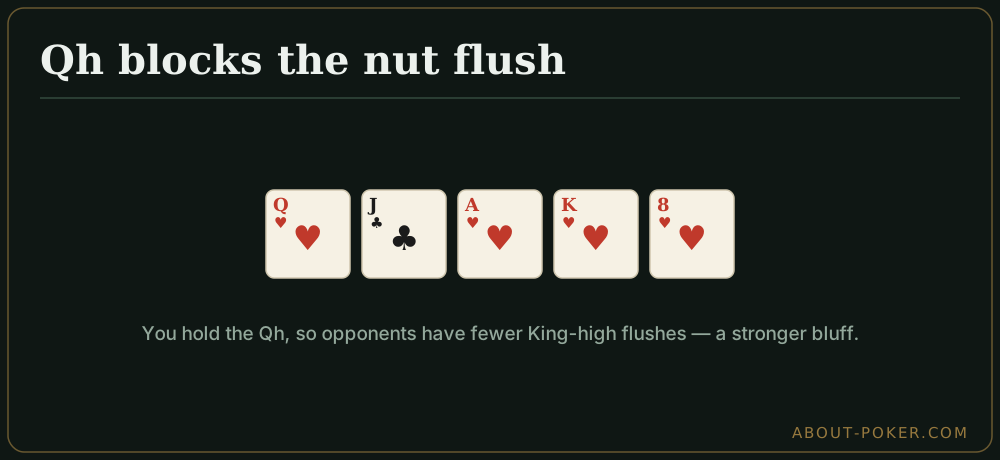
The board reads Ah Kh 8h 4s 2c. Hearts got there. You hold Qh Jc — a busted straight draw with no pair. You are considering a big bluff.
Here is the blocker in action. The nut hand is the Ace-high flush, made with two hearts, and the biggest threat is any hand holding the Ah — but that is on the board. The real nut flush now is King-high hearts (Kh), and you hold the Qh. That means:
- You block a chunk of the flush combinations, because one of the hearts your opponent needs is in your hand.
- Your opponent is less likely to hold a made heart flush than a player without the Qh would face.
So when you fire a large bluff, the specific monster that calls you down — a heart flush — exists less often. Your bluff gets through more of the time than the same bluff with, say, 6c 5c, which blocks nothing relevant. Choosing Qh Jc as your bluff over 6c 5c is a blocker decision, and it improves your bluff-to-value ratio by making each bluff more likely to work.
Blockers for calling, too
Blockers cut both ways. Suppose you face a big river shove and you are deciding whether to call with a bluff-catcher. If you hold a card that blocks your opponent’s likely value hands, they are less likely to be betting for value and more likely to be bluffing — so you should call more. If instead you hold a card that blocks their bluffs (for example, you hold the very draw they would be bluffing with), they are relatively more likely to have value, so you should fold more.
A clean way to think about it:
- Block their value → call more.
- Block their bluffs → fold more.
Preflop blockers
Blockers show up before the flop as well, though the effect is smaller. Holding an Ace means your opponent is less likely to have Aces or Ace-King, which matters when facing an all-in. Holding a King blocks Kings and Ace-King. These small nudges are part of why Ace-King is a comfortable hand to shove or call with against tight ranges — it blocks two of the exact premium hands that beat it. This ties into broader range equity thinking, where the whole distribution of hands matters more than any single holding.
The beginner takeaway
You do not need to memorize combination counts to use blockers. Build one habit: when facing a big decision, glance at your cards and ask, “Does anything I hold make their scariest hand less likely?” If you block the nuts, lean toward bluffing. If you block their value, lean toward calling. If you block their bluffs, lean toward folding. That one question turns your hole cards into information about their hand — and that is exactly what blockers are for.
Frequently asked
What is a blocker in poker?
A blocker is a card in your own hand that reduces the number of strong combinations your opponent can hold. Because you hold that card, they cannot, so fewer of their scary hands exist. Blockers matter most when you are deciding whether to bluff or call a big bet.
How do blockers help you bluff?
Holding a blocker to the nuts means your opponent is less likely to have the hand that beats you. That makes them more likely to fold, so a blocker bluff succeeds more often than a random bluff. The Ace of a suit blocking the nut flush is a classic example.
Do blockers matter more preflop or postflop?
Both, but the effect is most powerful postflop and on the river, where ranges are narrow and one blocked combination is a large share of the remaining hands. Preflop, blockers slightly reduce the chance an opponent holds premium pairs or Ace-King.
What is card removal in poker?
Card removal is the same idea as blockers: the cards you and the board hold are removed from the deck, so they cannot appear in your opponent's hand. This shifts the math of what they are likely to be holding.