Fold Equity Explained for Beginners
Fold equity is the profit you win when opponents fold to your bet. A beginner-friendly guide with the formula, a worked semi-bluff, and when it dies.
On this page · 5 sections
Fold equity is the profit you earn from the chance an opponent folds to your bet or raise. When you only check or call, your hand can win exactly one way — by showing the best cards at showdown. The moment you bet, you add a second way to win: the other player folds and you scoop the pot immediately, no matter what your cards would have done. Fold equity is the value of that second path, and it is one of the most important ideas a beginner can learn because it explains why aggression makes money.
Why betting beats calling
Imagine two players holding the identical draw on the identical board. One checks and calls; the other bets. Over many hands, the bettor wins more money. Why? Both have the same raw hand equity — the same share of the pot if all five cards run out. But the bettor also collects every pot where the opponent folds. That extra slice is pure profit the caller never touches.
This is the beginner’s version of a deeper truth: value in poker comes from decisions your opponent gets wrong. A fold is often a mistake you forced, and fold equity is you getting paid for forcing it.
The formula
There is no need for anything fancy. The core idea is simple:
Fold equity ≈ chance they fold × pot you win now
Suppose the pot is $100 and you bet. If you think your opponent folds 40% of the time, your fold equity is roughly 0.40 × $100 = $40 of immediate expected value from folds alone. The other 60% of the time they continue, and now your hand’s own equity takes over. A good bet is one where the fold-driven profit plus your equity when called beats simply checking. This ties directly into expected value, the master metric behind every betting decision.
A worked semi-bluff
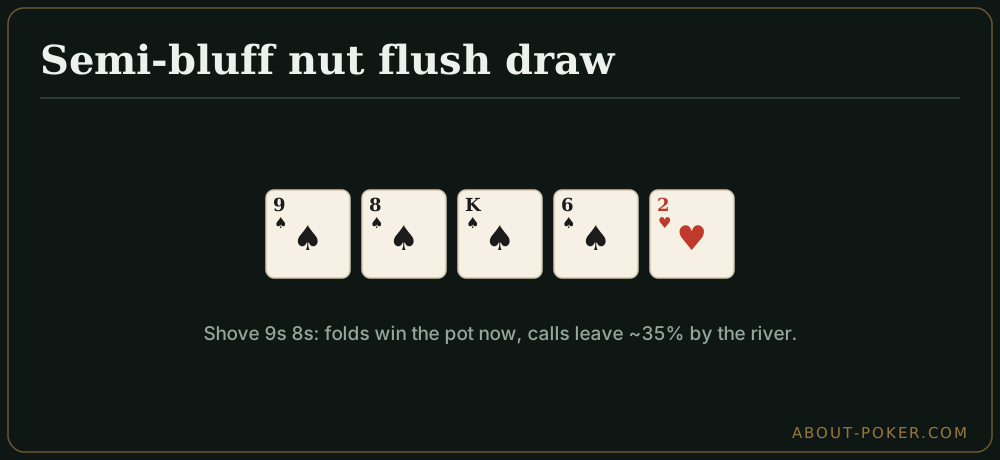
You hold 9s 8s on a Ks 6s 2h flop — the nut flush draw with nine outs. The pot is $100 and you shove your last $80.
- When they fold (say 45% of the time): you win the $100 pot right now. That is 0.45 × $100 = $45 of expected value from fold equity.
- When they call (55% of the time): you are roughly 35% to make your flush by the river with two cards to come. You win a $180 pot 35% of the time, which is more than enough to profit against the $80 you risk.
Neither path alone is huge, but stacked together the shove clearly beats checking and folding. Notice the magic: even if your flush draw were a slight underdog when called, the folds carry the play into the black. That is fold equity doing the heavy lifting. For a deeper numerical treatment of this exact spot, see fold equity in poker.
What raises and what kills fold equity
Fold equity is not a fixed number — it swings with the situation.
It goes up when:
- You represent a credible strong hand the board supports.
- Your opponent is capped (their range is missing the nuts).
- You bet larger, putting more of their stack at risk.
- You have position and initiative.
It goes down or disappears when:
- Your opponent is already committed or short-stacked and calling anyway.
- The board smashes their likely range.
- You are up against a calling station who rarely folds.
- You are already all-in and called — at that point fold equity is exactly zero.
The practical lesson for a beginner: pick your spots. A semi-bluff into a player who never folds is just gambling on your draw, because you have thrown away the fold equity that made the bet good.
Turning it into a habit
Before you fire a bluff or semi-bluff, ask two quick questions. First, “How often does this player fold here?” Second, “If they call, do I still have a way to win?” When the answer to the first is “reasonably often” and the second is “yes, I have a draw or backup equity,” you have found a spot where fold equity is real money. When both answers are weak, the bet is usually a leak.
Learn to see the fold as a prize, not an accident. Once you do, betting stops feeling like a risk and starts feeling like a tool — one that wins pots your cards alone never could.
Frequently asked
What is fold equity in poker in simple terms?
Fold equity is the value you gain from the chance your opponent folds when you bet or raise. It is the extra way a bet can win a pot that a check or call can never win, on top of the times your hand is simply best at showdown.
How do you calculate fold equity?
Estimate the chance your opponent folds, then multiply that by the pot you would win right now. Fold equity roughly equals fold percentage times current pot. A bet is worth making when that gain plus your equity when called beats folding or checking.
Does fold equity still exist when you are all-in and called?
No. Once your opponent calls your all-in, there are no more decisions left for them to fold, so fold equity drops to zero. It only exists while an opponent still holds a hand they could lay down.
Which hands benefit most from fold equity?
Semi-bluffs benefit most: draws like flush draws or open-enders that can win by making a fold happen now and can still improve if called. They combine fold equity with real backup equity.