How Often Do You Flop a Pair
With two unpaired cards you pair the flop about 32.4% of the time — roughly 1 in 3. The exact math, top pair odds, and why 'missing' is normal.
On this page · 6 sections
If you take one number away from flop math, make it this one: with two unpaired hole cards you pair the flop about 32.4% of the time — a little under one in three. That single figure explains a huge amount of winning poker, from why continuation bets work to why chasing every flop with weak cards drains your stack.
The core answer: about 1 in 3
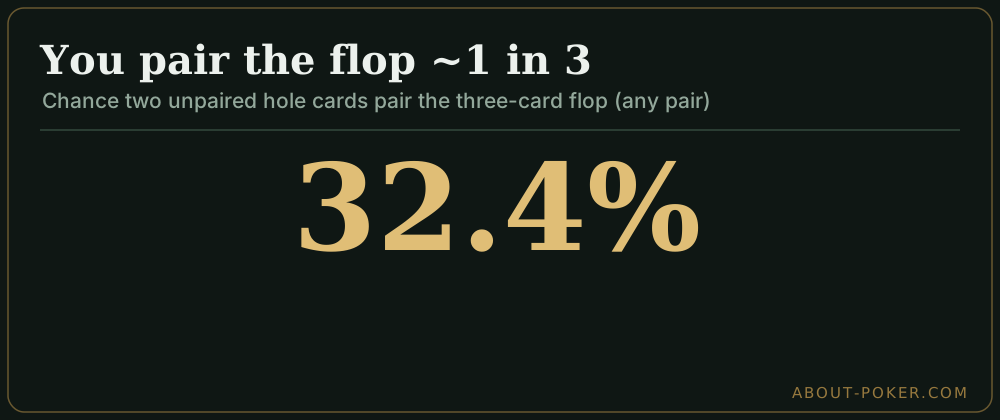
Start with your two hole cards, say Ac Kd. There are 50 unseen cards. Six of them pair you (three aces, three kings). The cleanest way to compute the chance is to find the probability you pair nothing and subtract from one.
The chance the first flop card misses both your ranks is 44 out of 50. The second is 43 out of 49, and the third 42 out of 48. Multiply those together and you get about 0.676 — a 67.6% chance of whiffing. Subtract from one and you land on 32.4%, roughly 1 in 3. That number holds for any two unpaired cards, whether it’s AK or 72.
A worked example
You hold Ac Kd and the flop comes Ah 8s 4c. You’ve paired — top pair, top kicker. Good. But run that same hand a hundred times and about 68 of those flops will bring nothing that pairs you. That is not bad luck; it is the arithmetic. The player who understands that everyone flops air two times in three is the player who keeps betting when a scary board favors their range, and who folds when an opponent shows real resistance.
This is why continuation betting is so profitable at low frequencies of resistance: your opponent also missed roughly two-thirds of the time, so a single bet often ends the hand.
Top pair vs. any pair
“Pairing the flop” and “flopping top pair” are different questions. Of the 32.4% of flops that pair you, only about a third give you top pair; the rest are middle pair, bottom pair, or a pair using your lower card. So the practical breakdown for a hand like AK is:
- Any pair or better: ~32%
- Top pair specifically: ~26% (because your ace is usually the top rank)
- Two pair or trips using both cards: a small few percent on top
For a middling hand like J9, “top pair” is rarer because the board often brings an overcard. The overall pairing chance stays ~32%, but the quality of that pair drops. That distinction drives whether you should bet for value or check to control the pot — see pot control basics.
How it shifts with your hand type
Not all unpaired hands are equal on the flop:
- Unpaired, unsuited, unconnected (e.g. K4o): ~32% to pair, but many of those pairs are weak and dominated.
- Suited connectors (e.g. 9h8h): the 32% pairing chance is the same, but you add flush and straight-draw equity, so your total “flop something useful” rate climbs toward 50%.
- Pocket pairs: a completely different question — you already hold a pair, and you flop a set about 11.8% of the time. That math lives in odds of flopping a set.
The takeaway: raw pairing odds are constant, but the value of pairing and the extra draw equity around it are what separate a playable hand from a trap.
Common mistakes
Overvaluing bottom pair. You paired the flop, but bottom pair with a weak kicker is often behind a caller’s range. Pairing at 32% does not mean 32% of the time you’re ahead.
Forgetting the miss rate cuts both ways. People fold too often to c-bets because they feel like they always miss. You do miss — but so does your opponent, two-thirds of the time. Defend with backdoor equity and position instead of surrendering.
Confusing “a pair” with “a good pair.” Use the rule of 4 and 2 to weigh your draws, and separate the marginal pairs from the strong ones before committing chips.
Quick checklist for the felt
- Two unpaired cards pair the flop ~32.4% — expect to miss ~68% of the time.
- About a third of your pairs are top pair; the rest are weaker.
- Suited/connected cards keep the same pairing rate but add draw equity.
- Everyone misses most flops — position and aggression win the leftover pots.
- Don’t stack off with bottom pair just because you “hit.”
Internalize the one-in-three figure and the flop stops feeling random. You’ll bet when the board misses ranges, fold when the math says your weak pair is beat, and stop paying off the times you were always behind.
Frequently asked
How often do you flop a pair with two unpaired cards?
About 32.4%, or roughly 1 in 3. That figure counts any pair, including pairing either of your two hole cards. It is one of the most useful baseline numbers in Hold'em because it tells you that missing the flop entirely is the norm, not the exception.
How often do you flop top pair specifically?
Roughly 1 in 3 of your paired flops are top pair, so you flop top pair about 26% of the time when you hold an ace-high or similar strong holding — closer to 17% overall for an average two-card hand. The exact figure depends on how high your cards rank versus the board.
How often do you completely miss the flop?
With two unpaired, unconnected cards you flop no pair, no draw about 60% of the time. That is why continuation betting and position matter so much: everyone misses most flops, and the player who represents strength first often wins the pot uncontested.