How Often Does AK Win
AK is never worse than a coin flip against a single pair and dominates most hands. Here is exactly how often ace-king wins by matchup, and why it whiffs so often.
On this page · 7 sections
Ace-king is one of the most talked-about hands in poker, and one of the most misunderstood. New players treat it like a made hand and get frustrated when it loses; strong players understand it is a drawing hand with a very high ceiling. The honest answer to “how often does AK win” is: it depends on what it is up against, and it depends on whether the board cooperates.
The short answer by matchup
Preflop and all-in, AK’s win rate falls into a few clean buckets you should memorize:
- AK vs a bigger pair (AA, KK): you are a big dog. Against AA you win about 12%; against KK about 34% (a king is dead in the KK case).
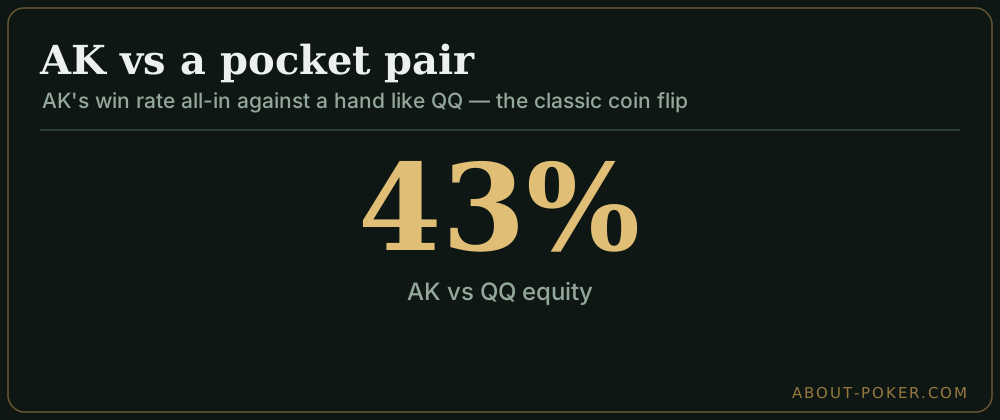
- AK vs a middle or small pair (QQ down to 22): this is the classic coin flip. AK wins roughly 43% — the pair is favored but only just.
- AK vs a dominated ace (AQ, AJ, AT): you crush it, winning around 70 to 74%.
- AK vs two random undercards (like 76s): you win about 58 to 60%.
- AK vs two random cards overall: roughly 65%.
So AK is never worse than a modest underdog against a single pair, and it is a strong favorite against most of the hands people actually call raises with. That combination is why it is a premium holding.
Why the “coin flip” number matters
The 43% figure against a pair like QQ is worth internalizing. When you get AK all-in preflop against a pair, you are not the favorite — but you are close enough that the pot odds usually make it correct anyway. If you are calling an all-in getting even money, 43% equity means you lose small chips long term, but if there is any dead money in the pot (blinds, antes, a limper), the call becomes profitable. For the full breakdown of the classic pair matchup see AK vs QQ preflop odds and equity.
A worked example
You raise Ac Ks and the button shoves. You suspect a range of (QQ+, AK). Let’s weight it: say it’s TT+ and AK. Against that whole range your equity is roughly 40 to 45% because it is loaded with pairs. Now add the money already in the pot. If the pot is 100 before your call and you must call 90 to win 190 total, you need about 47% equity to break even (90 ÷ 190). At 43% you are slightly short — but if the villain’s range also includes weaker aces or a bluff, your equity climbs past the threshold and calling becomes clearly correct. The point: AK’s win rate is a moving target you compare against the price you are paying.
The flop problem: two unpaired cards
Here is the part that frustrates people. AK pairs the flop only about 32.4% of the time, the same as any two unpaired cards — the same math covered in how often you flop a pair. So roughly two out of every three flops, your ace-king is just ace-high. That is not a disaster, because ace-high still beats a lot of hands and you often have overcards plus a backdoor draw. But it means AK is a hand that wins by aggression and equity realization, not by flopping monsters.
When AK does hit, it hits hard: top pair with the best possible kicker. That top-pair-top-kicker holding is exactly the hand that gets paid off by worse aces and second pairs, which is where most of AK’s real-money profit comes from.
Suited vs offsuit: a small but real edge
Suited AK is stronger than offsuit AK, but the gap is smaller than the flashy flush suggests. You complete a flush by the river only about 6.5% of the time when you start with two suited cards. In all-in equity terms, suited AK is usually about 3 to 4 percentage points ahead of offsuit AK. Most of suited AK’s extra value is realized postflop through better playability and more nut draws, not through the raw flush frequency.
Common mistakes with AK
- Overvaluing it as a made hand. It is ace-high preflop. Treat it like a strong drawing hand.
- Refusing to fold to obvious strength. Against a tight player’s four-bet, AK can be behind their entire range (AA/KK heavy) and folding preflop is sometimes correct.
- Failing to bet when you flop top pair. The whole point of AK is to get value on the ~32% of flops it connects. Passive play wastes that.
- Ignoring stack depth. Deep-stacked, AK’s implied odds and playability rise; short-stacked, its raw all-in equity is what counts.
Quick checklist for playing AK
- Preflop, raise or three-bet it aggressively — it flops well against calling ranges.
- Facing an all-in, estimate the opponent’s range and compare your equity to the pot price rather than assuming you’re behind.
- Remember you will miss the flop about two-thirds of the time; a continuation bet is standard.
- When you make top pair, bet for value against worse pairs and aces.
- Don’t marry it against a passive player who suddenly wakes up with big action.
AK wins often enough to be a monster, but never so often that you can play it on autopilot. Its win rate is a function of the matchup and the price — learn the buckets above and you’ll know exactly where you stand. For the underlying all-in framework, see preflop all-in equity rules.
Frequently asked
How often does AK win all-in preflop?
It depends entirely on the opponent's hand. Against a single pair like QQ, AK wins about 43% of the time. Against a smaller ace like AQ it wins around 74%, and against two random cards it wins roughly 65%. AK is never worse than a slight underdog and is often a big favorite.
Why does AK miss the flop so often?
AK is two unpaired cards, so it pairs the flop only about 32.4% of the time. That means roughly two flops out of three leave you with just ace-high. AK's strength comes from making top pair top kicker when it does connect, not from having a made hand preflop.
Is suited AK much better than offsuit?
It helps but less than people think. Suited AK adds only about 3 to 4 equity points in most all-in spots because you complete a flush only around 6.5% of the time by the river. The bigger edges come from playability postflop, not the flush itself.