Odds of Two Pair by the River
Hold two unpaired cards and you make two pair or better by the river about 24% of the time. Here is the count, a worked example, and how to play it.
On this page · 6 sections
Hold two unpaired cards and see all five community cards, and you will finish with two pair about 20% of the time, or two pair or better roughly 24% of the time. That is a big jump from the flop, where two pair shows up only about 2% of the time. The reason is simple: two extra cards give the board many more chances to pair each of your two ranks. Here is the exact count and how to play the hand once you get there.
The core answer
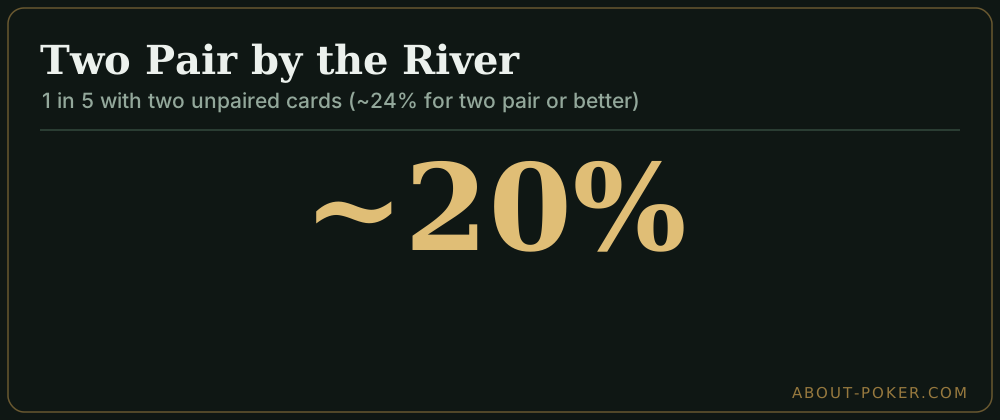
Start with two unpaired cards, say ace-king. To make exactly two pair by the river you need the board to pair one of your aces and one of your kings, without giving you three of a kind or a full house that would classify as something bigger. Roughly one in five times, the five-card board delivers that outcome. Add the times a paired card turns into trips or a boat and your “two pair or better” rate reaches about 24%.
Compare that to the single milestones. You flop a pair of one card about 32% of the time. You flop two pair only 2% of the time. The gap between 2% and 20% is entirely the work the turn and river do. This is why chasing a second pair on the flop with a single pair is often reasonable: the board is not done.
A worked example
You hold A♠K♦ and the flop comes A♣7♥2♦. You have top pair, top kicker. Now you want a king to pair up for two pair. There are three kings left among the 47 unseen cards. On the turn you hit one of them 3 in 47, about 6.4%. Miss the turn and you get another shot on the river, again about 3 in 46, roughly 6.5%. Combined, you pair your king by the river a little under 13% of the time.
That 13% is the improvement on top of what you already have. It matters because it changes how much value your top pair can extract: sometimes the turn king lets you bet a third street for full value against a worse ace.
How the number shifts by starting hand
The 20% figure assumes two unpaired, unconnected cards. Suited or connected holdings do not change your two-pair frequency much, because two pair depends only on your ranks pairing, not on suits or straights. What changes is the value of the two pair when you make it. Two pair with ace-king is close to the top of the two-pair ladder; two pair with seven-deuce is bottom of the barrel and often dominated.
If either of your cards is already paired on the flop, your remaining outs to the second pair drop. Counting your live cards accurately is the same skill covered in poker outs: three cards per unpaired rank, adjusted for anything already on the board.
Common mistakes with two pair
The biggest error is treating two pair like the nuts. It is a strong made hand, not an unbeatable one. On a board like Q♥J♥9♠, a made two pair of queens and nines is genuinely at risk against straights and flush draws. Bet for value, but respect big raises and wet runouts.
The second mistake is slow-playing. Because two pair is vulnerable to free cards that complete straights and flushes, you usually want to bet and charge draws rather than trap. The exception is a dry, disconnected board where few draws exist.
The third mistake is over-counting your outs. If you hold K♦Q♦ on a K♥7♠2♣ flop, your outs to two pair are the three remaining queens, not “any pair.” Precise counting keeps your equity estimates honest.
Quick reference for two pair frequency
- Flop exactly two pair with two unpaired cards: about 2% (1 in 49).
- Make exactly two pair by the river: about 20% (1 in 5).
- Two pair or better by the river: about 24%.
- Pair your second card on turn or river after flopping top pair: about 13%.
These numbers come straight from combinatorics. If you want to see how the counts are built, the poker combinatorics walkthrough shows the underlying card math.
Playing two pair well
When you make two pair, ask two questions. First, how strong is my two pair relative to the board? Top-and-bottom on a dry board is gold; middle-and-bottom on a coordinated board is fragile. Second, how many draws can beat me? The more flush and straight draws live on the board, the harder you should bet to deny equity.
A clean plan is to bet roughly two-thirds pot on the flop and turn with a strong two pair on a drawy board, then reassess the river. On dry boards you can size smaller and get called by worse pairs. The goal is to win a big pot when you are ahead and avoid stacking off when the runout screams that you are behind.
Frequently asked
What are the odds of making two pair by the river?
Starting with two unpaired cards, you finish with exactly two pair on the river roughly 20% of the time, and two pair or better about 24% of the time once you count trips and full houses that grow out of paired cards. The flop does most of the work, but running the board out adds meaningful improvement.
Is two pair a strong hand at showdown?
Two pair is above average and wins a lot of pots, but it is not the nuts. It loses to sets, straights, and flushes, and on paired boards it can be beaten by a full house. Value bet it, but slow down when the board gets wet or pairs.
How does two pair by the river compare to flopping two pair?
You flop two pair with two unpaired cards only about 2% of the time. By the river the number climbs to roughly 20% for exactly two pair because you have five community cards to work with instead of three. Most of your two-pair hands are made on the turn or river, not the flop.