Odds of Two Players Flopping a Flush
Two players flopping a flush at once is astronomically rare — on the order of 1 in a few hundred thousand for a specific pair of hands. The math, explained.
On this page · 7 sections
Two players both flopping a made flush on the same three community cards is one of the rarest coolers in Hold’em — the kind of hand people photograph. For two specific same-suit starting hands it’s on the order of 1 in a few hundred thousand, and once you also require both players to be dealt matching suited cards, it becomes a genuine table legend.
Why it’s so rare: two conditions must both hit
A flopped flush needs five of one suit… but on the flop there are only three community cards. So each player must use both of their hole cards plus a monochrome flop. That forces two things to happen simultaneously:
- The flop is all one suit (monochrome).
- Both players hold two cards of that same suit.
Neither alone is enough. A monochrome flop with only one player suited gives just one flush. Both players suited in different suits gives zero flopped flushes. The stars have to align on the same suit for everyone involved. The single-player version is covered in odds of flopping a flush.
Step one: the monochrome flop
Suppose we fix two players who each hold two hearts — four hearts are already dealt, leaving 9 hearts among 48 unseen cards. For the three-card flop to be all hearts, we need three of those 9 remaining hearts:
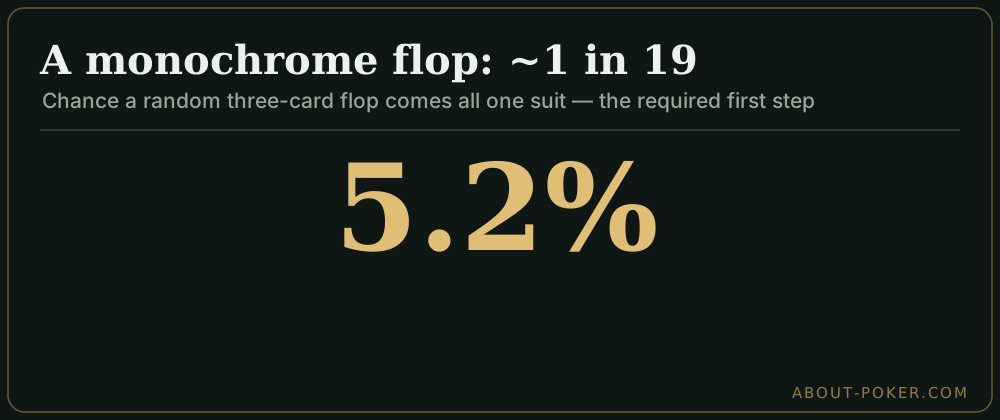
The count is (9/48) × (8/47) × (7/46) ≈ 0.00466, or about 0.47% — under 1 in 200 just for the monochrome-hearts flop, given both players already hold two hearts. In general, a random flop is monochrome (any suit) about 5.2% of the time, but here we’ve locked the suit to hearts, which is why the number is smaller.
Step two: both players dealt the right suited cards
The far bigger filter is getting both players dealt two cards of the same suit before the flop even arrives. A single player is dealt a suited hand only about 23.5% of the time, and dealt two hearts specifically about 5.9% of the time. Requiring a second player to also hold two hearts, from the remaining deck, drops the joint probability into fractions of a percent. Chaining that with the ~0.47% monochrome-flop step lands the full event on the order of 1 in a few hundred thousand for the complete sequence.
The exact figure depends on how you frame the question — “these two specific hands” versus “any two players at a full table” — but every framing lands in the same astronomical neighborhood. The combinatorics behind it are just multiplication of these conditional steps.
A worked example
Two players look down at Ah Kh and Qh Jh — four hearts gone. The flop rolls out 9h 6h 2h. Both players have flopped a flush; the AhKh has the nut flush, the QhJh a strong but second-best flush. This is the picture-perfect version, and the reason it makes for a memorable bad beat is that the loser flopped a monster and still lost the stack.
Now appreciate what had to happen: two specific players each dealt two hearts, then three of the nine remaining hearts arriving on the flop. That compound requirement is why you might play for years without seeing it live.
How the framing changes the number
- “These two exact suited hands, will the flop be monochrome?” ~0.47%.
- “Any two players at a 6-max table both flop a flush this hand?” Rarer, because you first need two players simultaneously dealt same-suit hands — a fraction of a percent — before the flop even matters.
- “Flush over flush by the river?” Much more common, since five board cards give far more ways to make flushes than three do.
Common mistakes
Confusing flopped with river flushes. Most flush-over-flush pots complete on the turn or river across five cards. The flopped version — both made on three board cards — is dramatically rarer.
Forgetting the dealing step. People compute the monochrome flop and stop. The harder condition is both players being dealt two of that suit in the first place.
Assuming it’s a table-wide 5% event. The 5.2% monochrome-flop figure is for any suit with random hole cards — it does not mean two specific players will have flushes.
Quick reference
- Both flopping a flush needs a monochrome flop plus each player holding two of that suit.
- Monochrome flop for random cards: ~5.2% (1 in 19).
- Given both hold two hearts, a hearts flop: ~0.47%.
- The full event for two specific suited hands: ~1 in a few hundred thousand.
- Flush over flush is far more common by the river than on the flop.
It’s the rarest kind of “I flopped the flush and lost” — and now you know exactly why the deck almost never lets it happen.
Frequently asked
What are the odds of two players flopping a flush?
It requires a monochrome flop plus both players holding two cards of that exact suit. For two specific suited hands of the same suit, it is on the order of 1 in a few hundred thousand. Because it also needs both players dealt matching suited cards, the practical frequency at a table is far rarer still.
How often does a flop come all one suit?
A three-card flop is monochrome about 5.2% of the time — roughly 1 in 19. Both players flopping flushes requires exactly that monochrome flop plus each holding two cards of that suit, which multiplies the rarity dramatically.
Is flush over flush common?
Flush over flush is far more common on the turn or river, where players make flushes across five community cards. Both players flopping a made flush on the same three-board cards is one of the rarest routine coolers in Hold'em.