Odds of Flopping Two Pair
You flop two pair about 2% of the time (1 in 49) with two unpaired cards. Here is the exact count, why it is a trap hand, and how to play it.
On this page · 7 sections
Hold two unpaired cards and you will flop two pair about 2% of the time — roughly 1 in 49, counting the times both of your cards pair on the flop. It is one of the stronger flops you can make with a hand like ace-king or king-queen, but it is a hand that wins medium pots and loses big ones if you play it carelessly. Here is the count and the strategy.
The exact count
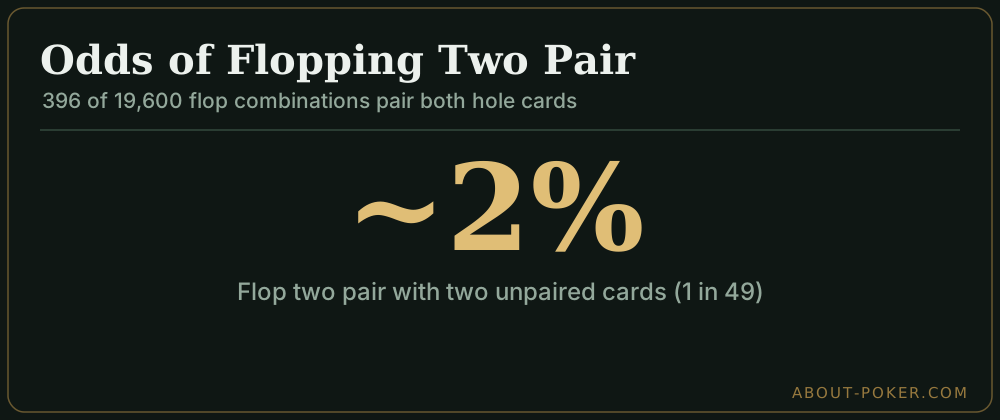
Take A♥ K♠. To flop two pair, the flop must pair the ace, pair the king, and bring one other card. Three aces and three kings remain, and the third flop card can be any of the 44 cards that are neither an ace nor a king (to avoid making trips or a full house instead):
P(two pair) = (3 × 3 × 44) ÷ C(50,3) = 396 ÷ 19,600 = 2.02%
That is 1 in 49. Note this counts exactly two pair using both hole cards. If you want the broader picture of how these combinations are counted, see poker combinatorics — the same C(50,3) denominator underlies every flop probability.
Two pair is strong but not the nuts
At 1 in 49, flopped two pair is rarer than a flopped set (1 in 8.5) and much rarer than flopping a single pair (about 1 in 3). That makes it a strong holding — but it sits below sets, straights, and flushes. On a coordinated board it is often behind or drawing thin. The correct default is to bet for value and protection: you want worse pairs and draws to pay you, and you do not want to give free cards that let a lone overcard or a draw catch up. Count what can beat you carefully with poker outs before deciding to pot-commit.
A worked example
You raise with A♦ Q♣ and the flop comes A♠ Q♥ 6♦. You have flopped top two pair — a clean 1-in-49 hit. Against a single opponent this is a big favorite: only sets of aces, sets of queens, or sixes-up beat you, and the runner-runner and straight draws are limited. You should bet firmly for value. Now change the board to A♠ Q♥ J♦: your two pair is still strong, but any king or ten now makes a straight, and a set of jacks is live. Here you still bet, but you should be ready to fold to heavy aggression, because your hand has quietly dropped in relative strength. The lesson: two pair’s value depends heavily on how wet the board is.
How board texture changes the play
On dry, disconnected boards, top two pair is close to the effective nuts and you can build the pot aggressively across three streets. On wet boards — connected, two-tone, or paired — two pair becomes a value-bet-and-fold-to-raises hand, because the times you get raised, you are frequently against a set or a made straight or flush. A paired board is the sharpest warning: if the board reads K♥ K♠ 7♦ your two pair is drawing nearly dead to trips. Compare this to a set, which on the same textures is far more robust — see odds of flopping a set — because a set hides better and beats two pair outright.
Common mistakes
The classic error is slow-playing two pair on a wet board, handing free cards to draws that then get there for a stack. Bet it. The second is refusing to fold when the action screams a bigger hand: two pair is strong, but it is not a hand to go broke with facing a check-raise-and-jam sequence on a connected board. Third, do not confuse top two pair with bottom two pair — hitting the two lowest cards on a high board leaves you exposed to overcards and kicker problems, and it should be played more cautiously than the AQ-on-AQ6 dream flop.
Two pair versus draws and made hands
It helps to place two pair on the ladder of flop strength. It crushes single pairs and top-pair-top-kicker, so those hands pay you off, and it is a favorite over most single draws — a flush draw or open-ended straight draw has only about a third of the equity against your made two pair. But the moment a draw completes, your two pair may drop to second best, which is exactly why protection betting matters: you want draws to fold or to pay a premium to continue. Against sets, two pair is a big underdog and usually drawing to just four outs to fill up. Knowing where your hand sits against the likely range — value hands you beat, draws you are ahead of, and sets you fear — is what turns a raw 1-in-49 flop into a profitable one.
Quick checklist
- Flopping two pair with two unpaired cards: about 2%, or 1 in 49.
- It beats one pair and top-pair-good-kicker, but loses to sets, straights, and flushes.
- Bet for value and protection on dry boards; do not slow-play the wet ones.
- Paired boards are the danger — two pair can be drawing nearly dead to trips.
- Be willing to fold bottom two pair or when heavy action signals a bigger hand.
Frequently asked
What are the odds of flopping two pair?
About 2%, or roughly 1 in 49, when you hold two unpaired cards and both pair on the flop. It is one of the stronger flops you can hit with a hand like ace-king, but it is far less common than flopping a single pair.
How does flopping two pair compare to flopping a set?
A set is much more common. You flop a set with a pocket pair 11.8% of the time (1 in 8.5), while you flop two pair with unpaired cards only about 2% of the time (1 in 49). So a flopped two pair is genuinely rare and should be treated as a strong hand.
Is flopped two pair vulnerable?
Yes. Two pair loses to sets, straights, and flushes, and it is exposed on wet boards. Bet it for value and protection rather than slow-playing, because free cards can flip it from best hand to second best.