Odds of a Bad Beat
How often bad beats really happen, the true odds behind classic cooler spots, and why big favorites still lose 15-20% of the time at showdown.
On this page · 6 sections
A bad beat is one of the most emotionally loaded moments in poker, but underneath the frustration it is just probability doing exactly what it always does. When you get your money in as a big favorite and lose, nothing has gone wrong. The math simply resolved into the small slice that was always going to happen some of the time. Understanding the real numbers helps you stop tilting and start treating these spots as routine variance.
What actually counts as a bad beat
There is no rulebook definition, but the working standard among serious players is that the losing hand was at least a 4-to-1 favorite (80% equity or better) when the last chips went in. Aces losing to a rivered flush qualifies. So does a flopped set losing to a runner-runner straight. A coin flip that goes the wrong way, like ace-king losing to a pocket pair, is not a bad beat at all, even though it stings. It was close to 50/50 the whole time.
The distinction matters because it separates true variance from misremembered pain. Most hands people call bad beats were actually closer than they felt in the moment.
The core numbers you should memorize
Here are the reference points that come up most often at showdown. Learn these and you can instantly judge whether you got unlucky or just lost a normal flip.
- Pocket aces versus a random hand all-in preflop: about 85% to win, so you lose 15% of the time.
- Pocket aces versus pocket kings: about 82% versus 18%.
- A flopped set versus a flopped flush draw with two cards to come: the set is roughly 66-75% depending on straight outs.
- A made flush on the turn versus a set drawing to a full house or quads: the flush is about 77%, so it gets beaten on the river around 23% of the time.
- Set over set, where both players flop three of a kind: the underset is drawing to one out and wins under 5% of the time.
That last spot is the classic stack-off cooler. For a full breakdown of how rare it is to be on either side, see set over set odds.
A worked example: aces cracked
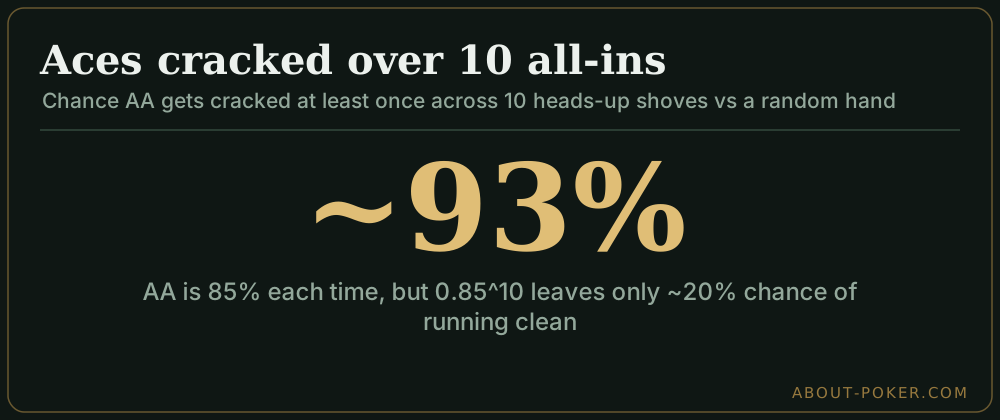
Say you hold Ac Ah and get all-in preflop against a single opponent holding 7d 6d. Your aces are about 77% to win, meaning suited connectors win roughly 23% of the time. That is nearly one in four. Now imagine this exact spot happens ten times in a session. The chance your aces hold up every single time is 0.77 to the tenth power, which is about 7%. In other words, if you shove aces ten times heads-up, you should expect to get cracked at least once about 93% of the time. Bad beats are not rare events. They are the expected outcome of playing enough hands.
The same logic applies to the truly brutal spots. A one-outer, like set over set drawing to quads, hits about 4.3% on the river when one card remains, or roughly 8.4% across turn and river combined.
Why big favorites still lose so much
The mistake most players make is treating an 80% favorite as a lock. Flip that around: a 20% underdog wins one time in five. If you get money in as a 4-to-1 favorite five separate times in a night, the odds that you win all five are 0.8 to the fifth, about 33%. You will lose at least one of those roughly two thirds of the time. This is not the site cheating you. It is the definition of 80%.
This is also why volume smooths results. Over a single session, variance dominates and bad beats feel personal. Over hundreds of thousands of hands, your win rate converges on your true edge. If you want to reduce swings without changing your edge, running it twice splits the pot across two runouts and lowers variance without touching your long-run expectation.
Common mistakes players make around bad beats
The first error is chasing losses. After a bad beat, many players loosen up, gamble, and turn one unlucky hand into a losing session. The variance already happened; punishing the table will not get your chips back.
The second error is misjudging equity in the moment. People remember the river card, not the actual percentages. A hand that was 65/35 gets filed away as a horrible beat when it was closer to a normal flip. Reviewing hands with a calculator, or reading a resource like preflop all-in odds, recalibrates your sense of how often these outcomes are supposed to occur.
The third error is believing online play is rigged because beats feel more frequent. You are simply seeing three to five times as many hands per hour. More samples means more of every rare event, including bad beats and monster wins alike.
A quick sanity checklist
Before you label a hand a bad beat, run through this: Were you actually a big favorite (80% or more) when the money went in, or just ahead? How many outs did your opponent have, and what was the real percentage across the remaining streets? How many similar spots have you played recently, since one beat in twenty favorable all-ins is completely normal? And finally, did you play the hand correctly regardless of the result?
If the answer is that you got it in good and got unlucky, you did your job. The chips will come back over volume. Bad beats are the price of admission for being the player who gets the money in ahead, and that player wins in the long run.
Frequently asked
What counts as a bad beat in poker?
A bad beat is when a hand that was a strong favorite loses to a much weaker holding that improves on a later street. There is no official cutoff, but most players use the term when the loser was at least a 4-to-1 favorite when the money went in, such as aces cracked by a rivered set or a flopped set beaten by a runner-runner flush.
How often does aces lose to a single opponent?
Pocket aces are roughly an 85% favorite against a random hand all-in preflop, so they lose about 15% of the time heads-up. Against a specific hand like KK the number is about 82%, meaning kings win roughly 18% of the time. The more opponents you face, the more often aces get cracked.
Are bad beats more common online than live?
No. Online sites deal far more hands per hour, so you simply see more bad beats in the same clock time, which feels like the deck is rigged. The underlying probabilities are identical to live poker. Reputable rooms use audited random number generators, so the frequency of coolers matches the math exactly.