QQ vs JJ: Preflop Odds & Equity
Pocket queens are about an 82/18 favorite over jacks preflop — a classic overpair-vs-underpair spot. Here are the exact equities and why JJ is trapped.
On this page · 7 sections
You look down at Q♠ Q♥, the money goes in, and villain rolls over J♣ J♦. This is one of the most comfortable spots in poker: you are an 82/18 favorite, roughly 4.5-to-1, and about to win better than four times out of five. The story is short — one made pair simply outranks another, and the lower pair is drawing thin.
The headline equity
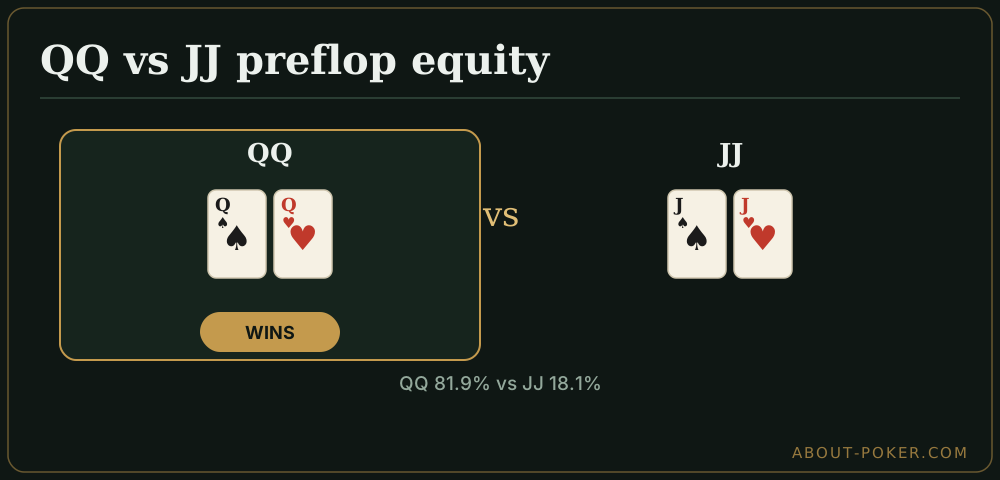
Every figure below comes from simulating the full run of possible boards and cross-checking against a Monte Carlo run:
| Matchup | QQ equity | JJ equity |
|---|---|---|
| QQ vs JJ | 81.9% | 18.1% |
Queens win about 82% of the time. Ties (a board that plays the same for both, like four to a straight or flush that neither pair beats) show up well under 1% of the time and barely move the number.
Why queens dominate jacks
The key idea is that this is an overpair vs underpair clash, not a race. Ace-king against a pair is close to a coin flip because the unpaired hand has two live overcards. Here, jacks have no overcard to the queens except spots that help queens too. JJ has to make a hand that beats a pair of queens, and the cleanest path is a set of jacks.
Count what jacks are really chasing:
- Flop or make a set: two jacks remain in the deck, so JJ hits a set on the flop about 11.8% of the time and roughly 19% by the river.
- Runner-runner straights and flushes fill in a little more.
- A board four-flush or four-straight that neither pair completes is where the rare ties come from.
Everything else loses. When queens don’t improve, they still beat jacks by rank; when both improve to the same category (two pair, say), queens usually win the kicker or the higher pair. That asymmetry is the whole 82%.
A worked example
Say the money goes in preflop for a 100 big blind pot. Queens have 81.9% equity, so your share of that pot is about 81.9 big blinds of expected value before variance. Jacks own the other 18.1.
Now watch the flop turn the numbers. On a 9♦ 4♠ 2♣ board that misses both hands, queens are still an overpair and jump to roughly 90% — jacks are down to their two remaining outs for a set. But on a J♠ 7♥ 3♦ flop, jacks spike a set and flip to about 90% themselves. That single card swing, from 18% to 90%, is why set-mining is the only real hope for the underpair, and why queens want to get all the chips in before that flop lands.
The range problem
The trap with a premium pair is folding it because the one hand that crushes you exists. Queens lose big only to aces and kings. But count the combinations: AA is 6 combos and KK is 6 combos, 12 total, while the hands queens dominate — JJ, TT, AK, AQ, and lower — run to dozens of combos.
Against a realistic shoving range, blend it out and queens are a clear favorite. That is why strong players get QQ in against unknown opponents almost every time. The preflop all-in odds page turns a range read into an actual call-or-fold line, and the equity page explains why 82% translates so directly into money.
From equity to a decision
Knowing QQ is 82% over JJ only pays when you convert it. All-in for a pot you’ve half-built, you need your equity to beat the price:
| Villain holding | QQ win % | Rule of thumb |
|---|---|---|
| JJ / TT / lower pair | ~82%+ | Big favorite, get it in |
| AK / AQ | ~54% | Small favorite, still call |
| KK | ~18% | Big dog |
| AA | ~18% | Big dog |
Why 82% is the universal overpair-vs-underpair number
The most useful thing about QQ vs JJ is that the 82/18 result is not specific to queens and jacks — it is roughly the number for any higher pair against any lower pair, as long as no cards are shared and no overcard help is involved. Kings over queens, tens over sevens, sixes over threes: all land close to 80/20 to 82/18. Committing that single anchor to memory means you don’t have to relearn every pair-over-pair matchup.
The small variations that do exist come from two sources:
- Straight and flush coverage. When the two pairs are close in rank (say TT vs 99), the boards that make a straight can occasionally favor or connect one hand’s ranks more, nudging the number a point or two. When they’re far apart (QQ vs 22), there’s essentially no interaction and it sits right at 82/18.
- Board-tie effects. A shared straight or four-flush on board that plays for both hands produces the rare sub-1% ties, slightly denting the higher pair’s win rate.
For practical purposes, treat every clean overpair-vs-underpair spot as roughly 4.5-to-1 for the bigger pair. That’s the anchor.
The set-mining trap from the jacks’ side
It’s worth flipping the hand around, because most players will hold the jacks far more often than they hold the exact queens that beat them. From JJ’s point of view, being an 18% dog to an overpair is the entire argument for playing pairs cautiously against strength. Jacks are a strong hand in a vacuum, but against a range that’s genuinely QQ+, their only real equity is the roughly 19% chance of flopping or turning a set.
That’s the “set-mining” reality: when you’re the underpair against a made overpair, you win by hitting a set and lose almost everywhere else. The implication is that JJ should rarely commit a huge stack preflop against a tight range that has it dominated — the price of getting it in as an 18% dog is steep, and the set that saves you comes only about one time in five. Getting the pot odds right is the difference between a disciplined fold and a spew, and the combinatorics of how many overpairs a range actually contains is what tips the decision.
Lock in the anchor — 82% over jacks — and every queens decision collapses to one read: how much of villain’s range is really aces or kings? Almost always, not enough to fold. Build the surrounding skills through combinatorics, equity, and the poker odds & math hub.
Frequently asked
What are the odds of QQ vs JJ preflop?
Pocket queens win about 82% of the time against pocket jacks, with roughly 18% for the jacks. That is close to a 4.5-to-1 favorite. Ties are rare, under 1%.
Why is QQ such a big favorite over JJ?
Both hands are made pairs, but queens outrank jacks from the start. The only clean way for JJ to win is to flop or turn a set, which happens about 19% of the time across all five cards, minus the spots where queens also improve.
How often does JJ flop a set against QQ?
About 11.8% of the time on the flop alone, or roughly one flop in 8.5. Extend it to the full board and JJ makes a set or better around 19% of the time, which is where most of its equity comes from.
Should you ever fold QQ preflop against a shove?
Rarely. Queens beat every pair below them and are only a big dog to AA and KK. Against a wide shoving range that also contains jacks, tens, and ace-king, getting the money in with queens is almost always correct.