C-Betting Wet Flops
Wet flops demand bigger bets and a tighter, more polarized c-betting range. Learn which boards qualify, how to size up, and when to check back instead.
On this page · 6 sections
Wet flops are where careless c-bettors go to lose their stack. A coordinated, draw-heavy board like 9-8-7 with two hearts helps the player who called your raise far more than a dry K-7-2 ever could. To beat these textures you have to flip your strategy: bet bigger, bet less often, and bet a much more polarized range. Get it right and you charge draws a fortune; get it wrong and you bloat pots with hands that can’t take the heat.
What Makes a Flop “Wet”
A wet board has connected ranks, one or more flush draws, and often a made straight or two-pair possibility already available. Prime examples are 9-8-7 two-tone, J-T-8 two-tone, and 6-5-4 with a flush draw. Every one of these gives your opponent live draws and made hands they’ll happily continue with. That’s the opposite of a dry board — the full comparison lives in wet vs dry board texture.
The problem is equity distribution. On a dry K-7-2 your opponent whiffs most of their range. On 9-8-7 two-tone, a big chunk of the caller’s hands have real equity: open-enders, flush draws, pair-plus-draw combos, and made two pairs. You no longer have a lopsided range advantage, so you can’t just bet everything cheaply and print folds.
Bet Bigger, Bet Polarized
Two adjustments define wet-flop c-betting. First, size up to two-thirds pot or larger. A tiny bet lets every draw continue for free; a big bet makes them pay. A flush draw has about 35% equity on the flop, and an open-ended straight draw about 31% — you want to charge those hands more than their fair share to see the turn.
Second, polarize your range. Instead of betting almost everything as you would on a dry board, split into two groups: bet your strong made hands (sets, two pair, overpairs) and your highest-equity draws (a nut flush draw, a big combo draw), and check a lot of your marginal made hands and total air. Betting your whole range into a board that smashes the caller just builds pots you’ll be forced to fold. This is the same polarized range logic that governs river betting, applied to the flop.
A Worked Example
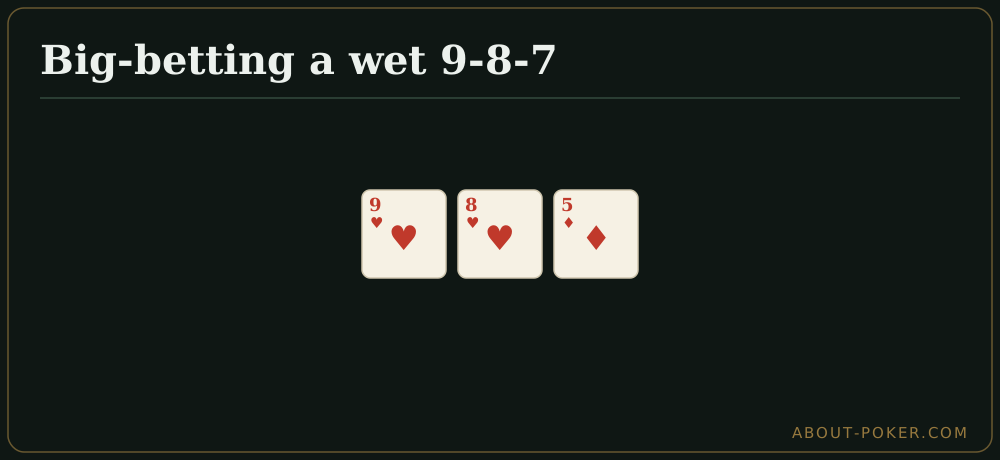
You raise A♥Q♥ on the button, the big blind calls, and the flop is 9♥8♥5♦ in a 5.5bb pot. You don’t have a made hand, but you have the nut flush draw plus two overcards — roughly a coin flip against many made hands and a monster semi-bluff.
Bet big, around three-quarters pot (4bb). You accomplish two things at once: you deny equity to the caller’s weaker draws and gutshots, and you build a pot you’re happy to keep betting if a heart or an ace or queen arrives. If called, you have 15 outs to a very strong hand on the turn. This is a textbook semi-bluff — see playing draws postflop for how to build these lines.
Now hold K♣K♦ on the same board. That’s an overpair, but a vulnerable one: any heart, any 6, 7, T, J, or Q that completes a straight, and even a 9 or 8 pairing the board can put you behind. Bet large for protection and value, and be ready to slow down or fold if the action gets heavy — this is a bet-for-value-and-protection hand, not a hand you want to stack off with on a bad runout.
When to Check Back
Checking is a real weapon on wet boards, especially in position. Marginal hands like second pair or ace-high with no draw don’t want to bloat the pot, and a large c-bet only gets called by better. Checking back keeps the pot small, protects your checking range so you’re not always weak when you check, and lets you realize equity for free. If you fire every wet flop, observant opponents will check-raise you off your equity and pile pressure on your capped range.
Position and Stack Depth
In position you can control the pot after checking and choose your spots on the turn. Out of position, wet boards are treacherous: you can’t take free cards and you’re the one who gets check-raised. Play tighter and more value-heavy from out of position, leaning on the guidance in playing out of position postflop. Deeper stacks also push you toward bigger, more polarized sizing because the implied odds for draws — and the leverage of your big bets — both grow.
Common Mistakes
The number-one leak is using dry-board sizing on wet boards. A one-third-pot bet on 9-8-7 two-tone gives every draw a green light. The second is c-betting too wide and stacking off with one-pair hands that can’t withstand a raise. The third is never checking back, which caps your range and invites aggression. Respect wet textures: bet big, bet polarized, and be willing to check. The board is doing half the work for your opponent — don’t make it easy.
Frequently asked
What is a wet flop in poker?
A wet flop is a coordinated, draw-heavy board where many turn cards change who is ahead — for example 9-8-7 with two of a suit. These boards connect with a caller's range and make big draws and straights available.
How big should you c-bet a wet flop?
Bigger than on dry boards — typically two-thirds to full pot. A large bet charges the many draws a real price to continue and protects your made hands from cheap outdraws.
Should you c-bet your whole range on a wet board?
No. Wet flops call for a polarized, lower-frequency c-bet: fire your strong made hands and your best draws for value and semi-bluffs, and check back a lot of your marginal hands and pure air.