C-Betting Dry Flops
Dry flops let you c-bet small and often. Learn which boards qualify, the ideal one-third-pot sizing, and how range betting turns a texture edge into profit.
On this page · 6 sections
A dry flop is the c-bettor’s best friend. When the board comes down disconnected and unpaired — think K-7-2 with three different suits — almost nothing about it helps the player who called your preflop raise. That single fact changes everything about how you bet the flop, and learning to attack these textures cheaply and relentlessly is one of the highest-return skills in postflop poker.
What Makes a Flop “Dry”
A dry board has three features: no flush draw (rainbow or at most two of a suit), no obvious straight draw (the ranks are spread out), and usually a high card that connects with your raising range. Classic examples are K-7-2 rainbow, A-8-3 rainbow, and Q-6-2 rainbow. Compare that to a wet flop like 9-8-7 with two hearts, where dozens of turn cards swing the hand — see wet vs dry board texture for the full contrast.
The key idea is range advantage. As the preflop raiser, your range is full of big cards: A-K, A-Q, K-Q, and pocket pairs. On K-7-2 you hit top pair with all your king hands and hold overpairs with your aces and queens. The caller, who flatted preflop, has far fewer kings and almost no sets that beat you. The board belongs to you.
Bet Small, Bet Often
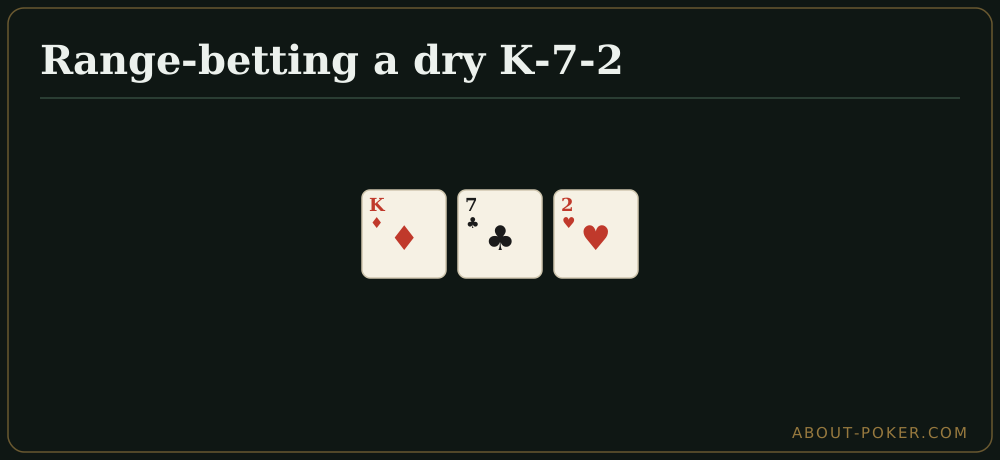
Because the board favors you and offers your opponent almost no equity to draw to, you don’t need a large bet to accomplish your goals. The standard play is a one-third-pot c-bet with a very wide range — often close to your entire range. This is called a range bet.
Why small? A one-third-pot bet risks 33% to win the current pot and only needs to work about 25% of the time to break even as a pure bluff. On a board where your opponent whiffed most of their range, folds come easily. Meanwhile your value hands still get called by second pair and ace-high, and your bluffs deny the little equity that hands like Q-J or 6-5 have to improve. There is no reason to bet big — the caller has nothing to draw to and won’t stack off light.
A Worked Example
You open A♥K♠ from the button to 2.5bb, the big blind calls, and the flop is K♦7♣2♥ in a 5.5bb pot. This is a textbook dry board and you have top pair, top kicker.
Bet one-third pot, roughly 1.8bb. Against a typical big-blind defending range, you are miles ahead: you beat every king with a worse kicker, every pocket pair below kings, and all the ace-high and gutshot bluffs. The small size keeps their weak kings and pocket pairs in the pot to pay you off, while charging their backdoor hands a small tax. If they raise, you can comfortably continue. There’s no flush draw to fear and only running cards can make a straight.
Now flip it: you hold 5♦4♦ as a bluff on the same board. The one-third-pot bet takes the pot down a large share of the time, and when called you have a backdoor straight and flush draw to barrel on favorable turns. Betting your air and your value at the same small size makes you impossible to read — this is the heart of a continuation bet strategy.
Position Changes the Plan
In position, dry-flop range betting is at its most powerful: you get to see the caller act first on later streets and can take a free card whenever you want. Fire small and often.
Out of position, tighten slightly. You lose the ability to control the pot cheaply on the turn, so mix in more checks with your weakest air and lean on your value and equity hands. Playing these spots without position is a distinct skill — read more in playing out of position postflop. The board still favors you, but you can’t run the same near-100% frequency you would with the button.
Common Mistakes
The biggest leak is overbetting dry flops. Players see top pair and slam a big bet, folding out all the worse hands that would have called a small one and only getting action from hands that beat them. On a dry board, a big bet is a value-killer.
The second leak is giving up too easily as the caller. If you’re the one facing a small dry-flop c-bet, don’t fold every hand with no pair — floating with backdoor equity or raising as a bluff punishes an opponent who bets 100%. The third mistake is c-betting dry boards on autopilot against calling stations who never fold; against those players, size up with value and check your air.
Quick Checklist
Before you fire a dry flop, run through this: Does the board favor my preflop range? (Usually yes if there’s a high card.) Are there draws my opponent can have? (On a true dry board, almost none.) Am I in position to bet small and cheaply? Is my opponent capable of folding? If the first two are yes, bet one-third pot with a wide range and collect the many folds that follow. Dry flops reward relentless, cheap aggression more than any other texture in poker.
Frequently asked
What is a dry flop in poker?
A dry flop is a disconnected, uncoordinated board with few draws — usually one high card and two low blanks of different suits, like K-7-2 rainbow. Very few turn cards change who is ahead, which makes these boards cheap to attack.
How big should you c-bet a dry flop?
Small — around one-third of the pot. The board barely helps the caller, so you don't need a big bet to deny equity. A small size lets you bet your entire range cheaply and pressure the many weak hands your opponent holds.
Can you c-bet 100% of your range on a dry flop?
On the driest boards that hit the preflop raiser hard, like A-K-4 rainbow, betting close to your whole range for a small size is a solver-approved strategy. It's the classic 'range bet' — cheap, high-fold-equity, and hard to counter.