Call vs Raise Preflop
Call or raise before the flop? Learn when flatting beats 3-betting, how position and stack depth decide, and a worked example with pocket eights on the button.
On this page · 7 sections
Every hand starts with a simple fork: someone has put in a raise, and now it’s on you to fold, call, or re-raise. Beginners default to calling because it feels safe. Winners treat the call-versus-raise decision as the single most leveraged choice they make all hand, because it defines the pot size, the range they’ll be perceived to hold, and how easily they’ll get paid later. Get this right and the rest of the hand plays itself.
The core question: what does each action accomplish?
A raise (or 3-bet) does three jobs at once. It builds a pot when you have the best hand, it folds out hands that might have outdrawn you, and it seizes the initiative so you can continuation-bet later. A flat call does something different: it keeps the pot small, keeps weaker hands in behind you, and disguises your holding.
So the honest question before you act is: do I want the pot bigger or smaller, and do I want fewer players or more? Premium hands want a bigger pot and usually fewer, weaker opponents — raise. Speculative hands want a small pot and more opponents to pay them off when they hit — often call. If you can answer those two questions, you already know your action.
Raise these hands
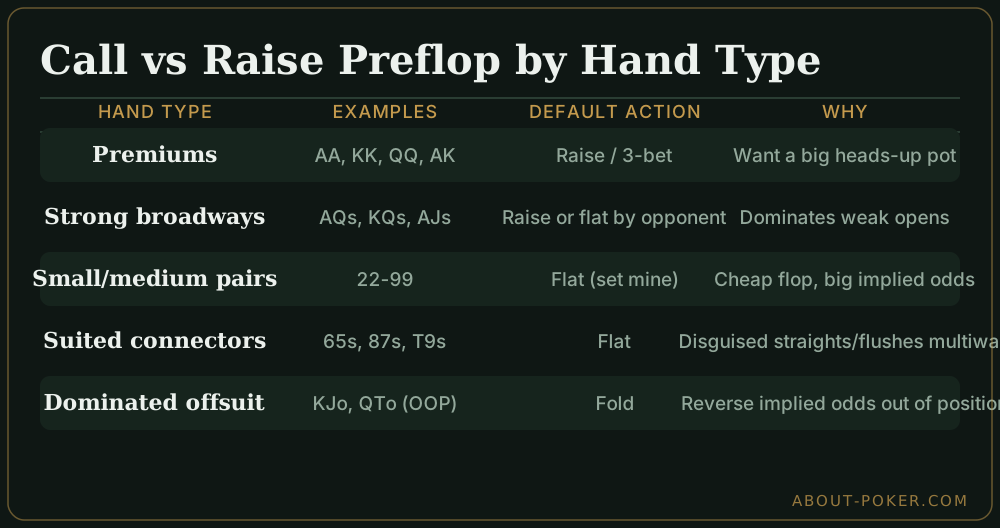
Raise (or re-raise) for value with hands that dominate the caller’s range and want action: AA, KK, QQ, JJ, AK, and AQs. These hands lose value when you let the field limp in behind cheaply, and they play far better heads-up in a bloated pot. You should also raise as a semi-bluff with hands at the top of your folding range — suited aces like A5s and broadway hands like KJs — so your raising range isn’t purely nutted and easy to play against. This is the same 3-bet vs flat call trade-off, viewed from the value side.
Call these hands
Flat-call with hands whose value comes from flopping big and stacking someone: small and medium pocket pairs (22–99) hoping to hit a set, and suited connectors and suited gappers (65s, 87s, T9s) that make disguised straights and flushes. These hands hate being 3-bet because they get folded off their implied odds. Calling keeps the pot small and the field wide, which is exactly what a set-mining vs flatting hand wants.
A worked example: 88 on the button
A tight player opens to 3bb from the cutoff. You’re on the button with pocket eights and 100bb stacks. Should you 3-bet or flat?
Raising here folds out worse hands (the KJ and QT types that give you action) and gets called mostly by bigger pairs and AK — hands that flip or crush you. Meanwhile you have position and a hand that flops a set roughly 1 in 8.5 times, which stacks a strong opener. So you flat. You keep his bluffs in, disguise your hand, and set yourself up to win a big pot when an 8 hits. If instead a loose-aggressive player opened and you expected the blinds to also come along light, flatting is even stronger because the multiway pot boosts your set’s implied odds.
Now change one thing: make it AK instead of 88. Now flatting is a mistake. AK wants the pot heads-up and big, wants to fold out the exact suited-connector hands that flatting invites, and wants the initiative to fire a flop c-bet. So you 3-bet.
Common mistakes
- Flatting premiums out of “trapping” instinct. Slowplaying AA or KK preflop lets six people see a flop for cheap and turns your monster into a coinflip. Raise them.
- 3-betting your set-miners. Blasting 55 into a 3-bet destroys the implied odds that make small pairs profitable in the first place.
- Calling out of position with dominated hands. Flatting KJo from the small blind against an early raiser is a chip leak — you’re often dominated and will be out of position the whole hand.
- Ignoring stack depth. Set-mining and suited-connector flats need deep stacks (roughly 15:1 implied odds). Short-stacked, those speculative flats lose their reason to exist and you should either raise or fold.
Position and stack depth change everything
In position, you can widen your flatting range because acting last lets you realize equity, control the pot, and bluff more freely. Out of position, tighten up: flat far fewer hands and lean toward raise-or-fold, because a caller who’s out of position bleaks money on every street. Deep stacks favor flatting speculative hands (implied odds are huge); shallow stacks favor raising strong hands and folding the rest, since implied odds evaporate.
Quick checklist before you act
- Does a worse hand call a raise? If yes, lean raise for value.
- Does my hand want a small multiway pot? If yes, lean call.
- Am I in position? In position widens calls; out of position narrows them.
- Are stacks deep enough to justify implied-odds flats?
- Would raising only fold worse and get called by better? If so, don’t raise — call or fold.
Master this fork and you’ve built the foundation for every postflop decision that follows. Explore the full postflop strategy hub to see how these preflop choices ripple through the later streets.
Frequently asked
Should I call or raise preflop with a strong hand?
With premium hands like AA, KK, QQ and AK you almost always raise or 3-bet for value — flatting lets weaker hands in cheaply and caps your range. Save flat-calling for hands that play well multiway and want to see a flop cheaply, like small pairs and suited connectors.
When is flat-calling better than raising preflop?
Flatting wins when you have a speculative hand that realizes equity best in a big multiway pot (set-miners, suited connectors), when there's already dead money in the pot, or when raising only folds out hands you beat and gets called by hands that beat you.
Does position change whether I call or raise?
Yes. In position you can flat more hands because you'll act last on every street and realize equity more easily. Out of position you should raise a tighter, stronger range and flat far less, since you'll be at an information disadvantage postflop.