Set Mining vs Flatting
Set mining or flatting? Learn the 15:1 implied-odds rule for calling with pocket pairs, when small pairs profit, and a worked example calling 55 for a set.
On this page · 6 sections
Facing a raise with a pocket pair, you have a quietly important choice. You can set mine — call planning to continue only if you flop a set — or you can flat as a broader hand that plays for more than just trips. They look identical preflop (you call either way), but the plans are completely different, and confusing them costs money. The whole thing turns on one number: your implied odds.
What set mining is, and the number behind it
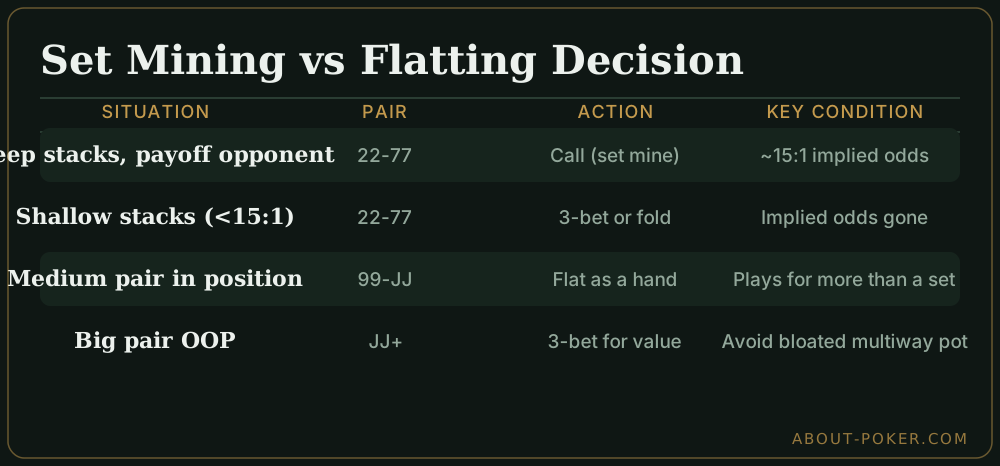
Set mining means calling a raise with a small pair (22–77 or so), fully intending to fold the flop unless you spike your set. You flop a set about 11.8% of the time — roughly 1 in 8.5. So most of the time you paid the raise and give up. For that to profit, the times you do hit have to pay for all the times you don’t.
That’s where the 15:1 rule comes from. The rough guideline: the total money you can reasonably win (the stacks behind, not just the current pot) should be at least about 15 times the amount you call. If you call 3bb, you want roughly 45bb+ of implied stacks to play for. Deep stacks make set mining a license to print; short stacks kill it.
Flatting is a bigger plan than set mining
Flatting a pocket pair as a hand, rather than a set-miner, means you’ll continue past the flop even without a set — as an overpair, a top pair, or a hand with equity to barrel or bluff-catch. This is right with medium and higher pairs (99–JJ) that flop the best pair often, and in position where you can realize equity on later streets. The distinction matters because it changes your flop plan: a set-miner c/folds a missed flop; a flatting overpair keeps betting. It’s the same fork as call vs raise preflop viewed through the pocket-pair lens.
A worked example: 55 facing a raise
A tight player opens to 3bb from early position. You’re on the button with 5♥5♦, and effective stacks are 120bb. Call or fold?
Implied odds check: you call 3bb into a pot where 120bb sits behind. That’s 40:1 potential — far above the 15:1 threshold. And your opponent is tight, meaning when he continues he likely has a big pair or AK, exactly the hands that stack off when you flop a set. So you call to set mine. You’ll flop your 5 about 1 in 8.5, and when you do against his AA/KK, you’re often getting his whole stack. When you miss, you fold to a c-bet and lose 3bb. The math is clearly profitable. For how to extract maximum when you hit, see playing sets for value.
Now change the stacks to 25bb effective. Now you’re calling 3bb to play for only 25bb — about 8:1, well below the threshold. Set mining no longer profits, so you either 3-bet (to play a different way) or fold. Same hand, opposite decision, decided entirely by stack depth.
Common mistakes
- Set mining shallow. Calling a raise with 22 at 30bb effective is a leak — you can’t win enough when you hit to cover the misses.
- Overvaluing a small overpair. If you flat 44 and the flop comes 9-6-2, you have an underpair to nothing scary but you’re not a set-miner’s fold or a strong hand. Don’t turn a set-mine into a bluff-catch station without a reason.
- Set mining vs nits who won’t pay. If your opponent snaps the brakes whenever a low card flops, your implied odds are imaginary. You need someone who’ll pay off the set.
- Flatting bigger pairs passively out of position. JJ+ out of position often plays better as a 3-bet for value than as a flat that gets bloated multiway.
How opponent and position shift the call
Against loose, sticky opponents who pay off big, set mining is fantastic even a touch shallow — the implied odds are real. Against tight, cautious players, you need to actually flop the set to win, so demand the full stack depth. In position, flatting medium pairs widens because you realize equity easily; out of position, lean toward set-mine-or-fold discipline with the small ones and 3-bet-or-fold with the big ones.
Quick checklist
- Small pair (22–77)? Default to set mining, and check implied odds first.
- Do you have ~15:1 implied odds (stacks ≥ ~15x your call)? If not, don’t set mine.
- Is the opponent a payoff wizard or a nit? Sticky players make mines print.
- Medium/large pair (99+) or in position? Flat as a broader hand, not a pure mine.
- Miss the flop as a set-miner? Fold to the c-bet without agonizing.
Set mining is one of the most reliably profitable plays in low-stakes poker — as long as the stacks are deep and someone’s willing to pay. Explore the full postflop hub to master what happens after you hit.
Frequently asked
What is set mining in poker?
Set mining is calling a preflop raise with a small or medium pocket pair, planning to fold unless you flop a set (three of a kind). It's a low-risk, high-reward strategy: you invest a little to hit a well-disguised monster that can stack an opponent.
What are the odds of flopping a set?
You flop a set with a pocket pair about 11.8% of the time, or roughly 1 in 8.5. That's why the standard rule of thumb is you need about 15:1 implied odds — the money you can win relative to your call — for set mining to be profitable.
When should I flat a pocket pair instead of set mining?
Flat as a broader hand — not pure set mining — with medium and larger pairs (99-JJ) that make good top pairs and overpairs, when you're in position, or against opponents who won't pay you off. Pure set mining needs deep stacks and a payoff opponent.