Facing a Min-Raise
A min-raise offers you great pot odds, so folding is rarely right. Learn how to call wide, 3-bet a polarized range, and punish tiny sizings profitably.
On this page · 7 sections
A min-raise is the smallest legal raise — exactly double the previous bet. Preflop that means raising to 2 big blinds. When you are facing a min-raise, the defining feature is the price: you are getting a fantastic pot-odds discount to continue, so folding is almost never correct with any reasonable hand. Instead you should be leaning toward calling wide and 3-betting a well-chosen range to punish the tiny sizing.
Why a min-raise gives you a great price
Pot odds decide how often you can profitably continue. Facing a 2bb min-raise with 1bb in the big blind and 0.5bb in the small blind, the pot before you act is roughly 2 + 1 + 0.5 = 3.5bb, and you need to call just 1bb more from the big blind. That is a call of 1 into 4.5, so you are getting about 4.5-to-1, meaning you only need around 18% equity to break even on the call.
Almost any two cards clear that bar against a raising range. That is exactly why a min-raise is a weak sizing in most deep-stacked no-limit games: it lets everyone in cheaply and surrenders the pressure a normal open would create. For the flip side — why openers usually size bigger — see open-raise sizing.
Call wide, but with a plan
The cheap price means you can defend a very wide range, especially from the big blind where you close the action. Prioritize hands that:
- Flop well and realize equity — suited connectors, suited aces, broadways, pairs.
- Have implied odds — small pairs for set-mining, suited hands for flushes.
This is essentially a wider version of your normal defending range. The frameworks in cold-calling ranges apply directly; just shade them looser because the price is so good.
Punish with a 3-bet
Calling is fine, but the sharper counter is often a 3-bet. A min-raiser has invested very little, so they fold a wide chunk of their range, and when they call you take initiative into the flop.
Key sizing point: size your 3-bet to a normal amount relative to the pot, not just double the min-raise. If you re-raise a 2bb min-raise to only 4bb, you’re repeating their mistake and giving them a cheap call. Raise to roughly 8 to 10bb instead — enough to actually charge them. Build this polarized re-raise from the templates in 3-bet range.
A worked example
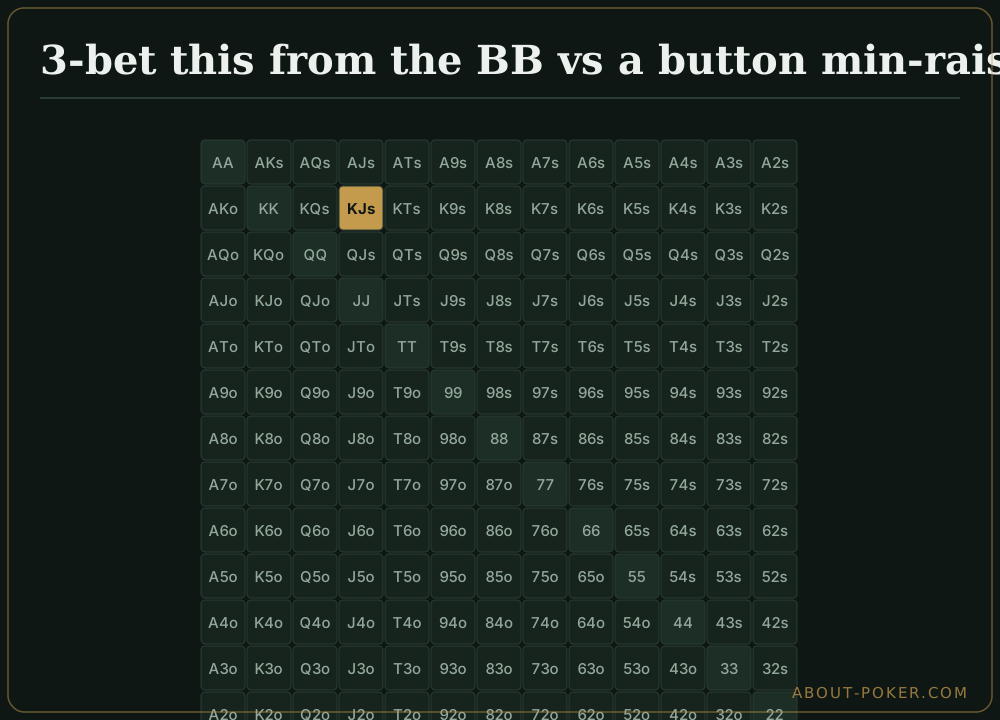
You’re in the big blind with K♠J♠ (KJs). A loose recreational player on the button min-raises to 2bb. The small blind folds.
You have two strong options. Call: you’re getting about 4.5-to-1 on a hand that flops top pairs, flushes, and straights, and you’ll see plenty of good boards. 3-bet: raise to about 8bb. KJs is a great candidate — it has blockers, plays well when called, and folds out the button’s weakest hands. Against a wide, passive min-raiser I lean toward the 3-bet to seize initiative; against a tricky player who calls light, calling to keep their range wide and their sizing exploitable is fine.
The one action to avoid is folding. KJs is far too strong to give up for such a cheap price.
Read the player first
Sizing tells you the price; the player tells you the range.
- Recreational min-raiser: usually a wide, undefined range with no plan. Attack with 3-bets and wide calls.
- Short-stacked tournament player: a min-raise can be a standard, well-constructed play when stacks are shallow (say 15–25bb). Respect it; their range may be strong and their commitment threshold low.
- Tricky regular limp-raising or min-raising to trap: rare, but exists. If someone only min-raises with monsters, tighten up and stop bluffing them.
Common mistakes
- Folding too much. The price is too good to fold reasonable hands — this is the biggest leak.
- Min-3-betting back. Re-raising to only double their raise repeats their error and gives them odds. Size up.
- Calling with no plan. A cheap flop is only valuable if you play it well; prefer hands that flop equity you can act on.
- Ignoring stack depth. Deep, a min-raise is weak; short-stacked, it can be correct. Adjust.
Checklist for facing a min-raise
- Compute the price — you usually need only ~18% equity to call from the big blind.
- Rarely fold — reasonable hands almost always continue.
- Choose call or 3-bet based on the opponent: 3-bet to attack wide passive players, call to keep tricky players’ ranges wide.
- Size 3-bets to the pot, roughly 8–10bb, not just double the min-raise.
- Adjust for stacks — respect short-stacked min-raises, punish deep-stacked ones.
A min-raise hands you a discounted ticket into the pot. Take it — either by calling wide and outplaying a capped range, or by 3-betting to make the tiny sizing cost the raiser dearly.
Frequently asked
What is a min-raise?
A min-raise is the smallest legal raise: exactly double the previous bet, so preflop that means raising to 2 big blinds. It gives opponents excellent pot odds to continue, which is why it is usually a weak or exploitable sizing in no-limit hold'em unless the stacks are shallow.
How should you respond to a preflop min-raise?
Because a min-raise offers great odds, you can call very wide and 3-bet a polarized range. Against most min-raisers you should either apply pressure with a 3-bet or call with hands that flop well, since folding is rarely correct when you are getting such a cheap price.
Are min-raisers usually weak or strong?
It depends on the player. Recreational players often min-raise with a wide, undefined range and no clear plan, which you can attack. Some strong players min-raise deliberately in specific spots like short-stacked tournament play, so read the opponent before assuming weakness.
Should you 3-bet a min-raise?
Often, yes. A larger 3-bet punishes the tiny sizing and takes back initiative, since the min-raiser invested little and folds a wide range. Size your 3-bet to a normal 3-bet amount relative to the pot, not just to double the min-raise, so you actually charge them.