Heads-Up Opening Ranges Chart
Heads-up opening ranges explained. Learn the correct button (SB) raise-first-in range, sizing, and how the big blind should defend in HU play.
On this page · 7 sections
Heads-up is its own game. With only two players, position and aggression matter more than anywhere else, and the ranges look nothing like a full-ring chart. If you understand why the button opens so wide and how the big blind fights back, you’ll have the backbone of solid heads-up play.
Position is everything heads-up
In a heads-up match the button is also the small blind. That player acts first preflop but last on every postflop street — the most valuable seat in poker. Because there’s only one opponent to get through and you’ll have position on all three postflop streets, you can open an enormous portion of hands profitably. For the broader concepts, see heads-up preflop strategy.
The big blind, meanwhile, is getting a great price to defend. If the button raises to 2bb, the big blind only needs to call 1 more into a pot of 3bb, meaning it wins by defending far more than half the time. So heads-up ranges are lopsided: the button opens almost everything, and the big blind defends almost everything.
Button (small blind) opening range
At 100bb, a strong heads-up button raising range is roughly 80-90% of all hands. A common approach is to min-raise (2x) and open everything except the true bottom of the deck:
- Open (raise 2x): all pairs, all suited hands, and almost all offsuit hands
- Typical folds: only the weakest offsuit garbage such as 72o, 82o, 92o, 62o, 73o, 83o
Some players open literally 100% at 2x against passive opponents. Against a strong defender, trimming the worst offsuit hands keeps your range slightly stronger. Either way, the button is the aggressor by default. This is a form of blind-vs-blind play taken to its extreme.
Big blind defense range
Facing a 2x button open, the big blind should continue with the large majority of hands, splitting into calls and 3-bets:
- 3-bet for value: big pairs (99+), strong aces (AJs+, AQo+), and some broadways
- 3-bet as a bluff: hands with blockers and playability like A2s-A5s, K9s, suited connectors
- Call: a wide range of suited hands, connected offsuit hands, small pairs, and most aces
- Fold: only the very weakest offsuit holdings
The general framework here mirrors defending the blinds, just widened dramatically because you’re facing one player instead of a full table.
Worked example: K7o on the button
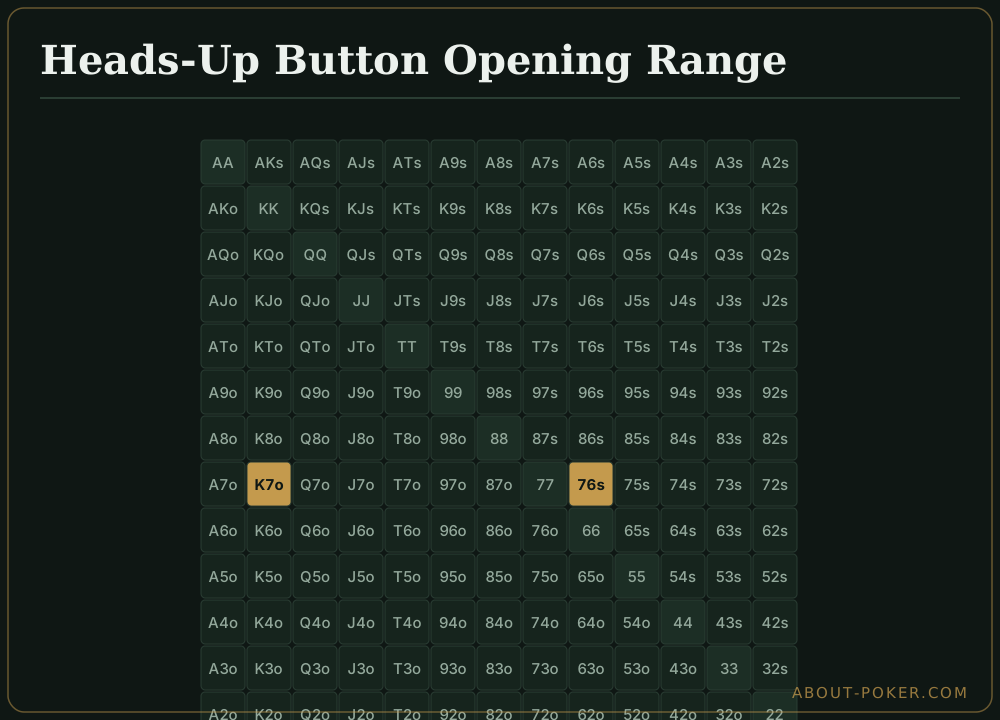
Heads-up, 100bb, you’re on the button with K7o. Is it an open?
Yes — comfortably. K7o has a strong high card, dominates the many worse king-x and seven-x combos in the big blind’s defending range, and plays fine in position. Min-raise to 2x. If the big blind flats, you can barrel many flops that hit your range. If the big blind 3-bets, K7o is at the bottom and can usually be folded to a 3-bet, since it’s now dominated by the value portion of their raise.
Compare that to 72o, the classic worst hand. Even heads-up it’s a marginal-to-losing open against a competent big blind who defends and 3-bets well, which is why it’s one of the few hands you trim.
How the ranges change with stack depth
The 80-90% button open assumes 100bb. As stacks shorten — common in heads-up tournament and sit-and-go play — the picture shifts toward raise-or-shove decisions and the ranges tighten and re-shape.
- 100bb (deep): min-raise almost everything. Postflop playability matters, so suited and connected junk keeps its place because it flops draws you can barrel.
- 40-50bb: still open very wide, but the worst offsuit hands come out faster because you have less room to outplay the big blind after the flop. Your open size stays around 2x-2.5x.
- 20bb or less: the button decision becomes largely a push-or-fold exercise. Here you jam a wide range directly — most aces, kings, pairs, and suited connectors go all-in for value or as pressure, while the very worst offsuit hands fold. Min-raising loses value because you cannot fold to a shove profitably with a marginal hand.
The lesson: “open 85%” is a deep-stack heuristic. As the stack shrinks, the same wide aggression expresses itself as shoves rather than raises, and the raw quality of your two cards matters more because you can no longer lean on position across three streets.
Common heads-up mistakes
Even players who know the ranges leak by misapplying them. The usual errors:
- Opening too small a range from the button. Full-ring instincts (“this is trash, fold it”) cost you enormous value heads-up. With position on one opponent, most hands are profitable raises. Folding the button too often simply hands the blinds away.
- Over-folding the big blind. Getting 3.5-to-1 or better on a call, the big blind must defend a huge share of hands. Folding to a min-raise with a hand that flops anything — any suited card, any connector, any ace — bleeds chips.
- 3-betting too linearly. Some players only 3-bet their best hands, which makes their raises transparent and lets a good opponent fold everything but premiums. A proper big-blind 3-bet is polarized: strong value plus blocker bluffs like A2s-A5s.
- Ignoring the opponent entirely. The charts are a baseline. A player who never folds should be value-bet relentlessly and bluffed rarely; a player who folds too much should be attacked with the widest possible range. Playing a static chart against a readable human leaves money on the table.
Adjusting to your opponent
The charts assume a balanced opponent. In practice, exploit tendencies. Against a big blind who folds too much, open literally everything and raise bigger. Against one who 3-bets relentlessly, tighten your opens slightly and 4-bet or flat more. Heads-up is the fastest feedback loop in poker — small edges compound quickly, so pay close attention to how your specific opponent deviates.
Frequently asked
How wide should I open on the button heads-up?
Very wide — around 80-90% of hands at 100bb. Heads-up you're only up against one opponent and you have position, so you profitably raise almost everything except the very worst offsuit trash like 72o, 82o, and 92o.
What is the button called in heads-up?
In heads-up the button is also the small blind and acts first preflop, then last on every postflop street. So the 'button opening range' and the 'small blind RFI range' are the same thing in a heads-up match.
How does the big blind defend heads-up?
Extremely wide. Because the button opens so many hands, the big blind gets great pot odds to continue and should defend the majority of hands — calling with a broad range and 3-betting a polarized mix of value and bluffs.