How to Play Ace-Eight Suited (A8s)
A8s is a solid suited ace that opens from most positions but folds to early raises. Learn where A8s plays, when to fold it, and how to play it postflop.
On this page · 6 sections
Ace-eight suited (A8s) sits right on the line between a comfortable open and a fold. It’s the last of the suited aces that carries real top-pair value — the eight kicker is high enough to sometimes be good — while still leaning on the two things that make every suited ace playable: the nut-flush potential and the ace blocker. Below is where A8s plays, where it doesn’t, and how to handle it after the flop.
Where A8s belongs preflop
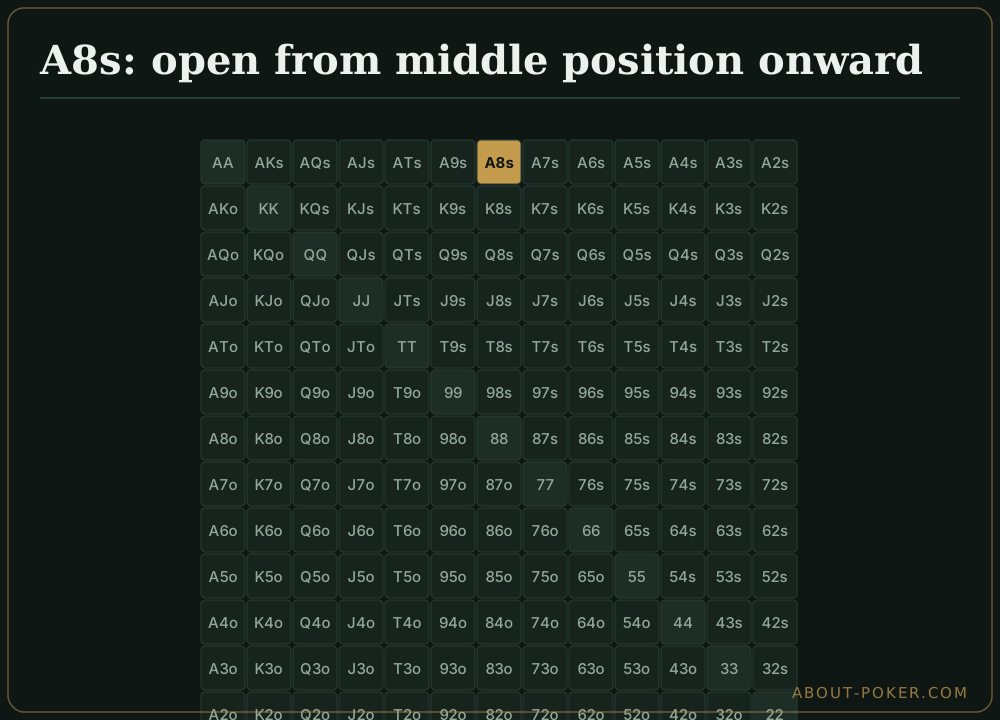
By position, A8s is a middle-of-the-pack open:
- Early position (full ring / UTG at 6-max): fold. You’re opening into too many players who can have you dominated, and the eight kicker isn’t strong enough to justify the exposure.
- Middle position: a standard open. The range has tightened enough that A8s is comfortably inside it.
- Cutoff and button: an easy open every time. On the button you’re opening a very wide range, and A8s is nowhere near the bottom of it.
- Small blind: open (raise) rather than limp — you don’t want to play a flop out of position with a marginal hand for cheap.
- Big blind: defend against most opens, especially with a good price.
If the exact borders are fuzzy, ground yourself in the preflop opening ranges and how they shift by seat in poker ranges by position.
Facing a raise: call, fold, rarely 3-bet
When someone else has opened, A8s becomes a hand you should mostly call in position or fold out of position.
- In position vs a late-position open: flat call. You realize your equity well, flop draws, and keep the pot manageable.
- Out of position (e.g., you’re in the blinds vs a middle-position open): this is closer. A8s can defend the big blind but is often a fold in the small blind, where you’d play the whole hand out of position.
- As a 3-bet bluff: A8s is a decent candidate because your ace blocks A-A and many A-x value combos. But it’s a worse bluff than the wheel aces (A-5s, A-4s) because it unblocks fewer of your opponent’s calling hands and has slightly worse straight potential. If you want a bluff-3-bet ace, reach for the wheel first. See how bluffs get chosen in the 3-bet range breakdown.
The dominated-ace problem
The recurring danger with any medium suited ace is domination. When A8s makes top pair on an ace-high board, you’re often either well ahead of a weaker ace or crushed by A-K, A-Q, A-J, A-T, or A-9. That’s why position matters so much: in position you can pot-control and get to showdown cheaply; out of position you bleak chips guessing.
This is the core reason A8s opens later than it does earlier — the wider the field, the more likely a better ace is out there.
A worked example
You open A♠8♠ from the cutoff. The button calls. The flop comes A♦ 8♥ 3♣ — you’ve flopped top two pair, a genuinely strong hand.
You bet, the button calls. Turn is the 5♣. You bet again for value; a worse ace or an eight will pay you off, and you deny equity to backdoor draws. River is the 2♦. Now think about what calls: a worse ace, a slowplayed set is rare, and most stronger two-pair hands didn’t get here quietly. A moderate value bet is correct — you’re targeting the ace-x hands that can’t fold. Two pair from a suited ace is exactly the payoff that justifies playing A8s in position.
Contrast that with the same hand played out of position from the small blind, where every street is a guess and the button controls the pot. Same cards, worse spot — position is doing the heavy lifting.
Postflop in one paragraph
When A8s flops a flush draw, it’s the nut flush draw — barrel it aggressively, since you can stack opponents when you hit and have fold equity when you don’t. When it flops top pair, size for value in position but pot-control out of position against strong ranges. When it flops air, the ace blocker and backdoor equity make it a fine give-up-or-barrel-once hand depending on the board. The suited ace’s value is loaded into the draws and the blocker, not the raw pair.
Where to go next
A8s is the pivot point of the suited-ace family: strong enough to open widely, weak enough to fold under early-position pressure. Anchor the seat-by-seat logic in poker ranges by position, tighten your opens with preflop opening ranges, and connect it all through the preflop strategy hub.
Frequently asked
Is A8 suited a good hand?
A8s is a solid but not premium hand. It's a clear open from middle and late position and blind vs blind, but it's too weak to open from early position at a full table. Its value comes from making the nut flush and having an ace blocker, not from its raw showdown strength.
Should I 3-bet with A8 suited?
Rarely for value, but A8s makes a reasonable 3-bet bluff in some spots because the ace blocks your opponent's strong ace-x and pocket aces. Against a standard opener you usually just call in position or fold out of position rather than 3-betting.
Can I call a 3-bet with A8 suited?
In position with a good price you can call, since A8s flops flushes, straights, and top-pair hands. Out of position it's usually a fold against a tight 3-bettor because you'll often be dominated by better aces.