How to Play Ten-Two Suited (T2s)
Ten-two suited is a fold from every seat in standard play. Learn why T2s is one of the weakest suited hands, the only cheap big-blind exception, and how to muck it.
On this page · 6 sections
Ten-two suited (T2s) is about as weak as a suited hand gets. The ten and the deuce are five ranks apart, so it makes almost no straights; the deuce is the worst kicker in the deck, so its top pairs are dominated; and its only real upside is the occasional flush. In standard play there is no seat you should be opening it from and almost no situation where it belongs in your range. The right way to “play” T2s is to fold it, and the point of this article is to make that reflex automatic.
Where T2s belongs (nowhere, essentially)
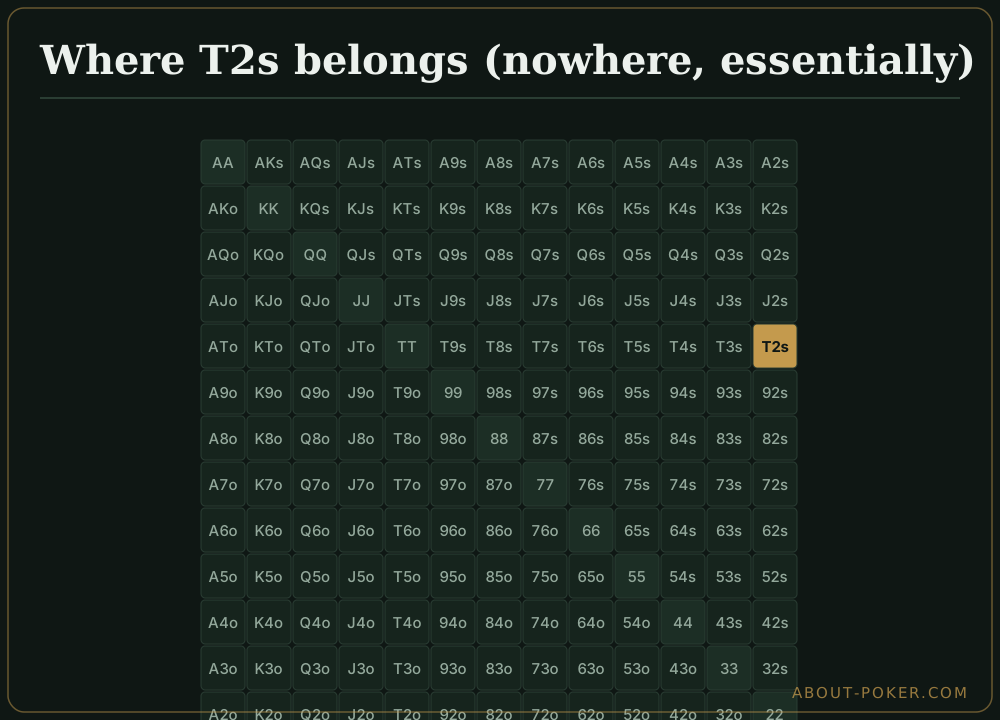
T2s is a fold from every opening position. Early, middle, cutoff, and button ranges all exclude it in any reasonable strategy. It does not have the connectivity to make straights, the kicker to win showdowns, or the high-card strength to steal — so even the button, where you open your widest, leaves it out. It falls well outside the widest preflop opening ranges, and raising it is a pure chip-burner.
It helps to think about why. A range is a collection of hands chosen because they profit as a group; T2s does not clear that bar in any opening range. What is a poker range explains how the bottom of a range is drawn, and T2s sits below the line every time.
The only arguable spot
The lone defensible use for T2s is big-blind defense against a small raise at a great price. When you close the action and the discount is large, you defend an enormous range, and T2s barely scrapes in at the very bottom because seeing the flop costs almost nothing and it can flop a flush draw. This is the extreme edge of wide blind defense — a price-only call, not a statement about the hand.
Even here, treat it as optional. The plan is rigid: continue only on a strong draw or a big made hand, and fold everything else on the flop without hesitation.
A worked example
You defend T2s (Ts-2s) in the big blind against a min-raise. The flop is 9s-6s-3d. You have a flush draw — nine spades complete it — worth roughly 35% equity by the river against one pair. That is the one flop texture where continuing is correct: check-call and play for the flush.
Now the far more common reality: the flop is Ah-Kc-7d. Ten-high, no pair, no draw. Fold. And when the ten pairs — flop of Td-8h-4c — you have top pair with a deuce kicker, a hand so dominated that any better ten crushes you and you can barely bet it for value. That is the trap: even “hitting” with T2s usually leaves you with a losing hand. The flush is the exception; the dominated top pair and the total misses are the rule.
How price and opponent decide the one exception
The big-blind defend is the only spot where T2s is even arguable, and whether it’s correct comes down to three things: the raise size, who raised, and how a flush will get paid. Against a 2x min-raise you close the action getting roughly 3.5-to-1, and a flush-draw-or-fold hand can afford a cheap look. Against a 3x or bigger open the discount is gone and T2s is a clean fold — the equity it realizes can’t cover the larger call.
The raiser’s range is the next filter. A tight late-position opener holds pairs, strong aces, and broadway cards that dominate a paired ten and can cooler your low flush; folding preflop is fine. A loose limper or a multiway limped pot is the friendlier scenario, because a completed flush gets paid by worse and no single opponent is likely to hold a premium. And crucially, you must have position on the decision to fold cheaply postflop — which you do here, since the big blind acts last preflop and can simply check-fold the many flops T2s misses. Remove any of those conditions and the answer reverts to the default: fold.
A quick decision checklist for T2s
- Opening from any seat, button included? Fold. No reasonable range opens T2s.
- Cold-calling a raise from outside the blinds? Fold. Out of position with a five-gapper and the worst kicker is a guaranteed loser.
- Big blind, small raise, closing the action, great price? A bottom-of-range call is defensible and always optional.
- Facing a 3-bet or a large open? Fold instantly — no price, and heavy domination.
- Flopped a flush draw or a big made hand? Continue, keeping the pot controlled unless you improve.
- Flopped a paired ten, a bare pair, or air? Check and fold; even top pair with a deuce kicker is dominated and can’t be bet for value.
Confirm the fold on your preflop opening ranges chart, and if you’re still calibrating which bottom hands make the cut, what is a poker range shows exactly where the line is drawn.
Bottom line on T2s
T2s is a fold in every situation that matters. Never open it, never cold-call a raise with it, and treat big-blind defense as an optional, price-driven exception only. If you do reach a flop with it, chase real draws and fold your air instantly. The value in studying the very worst suited hands is the reflex it builds: suited alone is never a reason to play. Fold T2s automatically and you close one of the most common leaks at low stakes.
Frequently asked
Should you ever play ten-two suited?
In standard strategy, no. T2s is a fold from every opening position, including the button. It is a wide five-gapper with the worst possible kicker, so it makes almost no straights and its top pairs are dominated. Being suited is its only redeeming trait.
Is T2s ever a legitimate call?
Only in the big blind against a small raise at a very generous price, and even that is optional. T2s wants the cheapest possible flop, a strong draw to continue with, and an immediate fold when it misses — which is most of the time.
What makes T2s one of the weakest suited hands?
The ten and two are five ranks apart, so straights are extremely rare, and the deuce is the worst kicker in the deck. When the ten pairs it is dominated by every other ten. Only the small chance of a flush keeps it from being pure trash.