How to Play Three-Two Suited (32s)
32s is the lowest suited connector, a wheel-flavored hand that steals from late position and defends blinds. Learn where Three-Two suited plays and how to.
On this page · 6 sections
Three-two suited (32s) is the lowest suited connector in the deck, but do not mistake it for junk. Because both cards share a suit and sit next to each other, 32s can flop flush draws, straight draws, and the well-disguised wheel (5-4-3-2-A). That flopping potential — not the raw rank of the cards — is why 32s earns a place in wide, positional ranges. It plays much like a scaled-down version of 43 suited, just with slightly less straight coverage.
Where 32s belongs preflop
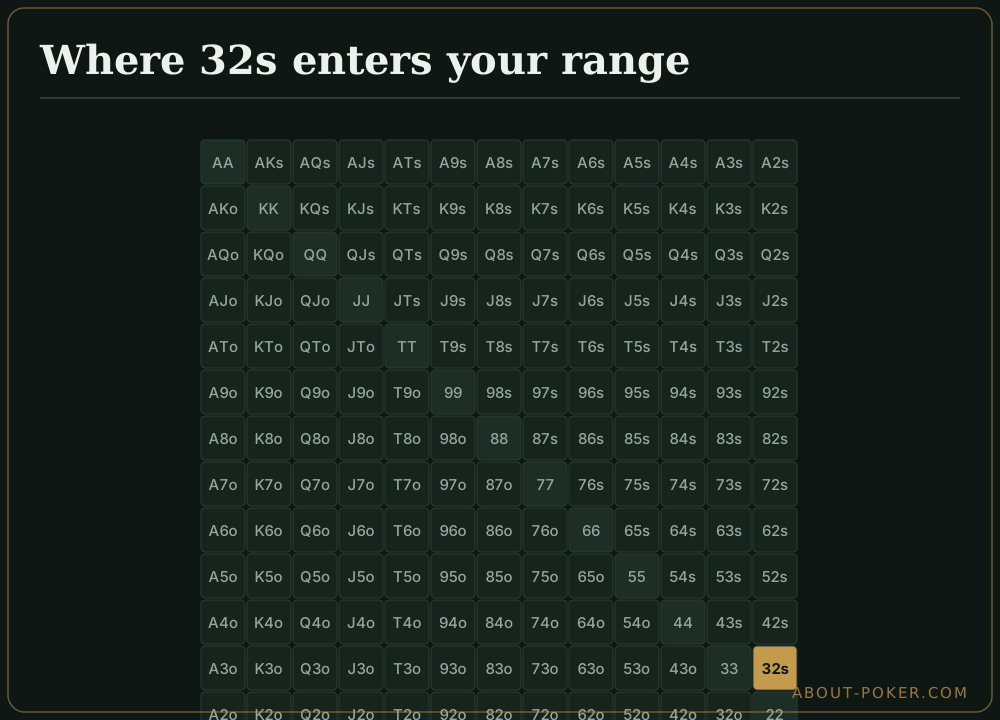
In a standard 6-max game, 32s is primarily a button open as part of a wide steal, and it can sneak into cutoff and small-blind ranges in some game types. From early and middle position, fold it — the ranges you face there are too strong to profitably play the lowest connector, even suited. The value of 32s comes from playing it in position against wide ranges where its ability to flop draws lets it barrel and realize equity.
Blind defense is the other home for 32s. In the big blind against a late-position raise at a good price, you can flat-call because you are closing the action cheaply with a hand that flops well. The preflop opening ranges chart shows exactly which seats can profitably enter with hands this speculative.
32s also makes a reasonable light 3-bet bluff from the blinds or button against a late open. When you get called, you can flop a flush draw or open-ended straight draw to fire additional streets. It has no value as a 3-bet for value — it is purely a semi-bluff with playability behind it.
Why suitedness rescues a low hand
The gap between 32s and an offsuit trash hand is enormous. Suitedness adds flush equity and a flush-draw semi-bluff on roughly one flop in eight, and the connectedness means you flop open-enders and gutshots that let you apply pressure. Best of all, the hands 32s makes — flushes and the wheel — are strong and disguised, so when you hit big you get paid because opponents rarely put you on 3-2.
This is a “flop a draw or fold” hand. You are not stacking off with a weak pair of threes; your money comes from the draws and the occasional monster, played aggressively in position.
A worked example
You open 3♠2♠ on the button to 2.5bb. The big blind calls, and the flop comes A♠-9♠-4♦. You have flopped the nut flush draw with a backdoor straight possibility.
This is a clear c-bet, and 32s is exactly the kind of hand you want firing here. You have nine outs to the nut flush, a backdoor wheel draw, and heavy fold equity on an ace-high board that misses most of the big blind’s calling range. Bet around half pot, and be prepared to barrel the turn on many cards: even when called, you can improve to the best hand. If a spade completes your flush, you hold a hand no one suspects.
Now suppose the flop came K♥-Q♦-8♣. You have three-high and no draw. Give up — there is no equity to continue with and no reason to bluff into a board that hammers the caller’s broadway-heavy range.
How 32s compares to its neighbors
Among suited connectors, 32s is the weakest simply because it has the least straight coverage — it can only make the wheel and 5-4-3-2 lines, whereas 43 suited and higher connectors make straights in both directions. Still, it clears every offsuit trash hand comfortably. In blind-versus-blind pots, where ranges are widest, 32s becomes a genuinely useful weapon; for those dynamics see blind vs blind play.
The practical takeaway: open it from the button and steal seats, defend it at a good price, use it as a light 3-bet bluff, and treat it as a flop-a-draw-or-fold hand. Its disguised flushes and wheels are where the profit hides.
How stack depth changes 32s
Because 32s makes its money through big, disguised hands, it lives and dies on implied odds — the amount you can win on the streets after you connect. That makes stack depth one of the biggest factors in whether it belongs in your range at all.
- Deep stacks (150bb+). This is 32s at its best. When you flop a flush draw or a wheel draw and get there, you can win a very large pot against someone with an overpair or top pair who cannot fold. The deeper the stacks, the more the occasional monster pays off, which is exactly what a speculative hand needs.
- Standard 100bb. A fine button steal and blind defend, played as described above.
- Short stacks (40bb or less). Cut 32s. The implied odds that justify it disappear when the effective stacks are shallow — you simply cannot win enough on the hands you make to cover the times you flop a weak draw and have to give up. At short stacks, favor hands with more raw high-card equity over pure speculators like this one.
Common mistakes with 32s
- Playing it out of position. 32s needs position to realize its equity through pot control and semi-bluffs. Calling an open from the small blind and playing a bloated pot out of position undoes everything that makes the hand playable.
- Continuing without a draw. This is a flop-a-draw-or-fold hand. If you flop a weak pair of threes or twos and no draw, you are usually beaten and have nothing to barrel with — give up rather than turning a marginal pair into a bluff-catcher.
- 3-betting it for value. 32s is a pure semi-bluff 3-bet. If you find yourself hoping to get called and see a flop with it, you have misjudged the hand. Its 3-bet value is entirely in fold equity plus the backup of flopping a draw.
- Overusing it against stations. A light 3-bet bluff or a steal only works when opponents fold. Against a calling station, drop 32s from your bluffing hands — you cannot fold them out, and you will too often see flops out of position with the weakest suited connector in the deck.
Frequently asked
Is 32 suited a good hand?
It is the weakest suited connector, but it is not trash. 32s makes flushes and low straights and plays well from late position and in blind defense, where its ability to flop draws and disguised nut hands gives it more value than its raw rank suggests.
Should I 3-bet with 32 suited?
Occasionally, as a bluff from the blinds or button against a late-position open. 32s makes a fine light 3-bet because it can flop flush and straight draws to barrel with, but it is far too weak to 3-bet for value.
Where can I open 32 suited?
Mainly the button, and sometimes the cutoff or small blind, as part of a wide steal. From early and middle position it is a fold in most games because the ranges you face are too strong to profitably play a hand this low.