How to Play Four-Three Suited (43s)
Four-three suited is a low suited connector with hidden straight and flush potential. Learn how to open, defend, and play 43s profitably by position.
On this page · 6 sections
Four-three suited (43s) is one of the lowest suited connectors worth putting in a range. It is fully connected, so it makes straights, and being suited it makes flushes and can back into the wheel (A-2-3-4-5). What it does not have is showdown strength: heads-up against a random hand it wins only about 42%, and it almost never wins a pot unimproved. You are not playing 43s to be ahead preflop. You are playing it for playability — the disguised draws it flops and the occasional big pot it stacks when those draws come in. It sits one rung below five-four suited in the same family of speculative hands.
Why 43s can be playable despite weak equity
Every hand has two sources of value: how often it is ahead right now, and how well it navigates future streets. 43s is rarely ahead, but it flops well-hidden straights and open-ended draws at a decent rate, and those hands are easy to play in position. When you flop a straight with 43s, it is completely off your opponent’s radar — they read you for high cards, not a 3-4-5 run — so you get action when you are strong.
The catch is that 43s is the bottom of its class. Compared with 54s or 65s, it makes fewer strong draws and its flushes and straights are lower, so it loses more often when two hands both connect. That is why 43s needs the best conditions to be profitable: position, a price, and reasonable stack depth.
Opening and defending with 43s
As an open, 43s is marginal. It is at most a small-frequency button raise in six-max, and it folds from early and middle position in almost every setup. Your preflop opening ranges should treat 43s as one of the very last hands you add from late position, not a standard open.
The big blind is where 43s earns its keep. Facing a raise you are getting a price and closing the action, so a suited, connected hand like 43s can profitably defend against late-position opens where the raiser’s range is wide. Even here it is near the bottom of the defending range — call it against small opens from the button or cutoff, and fold it to raises from early seats or to large sizings.
A worked example
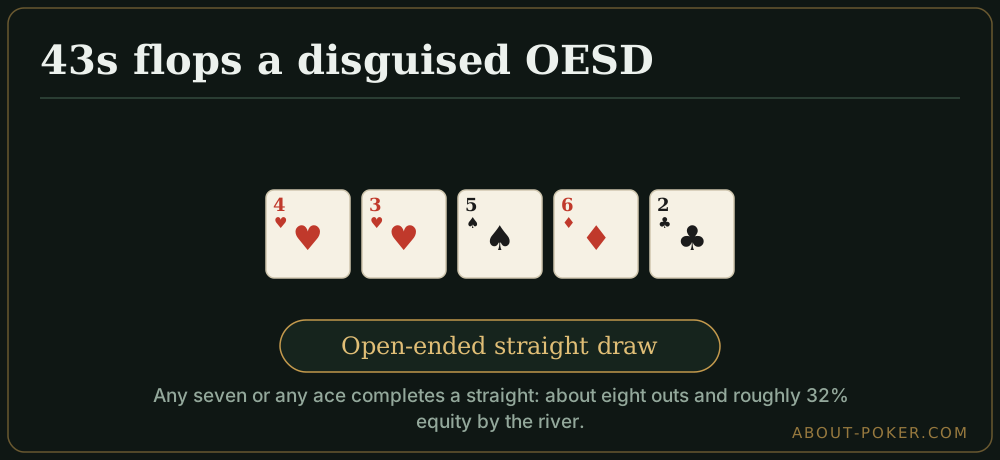
You defend a button open from the big blind with 4♥3♥ and the flop comes 5♠-6♦-2♣.
You have flopped an open-ended straight draw: any seven makes 3-4-5-6-7 and any ace makes the wheel, 2-3-4-5-A. That is roughly eight clean outs, or about 32% equity to hit by the river with two cards to come. This is a textbook semi-bluff — you can lead or check-raise, applying pressure while holding real equity, and when the straight arrives it is well hidden on this low board.
Now compare a flop of K♠-9♦-4♣, where you hold bottom pair with no draw. That is a weak, low-equity spot: fours are unlikely to be good, and you have no way to improve to a strong hand cheaply. Check and give up rather than firing chips into a pair that is usually beaten.
How position and stack depth change 43s
More than almost any other hand, 43s lives or dies on the conditions around it. Two levers matter most.
Position. In position, 43s can see how the opponent acts, control the pot size, and realize its draws cheaply — this is where its playability actually cashes in. Out of position, all of that reverses: you check into the aggressor, get charged to draw, and often fold the equity you flopped. That is why 43s is a late-position or big-blind hand and essentially never a call from early or middle seats. The same holding is roughly break-even in position and a clear loser out of it.
Stack depth. Speculative hands need implied odds — the chance to win a big pot when your disguised straight or flush comes in. Deep (150bb+), 43s gets better, because the reward for stacking someone dwarfs the small preflop investment. Short (under 40bb), it gets worse: there is no room to get paid off on the rare occasions you connect, and a hand that wins almost nothing at showdown has little going for it when the stacks are shallow. In short-stacked or push-fold territory, drop 43s entirely.
A second example: flopping a flush draw
You call a cutoff open from the big blind with 4♠3♠ and the flop is A♠9♠2♦. You have flopped a flush draw — nine spades give you a flush — which is about 35% equity to complete by the river with two cards to come. You also hold a backdoor wheel possibility with the deuce on board.
Play this as a semi-bluff draw. You can check-call a reasonable bet to keep the pot manageable, or check-raise on the right texture to apply pressure while holding real equity. The disguise cuts both ways here: an ace-high flop looks scary to you, but if a third spade lands your low flush is well hidden, and against a single opponent with a wide range you will often get paid. As always with 43s, the profit is in the draw finishing, not in the 4-3 itself ever winning a showdown.
The right mindset
Treat 43s as a price-and-position hand at the very edge of your ranges. Open it sparingly from late position, defend it against wide late-position raises in the big blind, and lean on its draws postflop — semi-bluff your straight and flush draws, stack opponents when your disguised hands get there, and fold cheaply when the flop gives you nothing but a bare low pair. Its profit comes entirely from playability, so realize that potential in position and let it go the moment the board offers no draw.
Frequently asked
Is four-three suited a good hand?
For its class, yes. 43s is a low suited connector that makes disguised straights and flushes, and it can make the wheel with an ace. Its raw equity is low, so it is a speculative hand you play for playability and position, not for showdown strength.
Should you open four-three suited?
Only from late position, and only in wider setups. 43s is a marginal open from the button and sometimes the cutoff in six-max games. From early and middle position it folds. It shines more as a big blind defend than as an open.
How do you play 43s after the flop?
Play it for its draws. Continue with straight draws, flush draws, and made straights or flushes, and semi-bluff your strong draws. Give up cheaply when you flop a bare bottom pair with no draw, since 43s rarely wins at showdown unimproved.