Spin & Go Opening Ranges Chart
Spin & Go opening ranges for 3-handed hyper-turbo play. Learn button, small blind, and big blind ranges plus push-fold spots at shallow stacks.
On this page · 7 sections
Spin & Gos are three-handed hyper-turbo sit-and-gos with a random prize multiplier. The format is fast and shallow: everyone starts around 25bb, blinds climb every few minutes, and within a handful of hands you’re deep into short-stack territory. That makes precise opening ranges and clean push-fold decisions the core skill.
What makes Spin & Go ranges unique
Three factors shape every Spin & Go decision. First, it’s only 3-handed, so ranges are much wider than full-ring — you’re never more than one seat from the button. Second, stacks are shallow and get shallower fast, so short-stack preflop strategy drives everything. Third, the blinds structure means stealing is highly profitable, since there are only two other players to get through.
When you’re heads-up in a Spin & Go (after one player busts), the concepts shift to pure heads-up preflop strategy, where the button opens 80%+ of hands.
Three-handed opening ranges around 25bb
At the 25bb starting depth, min-raise (2x) with these ranges:
- Button (~55%): 22+, A2s+, K5s+, Q7s+, J8s+, T8s+, 97s+, 86s+, 76s, 65s, A5o+, K8o+, Q9o+, J9o+, T9o
- Small blind (~45%, raise or jam mix): 22+, A2s+, K7s+, Q8s+, J8s+, T8s+, 98s, A7o+, K9o+, QTo+, JTo
- Big blind: you’re closing the action, so you defend by calling or 3-betting against the raiser rather than opening
The button is the workhorse seat: with position and only the blinds to beat, over half of all hands are profitable opens. This is essentially aggressive blind-vs-blind play applied three-handed.
Push-fold as stacks shrink
Once effective stacks fall to roughly 12bb or less, open-jamming replaces min-raising for much of your range. From the button at 10bb you can profitably shove a very wide range — most aces, most kings, all pairs, and many suited connectors — because the fold equity plus the ante-inflated pot makes the jam +EV even when called sometimes.
Worked example: A4o on the button at 10bb
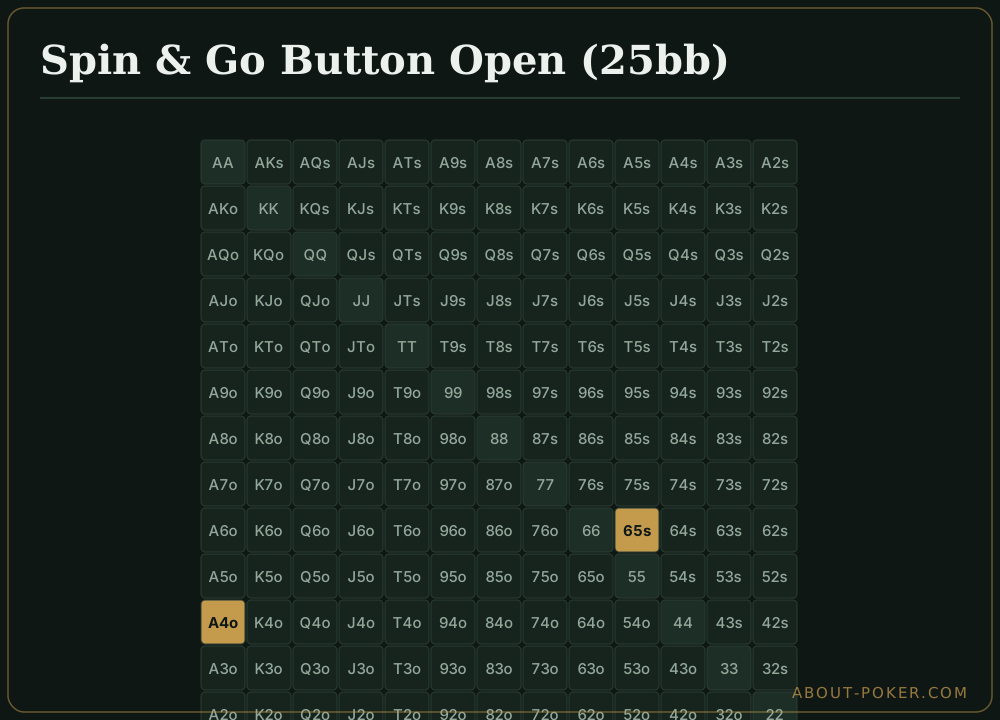
Three-handed, effective 10bb, folds to you on the button with A4o.
At 10bb, A4o is a clear open-jam. Shoving all-in accomplishes two things: it wins the blinds outright a large share of the time, and when called, A4o still has meaningful equity — it flips against many pairs and dominates the weaker aces and offsuit hands the blinds call with. Against a typical calling range here, A4o has enough equity that the shove is comfortably profitable.
If you tried to min-raise instead at 10bb, you’d commit a quarter of your stack and then face awkward decisions if 3-bet, so the clean jam is superior. Contrast with A4o under a deeper 25bb button, where a min-raise is fine because you retain room to play postflop or fold to a re-raise cheaply.
Calling ranges: when to look someone up
Ranges are only half the game — knowing what to call with is the other half, and it is where most Spin & Go players leak the fastest. When you face an open-jam, your call is governed by pot odds and the shover’s range. As a rough anchor, against a button that jams a wide (roughly 45-55%) range for 10bb, the big blind is getting about 1.5-to-1 and can call with any pair, most aces down to about A5o, most kings, and the stronger suited connectors and Broadways. That is a call threshold somewhere around the top 30-35% of hands.
Two adjustments matter. First, the tighter the shover’s range, the tighter you call — a nit who only jams 15% of hands should get folded most of your marginal aces. Second, position inside the call matters: if the small blind has already jammed and you are the big blind, you are last to act and can call a touch wider than if a player is still behind you. A useful habit is to separate “hands that beat a wide jamming range” (pairs, big aces) from “hands that merely have a coinflip” (small aces, weak Broadways) and only take the coinflips when the price is genuinely cheap.
A quick decision checklist
Before every Spin & Go hand, run this fast mental sequence:
- What is the effective stack? Above ~15bb, min-raise and play poker. Around 10-12bb or less, shift to open-jamming most of your opening range.
- What is my seat? Button opens widest (~55%), small blind next (~45%), big blind closes and reacts.
- Is the pot already opened? If yes, switch from opening ranges to defending — call, 3-bet-jam, or fold based on price and the opener’s tendencies.
- What is the multiplier? On a normal 2x, play maximally aggressive. On a large multiplier, add ICM caution to your calls.
Following that order keeps you from freezing on the fast clock, which is itself an edge in a hyper-turbo format where opponents routinely make rushed mistakes. For the deeper mechanics behind these thresholds, see short-stack preflop strategy.
Adjusting for the multiplier
The prize multiplier occasionally spikes to huge amounts. When it does, ICM pressure is real: busting costs you a big share of a large prize pool, so tighten your calling ranges against shoves slightly. On the vast majority of normal (2x) multipliers, though, the pool is small and close to a winner-take-all-ish payout, so play aggressively and lean on fold equity. Master the button, respect push-fold thresholds, and Spin & Gos become a high-volume, edge-rich format.
Frequently asked
How many players are in a Spin & Go?
Three. Spin & Gos are 3-handed hyper-turbo sit-and-gos where all three players start with a small stack (typically 25bb) and blinds rise fast, so the game quickly becomes shallow and push-fold heavy.
What starting stack do Spin & Gos use?
Usually 25 big blinds. Because blinds escalate every few minutes, you're often at 15-20bb or less within a few orbits, which is why short-stack and push-fold ranges dominate the format.
Should I limp or raise on the button in a Spin & Go?
At shallow depths, raising or shoving is generally better than limping. A min-raise steals blinds cheaply, and once you're around 12bb or less, open-jamming from the button captures the antes and blinds while denying the others a chance to realize equity.