88 Poker Nickname & Meaning
88 — pocket eights — is nicknamed the Snowmen, Little Oldsmobile, or Piano Keys. Here's where the names come from and how to play pocket eights.
On this page · 7 sections
88 is poker shorthand for pocket eights — two eights in the hole. It sits right in the middle of the pocket-pair spectrum: better than the small pairs, weaker than the big ones, and a hand that rewards knowing exactly when to push and when to pull back. It also has one of poker’s most recognizable nicknames.
The Snowmen — and the other names
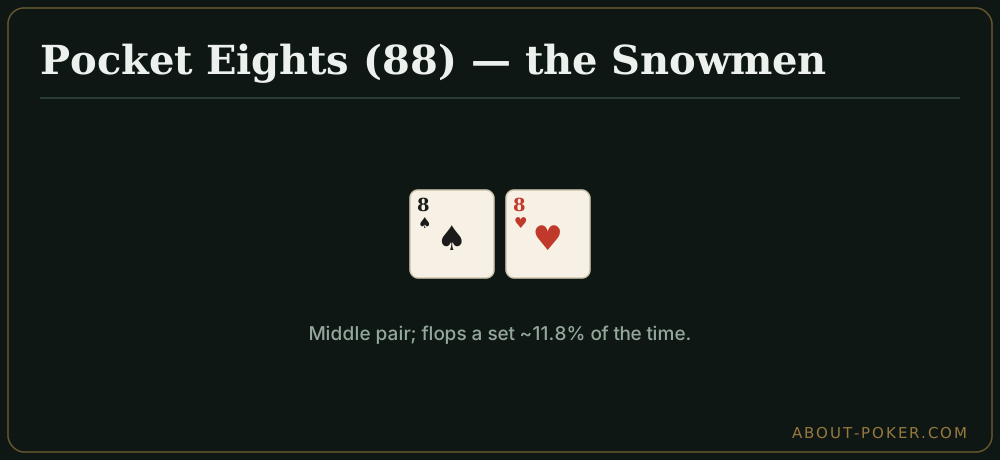
The signature nickname for 88 is the Snowmen. The reason is purely visual: the numeral 8 is two circles stacked on top of each other, just like a snowman’s body and head. A pair of eights makes two Snowmen. Other names you’ll hear:
- Little Oldsmobile — a nod to the Oldsmobile 88 car model.
- Piano Keys — a reference to the 88 keys on a piano.
- Snowmen or just the Eights — plain and always understood.
Snowmen is by far the most common and the one you’ll actually hear at the table.
How strong is 88, really?
Pocket eights is a serviceable middle pair. It beats every lower pair and all unpaired hands before the flop, winning about 69% of the time against a random holding. Its limitation is the sheer number of ranks above it: there are six — nine, ten, jack, queen, king, and ace.
With six overcard ranks live, an overcard will appear on the flop the large majority of the time when an opponent could hold higher cards. So eights almost never flop an overpair against a raising range. Their real value comes from set-mining — flopping three of a kind, which happens roughly 11.8% of the time with any pocket pair — and from stealing pots before opponents catch up.
Worked example: set-mining with eights
You call a raise on the button with 8♥ 8♠, hoping to hit a set. The flop comes 8♦ K♣ 4♠ — you’ve flopped a set of eights. This is exactly the outcome that makes calling profitable: your hand is nearly invisible, and an opponent with a king for top pair will happily pay you off.
Now the less rosy version: the flop comes A♠ J♥ 6♦. Your eights are an underpair against a range full of aces and broadway cards. If your opponent bets and shows strength, you’re often just check-folding. The gap between these two flops — a hidden set versus a beaten underpair — is the whole reason eights lean on set value rather than trying to win big pots with the pair itself.
Because eights flop an overpair so rarely, your discipline before and after the flop matters. The full framework — when to 3-bet, when to set-mine, and when to fold — lives in how to play pocket eights.
The set-mining math, in plain numbers
The reason eights lean on set value is worth spelling out. Any pocket pair flops a set (or better) about 11.8% of the time — roughly one in every 8.5 flops. That sounds infrequent, and it is, which is why set-mining is only profitable when the reward is large enough to cover all the times you miss.
The common rule of thumb is the “5 and 10” guideline: to set-mine by calling a raise, you generally want to be able to win at least 10 to 15 times the amount you are calling if you hit. If you call 3bb hoping to flop a set, you want effective stacks and opponent tendencies that let you win something like 30 to 45bb when it comes in. Deep stacks and opponents who pay off make set-mining with 88 profitable; shallow stacks or tight opponents who fold when the board pairs make it a losing call. When a set does arrive, it is nearly invisible and wins big pots against overpairs and top pair — which is exactly where the hand earns its keep.
Playing 88 by position
Because eights so rarely flop an overpair, position shapes the plan more than with the big pairs:
- Early position: raise, but keep the pot manageable. If you face a 3-bet, you are often calling to set-mine or folding to heavy pressure rather than getting all-in preflop — an underpair to the 3-bettor’s likely QQ+ and AK is not where you want stacks in.
- Middle position and cutoff: a standard raise. Against a single caller you can c-bet many flops, but slow down when overcards pair a range that connected.
- Button: your strongest spot. You can raise for value, and if you flop a set you have position to extract maximum value street by street.
- Blinds: 88 defends well and can 3-bet as a value hand against late-position steals, but out of position you lean harder on set value and pot control.
The through-line is that eights want smaller pots when they hold just the pair and bigger pots only when they improve to a set.
Using the term at the table
You’ll hear the Snowmen in lines like “flopped a set with the Snowmen and got there,” or “had eight-eight and the board came ace-high again.” Say “eights” or “Snowmen” and everyone knows the hand.
Eights are the classic set-mining pair — modest as a pair, dangerous as a set. Raise them in most spots, call to set-mine when the price and stacks are right, and let them go on scary boards. For the complete strategy, see how to play pocket eights, and browse more table talk in the poker slang guide.
Keep going
88 is the friendly-faced Snowmen — a middle pair built for set-mining. Learn more vocabulary in the poker terms glossary, explore colorful table talk in poker slang explained, and master the play in how to play pocket eights.
Frequently asked
What is the nickname for pocket eights (88)?
The most common nickname is the Snowmen, because the number 8 looks like a snowman built from two stacked circles. You'll also hear Little Oldsmobile and Piano Keys.
Why are pocket eights called Snowmen?
Because the shape of the numeral 8 — two circles stacked on top of each other — resembles a snowman. Two eights make a pair of Snowmen.
How strong is 88 in poker?
Pocket eights is a decent middle pair. It beats all lower pairs and unpaired hands before the flop, but with six higher ranks in the deck it often faces overcards after the flop.
Is 88 a good starting hand?
Yes, it's a playable, above-average pair worth raising in most positions. Its main strength after the flop is set-mining, since higher cards frequently appear on the board.