AJ Poker Nickname & Meaning
AJ is nicknamed Blackjack or Ajax. What ace-jack means, where the nicknames come from, and why this pretty hand is a domination magnet.
On this page · 8 sections
AJ — ace-jack — is nicknamed Blackjack, and sometimes Ajax. It’s a good-looking hand with an ace and a face card, but it sits below the premium aces and has a well-earned reputation for getting a player into trouble. Knowing where the nickname comes from is fun; knowing when to fold it is profitable.
Where “Blackjack” and “Ajax” come from
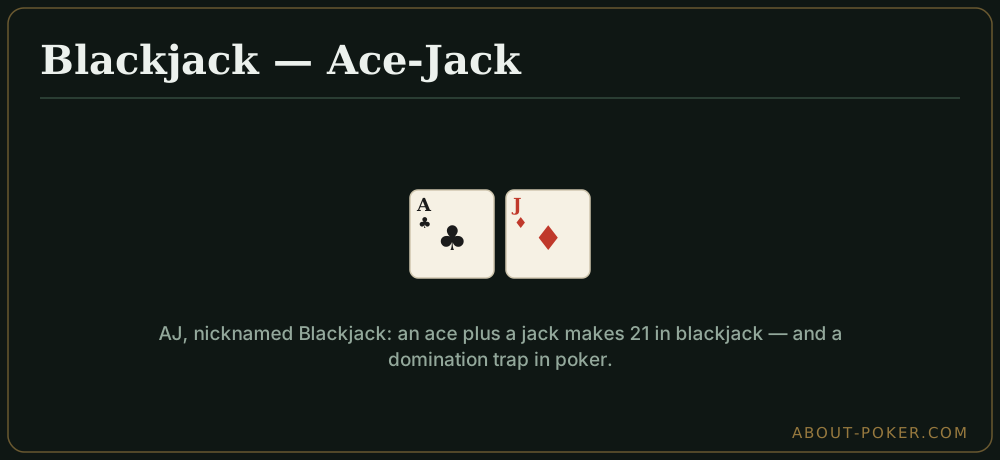
The main nickname borrows straight from the casino game. In blackjack, an ace plus any ten-value card — including a jack — makes 21, the best possible hand, called a “blackjack.” Poker players took the name and applied it to ace-jack. It’s one of the tidiest cross-game nicknames out there.
Ajax is the second name, and it’s pure wordplay: A and J — A-jax. Some players also nod to the mythological hero or the cleaning product, but it’s really just the two letters said out loud.
What ace-jack is worth
AJ is a playable hand, but it belongs in the “strong but not premium” tier alongside hands like KQ. Its weakness is the same one that plagues its bigger cousin AQ, only worse: domination.
- Kicker problems: When you flop an ace, your jack kicker loses to AK, AQ, and any bigger ace.
- Versus premium aces: AJ is a big underdog to AK and AQ — you’re out-kicked.
- Versus a pair: Against most pocket pairs, AJ is a slight underdog in a race, around 43-45%.
- Suited helps a lot: AJs picks up flush and straight potential that make it much more comfortable to play than AJo.
Worked example: dominated on a “good” flop
You call a raise from an early-position player with A♣ J♦.
Flop: A♥ 9♠ 4♦. Top pair — looks strong. But the raiser opened from up front, where the range is tight and loaded with better aces. Against A♠K♠, you have top pair jack-kicker while they have top pair king-kicker. You’re drawing to three jacks, roughly 12% equity to catch up by the river. That’s the AJ trap in a single hand: a flop that feels like a win but is often a slow leak.
Now flip it. If instead you’re the raiser and a loose caller holds A-8 or A-5, your jack kicker plays and they’re the ones dominated. AJ’s value depends entirely on whose range is stronger — which is why position and reads matter so much.
How to play ace-jack
The rule of thumb: play AJ more from late position, fold it more from early position and against strength.
- Late position: AJ is a comfortable open-raise. Fewer players left to act means fewer chances to be dominated.
- Early position: Tighten up. Many strong players fold AJo up front because it plays poorly against 3-bets.
- Facing a raise: Be cautious. Calling a tight player’s early-position raise with AJ out of position is a classic losing spot.
- Suited over offsuit: AJs can call raises and 3-bets that AJo should fold, thanks to its extra equity.
Blackjack versus the bigger aces
The through-line from AK to AQ to AJ is a steady drop in kicker strength. AK flops the best kicker; AQ flops a dominated one; AJ flops one that’s dominated even more often. Each step down means you win a little less when you pair and lose a little more when someone plays back. Respect that ladder, and you’ll stop paying off the bigger aces.
Suited versus offsuit: why the difference is bigger than it looks
The gap between AJs and AJo is one of the largest between a suited and offsuit version of the same broadway. The flush potential does two things at once. First, it adds raw equity — a suited hand runs a few percentage points ahead of its offsuit twin against most ranges. Second, and more importantly, it gives you a way to win big pots when you are behind: a flush draw lets you barrel with real equity, semi-bluff aggressively, and get paid when you complete, all of which AJo simply cannot do.
That is why the two hands live in different tiers. AJs can profitably call some raises and even continue against 3-bets, because the flush gives it a path to a strong hand independent of pairing its ace. AJo has no such lifeline — when it flops top pair it is stuck relying on a jack kicker, and when it misses it has nothing to work with. Treat AJs as a genuine playable broadway and AJo as a position-dependent hand you fold far more readily.
Common mistakes with ace-jack
The hands that lose the most money with AJ tend to repeat the same errors. Watch for these:
- Calling early-position raises out of position. This is the classic AJ leak. A tight player opening from up front is loaded with AK, AQ, and pairs — the exact hands that dominate you — and you will be out of position for the whole hand. Fold and wait for a better spot.
- Refusing to fold top pair. Flopping top pair with AJ feels strong, but against a range that keeps betting into you, your jack kicker is often beaten. Pot-control it and be willing to let it go, especially against tight opponents on ace-high boards.
- Playing AJo the same as AJs. The offsuit version is meaningfully weaker. Applying suited-hand aggression to the offsuit hand — cold-calling 3-bets, barreling missed flops — turns a marginal hand into a losing one.
- Ignoring position. AJ is a comfortable open in late position and a fold in early position. The identical two cards can be a clear raise or a clear muck depending only on where you sit.
Keep going
AJ is Blackjack — a pretty, playable hand that’s a domination magnet against strong ranges. Raise it in late position, fold it freely up front, and don’t marry top pair with a jack kicker. See how AQ handles the same trap, study ranges for ace-jack suited, and browse the full poker glossary for more.
Frequently asked
What is the nickname for AJ in poker?
Ace-jack is called Blackjack — because an ace and a jack (or any ten-value card) is the best hand in the game of blackjack. It's also nicknamed Ajax, a pun on the letters A and J.
Why is AJ called Blackjack?
In the card game blackjack, an ace paired with a ten-value card — including a jack — makes 21, a 'blackjack.' Poker borrowed the name for the ace-jack starting hand.
Is AJ a good poker hand?
AJ is a decent, playable hand but not premium. It's a raise from later positions and gets weaker up front, where it's often dominated by better aces like AK, AQ, and AA.
Should I fold AJ to a raise?
Often, yes — especially against tight players raising from early position. AJ is easily dominated by AK and AQ, so calling a raise out of position with it is a common leak.