How to Play Ace-Jack Suited (AJs)
Ace-jack suited is a strong but domination-prone hand. Learn when to open, when to 3-bet or flat, and how to avoid kicker traps with AJs.
On this page · 7 sections
Ace-jack suited (AJs) is a good hand that punishes players who overrate it. It flops well, carries the nut-flush draw, and dominates plenty of weaker holdings. But it also sits right in the domination danger zone: when you make top pair with your ace, better kickers (AK, AQ, AT) are often still ahead, and when you make a pair of jacks, larger pairs loom. The winning approach is to play AJs aggressively where you have the range edge and to fold or flat where a tighter range has you beaten.
Opening AJs
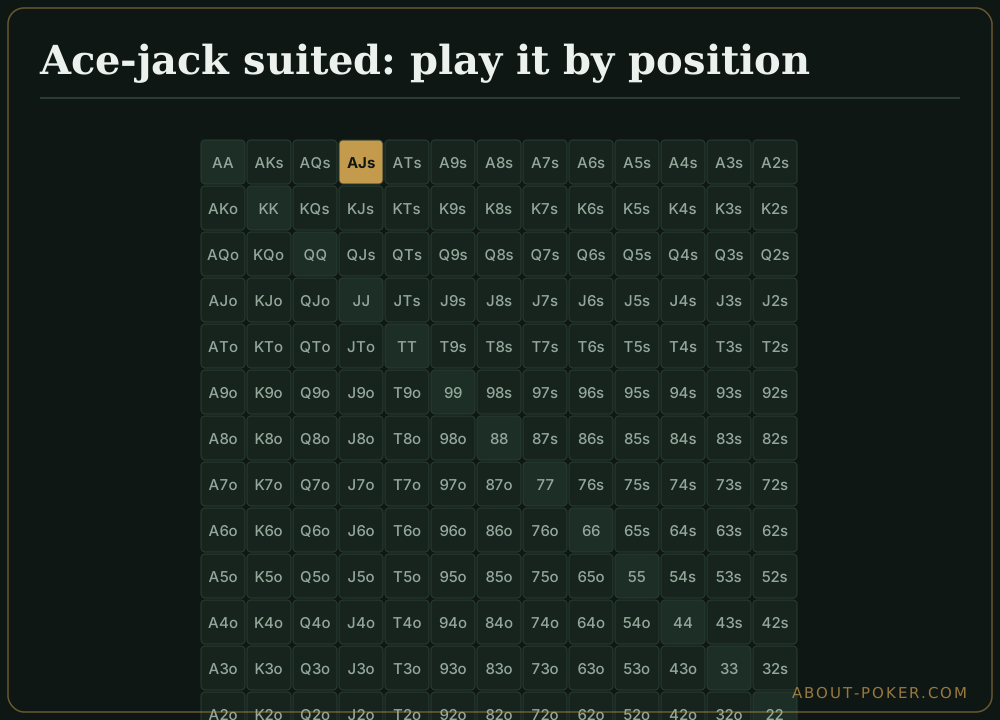
AJs is a comfortable open from middle position, the cutoff, and the button, and it makes the cut in most under-the-gun ranges in 6-max. It is inside your preflop opening ranges because it dominates weaker aces and jacks, flops top pair often, and has the suited flush upside. In full-ring games or at very tight tables, AJs from the earliest seat gets marginal — the hands that continue against you tend to be the ones that dominate it — but from middle position onward it is a clean raise-first-in.
To 3-bet or to call
Facing a raise, your decision hinges on the opener’s position and range:
- Against a late-position steal (cutoff/button open): 3-bet AJs. Their range is wide and full of dominated hands, so AJs is a strong value-and-pressure 3-bet.
- Against a tight early-position raise: flat in position or fold. A UTG range is heavy with AK, AQ, and big pairs — exactly the hands that dominate AJs. Here it belongs in your cold-calling range, not your 3-bet range, and against the tightest openers folding is fine.
The general rule: 3-bet AJs for value against wide ranges, and cool it against tight ones.
A worked example
You open A♠J♠ from the cutoff and the big blind calls. The flop is A♥8♣4♦ — top pair, jack kicker, on a dry board.
Bet for value. Against a big blind’s calling range you are ahead of most worse aces (A9, A7, A5 suited), pocket pairs below aces, and 8x. Size around 33–50% pot. But note the caution: if a tight opponent raises this flop hard and keeps barreling, hands like AK and AQ have you outkicked, and you should be ready to slow down rather than stack off top-pair-medium-kicker. AJs makes money by value-betting the many worse hands — not by paying off the few better ones.
Playing AJs after the flop
- Top pair, good board: Value bet, but respect a raising line from a tight player — your kicker is beatable.
- Nut-flush draw: Semi-bluff aggressively. You can win now or make the nuts, giving AJs real barreling equity.
- Whiff on a dry board: A single c-bet with two overcards and backdoors often takes it down.
- Whiff on a coordinated board: Give up cheaply; your ace-high has little value against a range that connected.
Understanding the domination map
AJs makes its money against the hands it beats and loses it against the hands it looks similar to, so it pays to know both lists cold. On an ace-high board, AJs is ahead of every worse ace a caller keeps — A9, A8, A7, A5s, A4s and so on — as well as pairs below aces and stray top-pair hands like KJ or QJ that share your board. That is a long list, and it is why AJs is a strong value hand most of the time. The short but painful list is AK, AQ, and AT: these have you either dominated or, in AT’s case, tied but drawing thin. The whole skill of the hand is betting confidently against the long list while reading raises and heavy barrels as the signal that you may be up against the short one.
A useful mental shortcut: passive money going into the pot (calls) usually comes from the hands you beat, while aggressive money (raises, three-barrel lines) skews toward the hands that beat you. Value bet the calls, and respect the aggression.
How AJs changes by stack depth
- Standard 100 big blinds. Play as described — open widely in position, 3-bet against steals, flat against tight early opens. This is the reference point for most cash games.
- Deep (150 big blinds and up). Domination gets more expensive because more money can go in on later streets, so lean slightly more toward flatting against strong ranges and slightly less toward stacking off with a naked top pair, jack kicker. The nut-flush draw gains value here since deep stacks reward the hand that can win a big pot cleanly.
- Short (25 to 40 big blinds). AJs becomes a clearer 3-bet-or-fold hand. Flatting loses appeal when stacks are shallow, and 3-betting to get all-in preflop against a wide opener is comfortable because AJs races or dominates most of what continues.
A quick decision checklist
- First in, middle position or later? Open. Under the gun in 6-max? Usually open; in full ring, treat as marginal.
- Facing a late steal? 3-bet for value.
- Facing a tight early raise? Flat in position or fold — do not 3-bet into a range that dominates you.
- Flopped top pair and getting raised hard by a tight player? Slow down; your kicker may be beaten.
- Flopped the nut-flush draw? Semi-bluff aggressively.
Played correctly, AJs is a profitable hand that extracts value from the many holdings it dominates while sidestepping the kicker traps that catch impatient players. Open it freely in position, 3-bet it against wide ranges, and don’t marry top pair when a tight line tells you your kicker just lost.
Frequently asked
Can you open ace-jack suited under the gun?
In 6-max, yes — AJs is inside most under-the-gun opening ranges. In full-ring or against very tight tables it becomes marginal from the earliest seat because it is dominated by the aces and jacks that continue against an early open. From middle position onward it is a clear raise.
Should you 3-bet or call with AJs facing a raise?
It depends on position and the opener. Against a late-position steal, 3-betting AJs for value and pressure is standard. Against a tight early-position raise, flatting in position or folding is often better because AJs is frequently dominated by that range.
Why is AJs a domination trap?
When you make top pair with an ace, hands like AK, AQ, and AT still beat or tie your kicker, and when you make top pair with a jack, many bigger hands hold. AJs looks strong but frequently ends up second-best in ace-high pots against a raising range.