How to Play Ace-Jack Offsuit (AJo)
AJo is a strong but trap-prone offsuit broadway that opens widely yet folds to serious pressure. Learn where AJo plays, when to fold it, and how to play it postflop.
On this page · 6 sections
Ace-jack offsuit (AJo) is a strong hand that beginners overvalue and experts play with respect. It opens from nearly every seat and flops plenty of top pairs and broadway straights, but it lives under the shadow of domination — the very hands that want to put in a lot of money against it (AK, AQ, and big pairs) all have it beaten. The trick with AJo is knowing when it’s the raiser and when it’s the underdog.
Where AJo belongs preflop
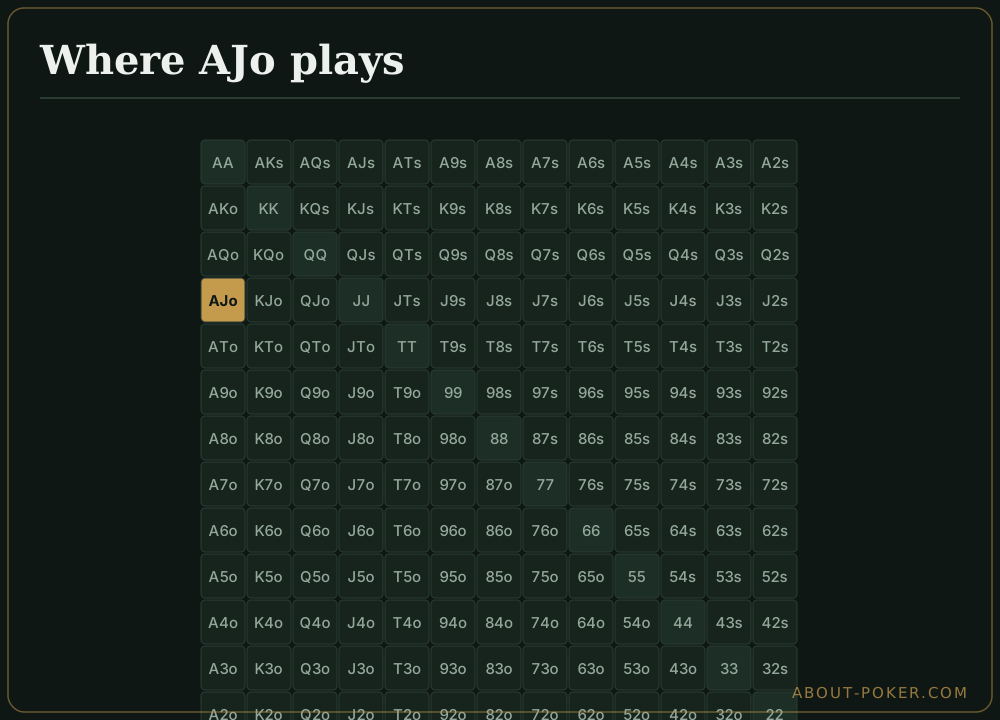
By position, AJo is a wide open that only tightens up in the earliest seats:
- Early position (full ring / UTG at 6-max): a marginal open. It’s inside the range at 6-max but closer to a fold in tight full-ring games, where you run into dominating aces more often.
- Middle position through button: a standard, comfortable open every time. This is where AJo does most of its work.
- Small blind: open (raise) rather than limp when it folds to you.
- Big blind: defend widely against opens; AJo is near the top of your defending range.
For the exact seat-by-seat borders, ground yourself in the preflop opening ranges and note how AJo climbs from a marginal early open to a routine late one.
The domination problem
AJo’s defining weakness is that it’s reverse-dominated by the strongest ace-x and pair hands. When the money gets big preflop, the hands still in against you are disproportionately AK, AQ, AA, KK, and QQ — and AJo is a big underdog to all of them. That’s why AJo is frequently a caller rather than a 3-bettor against tight ranges: 3-betting only folds out the hands you beat and gets called or 4-bet by the hands that beat you.
Against wide ranges, the calculus flips. A late-position steal or a small-blind open contains so many weaker aces, weaker broadways, and junk that AJo is comfortably ahead and can 3-bet for value. Choosing correctly between calling and 3-betting is the whole game with this hand; see how those bluffs and value hands are selected in the 3-bet range breakdown.
Facing 3-bets and 4-bets
When you open AJo and get 3-bet, you’re often in a tough spot. Against a tight 3-bettor, AJo is frequently a fold or a disciplined call in position; the last thing you want is to stack off against a range full of AK and QQ+. Against a wide, aggressive 3-bettor you can continue more, either calling in position or occasionally 4-bet bluffing. The general framework for these decisions lives in defending against 3-bets.
When you face a 4-bet, AJo is a clear fold. The value portion of any 4-betting range — AA, KK, AK — has you crushed, and you don’t have the equity or price to continue.
A worked example
You open A♥J♠ from the cutoff. The button, a loose regular, 3-bets. Because this player 3-bets a wide range, you call in position rather than folding. The flop comes A♦ 8♣ 4♠ — you’ve flopped top pair, decent kicker.
The button continuation-bets. You call, planning to control the pot: your hand is good against the many worse aces and bluffs in a wide 3-bet range, but it’s not strong enough to blast off against AK or a set. The turn is the 2♥. The button checks. You check back to keep the pot small and get to a cheap showdown. River is the 7♦, and the button checks again; you bet small for thin value against worse aces and take it down. That controlled line — call, pot-control, thin value — is exactly how AJo extracts money without paying off the hands that dominate it.
Now imagine the 3-bettor were a nitty full-ring player instead. Their range is AK, AQ, QQ+, and you’re crushed. Same cards, different opponent, and the correct preflop response shifts from a call to a fold. Range reading, not card strength, drives AJo.
Postflop in one paragraph
When AJo flops top pair, it’s a solid but not unbeatable hand: bet for value against worse aces, but pot-control against ranges heavy in AK and sets. When it flops a broadway draw (KQ, QT, or T9-type boards giving you gutshots to the nuts), you can barrel with real equity. When it flops middle pair or worse, it’s usually a give-up or a single-barrel bluff. The recurring theme is discipline: AJo makes good top pairs, but its kicker problems mean you rarely want to play a giant pot with just one pair.
Where to go next
AJo is the classic “strong-but-dominated” hand — a wide open that demands restraint against pressure. Sharpen your opens with preflop opening ranges, learn to survive aggression in defending against 3-bets, and connect the whole framework at the preflop strategy hub.
Frequently asked
Is AJ offsuit a good hand?
AJo is a strong hand that opens from most positions, but it's easily dominated by AK, AQ, and pocket pairs above jacks. It's a clear open and a fine value hand, yet it's often a fold or a call — not a 3-bet — against tight aggression.
Should I 3-bet with AJ offsuit?
Sometimes, but carefully. AJo can 3-bet against wide openers, especially in position and blind vs blind, where you're ahead of the opener's range. Against a tight early-position raise it's usually a call or fold because you're often dominated by the exact hands that 4-bet you.
Can I call a 4-bet with AJ offsuit?
Almost never. When you face a 4-bet, AJo is crushed by the value part of the 4-betting range (AK, AA, KK, QQ). Fold it against 4-bets unless you have a specific read that your opponent is 4-bet bluffing very aggressively.