KK Poker Nickname & Meaning
KK — pocket kings — is nicknamed the Cowboys, King Kong, or Ace Magnets. Here's where each name comes from and how strong the hand really is.
On this page · 8 sections
KK is the standard shorthand for pocket kings — two kings in the hole, the second-strongest starting hand in Texas Hold’em. It has picked up more nicknames than almost any other holding, and knowing them is a quick way to sound like a regular at the table.
The Cowboys — and the other names
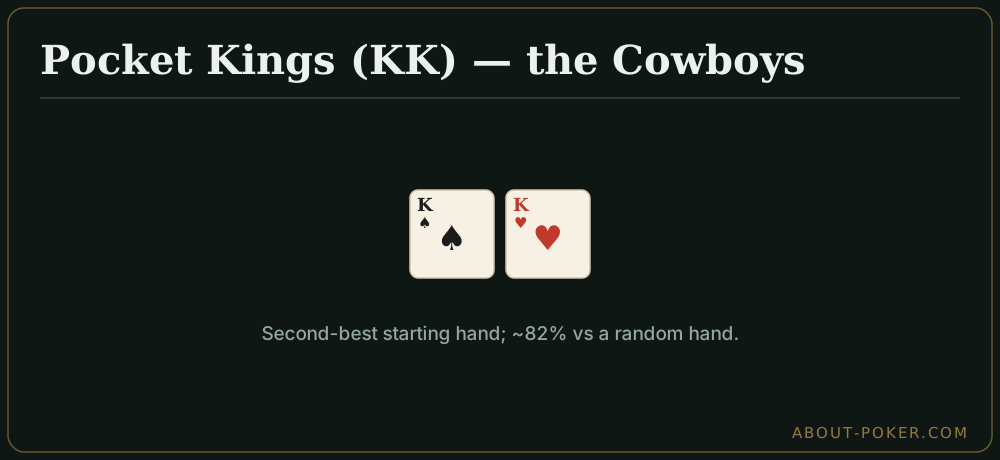
The most widely used nickname for KK is the Cowboys. The link is simple: the letter K on the card face brings cowboys to mind, and “riding in with the Cowboys” became table slang decades ago. A few of the other names you’ll hear:
- King Kong — a play on the double-K sound, and a nod to the hand’s raw power.
- Ace Magnets — a rueful joke: the moment you raise with kings, an opponent seems to turn up pocket aces.
- Elvis Presley — the King of Rock and Roll, doubled up.
- King Arthur or the Kings — plain and self-explanatory.
Most of these are affectionate. The Cowboys and Ace Magnets are the two you’ll actually hear at a live table.
How strong is KK, really?
Pocket kings is a genuine monster. It beats every other pocket pair and dominates every non-ace holding before the flop. Against a random hand it wins about 82% of the time. Its only real fear is pocket aces or an ace flopping.
Here’s the number that keeps kings honest: if you hold KK and someone else could have an ace, an ace will appear on the flop roughly 23% of the time — a little under one in four flops. That’s the source of the Ace Magnets nickname and the reason experienced players stay alert on ace-high boards.
Worked example: kings vs. ace-king
You open-raise with K♠ K♥ and a player 3-bets. You call, and the pot builds. Say they hold A♣ K♦ — ace-king, a hand many players will not fold.
Before any cards come, your kings are about a 70% favorite over their AK. You’re crushing them. The only board that flips the hand is one with an ace on it, which is exactly why you watch the flop closely. If it comes 9♦ 6♣ 2♠, you’re still miles ahead and should keep betting. If it comes A♥ 7♦ 3♣, you slow down — your opponent just paired the one card that beats you.
That single-card vulnerability is what separates KK from pocket aces, which fear nothing preflop. Kings win huge pots, but the disciplined player knows when an ace on the board means it’s time to control the size of the pot.
KK against the rest of the field
The 70% figure against ace-king is worth putting in context, because it shows just how dominant kings are before the flop:
- Against a lower pair (say QQ or lower): about 82% to win. You are a massive favorite and should get money in freely.
- Against a single overcard hand with an ace (AQ, AJ, AK): roughly 66-70%. The ace is the only card that scares you.
- Against two overcards without an ace: there are none — nothing is fully “over” kings except an ace, which is exactly why KK is so strong.
- Against a random hand: about 82%.
The only starting hand that beats you before the flop is pocket aces, which has you crushed at roughly 82% to your 18%. That’s the entire vulnerability of KK in one sentence: you are second only to aces, and you’re a favorite over literally everything else.
Playing KK when an ace flops
Because the Ace Magnets joke has real teeth, the important skill with kings is knowing how to slow down when an ace appears without over-folding a hand that is still often best. A few guidelines:
- Heads-up in a small pot: an ace on the flop rarely means you’re beaten. Many opponents don’t have an ace, and you can still bet for value or check to control the pot. Don’t hand over the pot to a single scare card.
- Multiway or against heavy aggression: the more players in the pot, the more likely someone holds an ace. On an ace-high board against multiple opponents or a big raise, kings often become a check-and-evaluate hand rather than a stack-off.
- Facing a 3-bet or 4-bet preflop: here the calculus is different. Against a very tight player who only 4-bets aces, folding kings is occasionally correct — but against most opponents, KK is far too strong to fold before the flop.
How KK changes by stack depth
Deep-stacked play rewards caution with one pair; short-stacked play rewards commitment. With 100bb or more, an ace on the board and mounting aggression should make you willing to fold kings on later streets, because the amounts at risk are large. Short-stacked — say 20bb in a tournament — you are usually committed once the money goes in preflop and should get it in without agonizing, since fold equity and the pot odds you’re laying make folding a premium pair a losing play. The deeper the stacks, the more an ace on the board should worry you; the shallower the stacks, the more you simply commit and accept the occasional cooler.
Using the term at the table
You’ll hear KK show up in sentences like “I had the Cowboys and still couldn’t get away from that ace,” or “raised it up with kings, of course he had the Ace Magnets working.” Say “kings” or “the Cowboys” and everyone at the table knows exactly what you mean.
Nicknames like this are part of the culture of poker — shorthand that carries a whole story. Kings are powerful, occasionally heartbreaking, and always worth raising. For the full playbook, see how to play pocket kings, and browse more table talk in the poker slang guide.
Keep going
KK is the hand everyone loves to look down at and occasionally curses when the ace arrives. Learn the rest of the vocabulary in the poker terms glossary, pick up more colorful table talk in poker slang explained, and master the strategy in how to play pocket kings.
Frequently asked
What is the nickname for pocket kings (KK)?
The most common nickname is the Cowboys, because the letter K on the cards evokes cowboys. You'll also hear King Kong, Ace Magnets, and Elvis Presley (from the King of Rock and Roll).
Why is KK called Ace Magnets?
Because it feels like every time you raise with kings, someone shows up with pocket aces. It's a joke about how often the one hand that dominates you appears when you finally pick up kings.
How strong is KK in poker?
Pocket kings is the second-best starting hand in Texas Hold'em, behind only pocket aces. It's a premium hand you almost always want to raise or re-raise before the flop.
Does KK beat AK?
Yes. Before the flop, pocket kings is roughly a 70% favorite against ace-king. KK only fears an ace hitting the board, which happens on the flop about 23% of the time.