QJ Poker Nickname & Meaning
QJ is nicknamed Maverick or Oedipus Rex. What queen-jack means, where the nicknames come from, and how to play this connected broadway hand.
On this page · 8 sections
QJ — queen-jack — is nicknamed Maverick, and less seriously Oedipus Rex. It’s a connected broadway hand with real straight potential, best known for a TV-Western reference and for being one of the more fun hands to play in position.
Where “Maverick” comes from
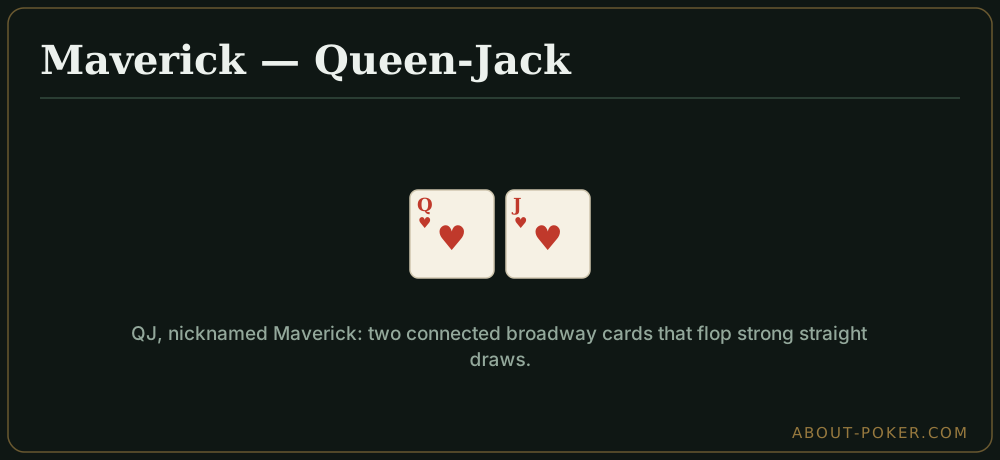
The main nickname comes from the classic TV Western Maverick (and its theme song), where the gambler hero holds “a queen and a jack.” Poker players borrowed it, and Maverick stuck as the name for queen-jack. It’s a nickname with genuine pop-culture pedigree.
Oedipus Rex is the darker, jokier alternative — a reference to the Greek tragedy about a man and his mother, played on the “queen and jack” (mother and son) pairing. It’s the kind of nickname you’ll hear from players who like their card jokes with a literary twist.
What queen-jack is worth
QJ is a broadway hand with a special feature: connectedness. The queen and jack sit right next to each other, so QJ makes more straights than the gappier king-based hands.
- Straight potential: QJ makes broadway (T-J-Q-K-A) and queen-high straights (9-T-J-Q-K), and it flops open-ended draws often.
- Two pairs to hit: You can flop top pair with the queen or a strong second pair with the jack.
- The weakness: Both cards are lower than a king, so QJ’s top pairs are out-kicked more often — by AQ, KQ, AJ, KJ, and any bigger hand.
- Suited is much stronger: QJs adds flush equity to its straight potential and plays far better than QJo.
Worked example: Maverick flops a big draw
You raise on the button with Q♥ J♥ and the big blind calls.
Flop: T♠ 9♦ 2♥. You’ve flopped an open-ended straight draw: any king or eight completes your straight. That’s eight clean outs, worth roughly 32% equity to complete by the river with two cards to come — and you also hold two overcards to some of the board and a backdoor flush draw with your hearts. Add it up and you have a powerful semi-bluffing hand.
Because you’re in position with a big draw, this is a spot to bet: you can win immediately when the big blind folds, and you have plenty of equity when called. That combination — position plus a live draw — is where Maverick shines.
Contrast that with a flop like A♣ K♦ 4♠, where QJ has only a gutshot to broadway and little else. Same hand, but now it’s a check-and-give-up spot against resistance.
How to play queen-jack
QJ is a position-dependent hand that loves to flop draws:
- Late position and suited are its strengths. Open QJs freely from the cutoff and button; be more selective with QJo and from early position.
- Semi-bluff its draws. Open-enders and combo draws are worth betting for their equity plus fold value.
- Don’t overvalue top pair. A flopped queen or jack is often out-kicked; one or two value bets is usually enough.
- Fold more against strength. QJ is dominated by most of the broadway hands that raise and re-raise, so calling big out of position is a leak.
Common mistakes with queen-jack
QJ looks pretty — two big cards, a Broadway hand — and that surface appeal leads to predictable errors:
- Calling 3-bets out of position. When you open QJo and a tight player 3-bets, you are often dominated by AQ, KQ, AJ, and every pair from tens up. Calling to play a bloated pot out of position with a hand that flops second-best top pairs is a steady loser. Fold QJo to most 3-bets; continue with QJs only in position and with a plan.
- Overplaying top pair. Flop a queen and it feels like a monster, but AQ, KQ, and QQ all have you crushed, and any king or ace overcard on the turn kills your action from worse. One or two value bets is plenty; don’t build a three-street pot with a marginal kicker.
- Chasing thin gutshots. QJ flops open-enders often, and those are worth playing — but a bare gutshot to Broadway on an A-K-x board is four outs and usually dominated. Fold the weak draws and save your chips for the eight-out combo draws where Maverick actually shines.
- Playing it too passively when it hits big. The flip side: when you flop a real combo draw or two pair, bet it. QJ’s whole edge is aggression with equity, and slow-playing a strong draw wastes its fold value.
How position and stack depth change QJ
QJ is one of the most position-sensitive Broadway hands. In position you can peel flops cheaply, semi-bluff your draws, and control the pot with marginal top pairs. Out of position all of that gets harder — you’re guessing on later streets and often check-folding hands that had real equity in position.
Stack depth matters too. At deep stacks (100bb+), QJs gains value because its straight and flush potential can win a big pot when it connects — implied odds reward the drawing hands. At short stacks (under 25bb), that drawing value shrinks, and QJ becomes more of a raw high-card hand: fine to open-shove or re-shove from late position for its two overcards and fold equity, but a poor call-and-see-a-flop hand when you can’t realize your draws profitably. As a rule, play QJ wider and more aggressively when you’re deep and in position, tighter when you’re short or out of position.
Maverick versus the other broadways
Among the broadway hands, QJ trades kicker strength for connectedness. Where KJ has a higher card but a gap, QJ has two touching cards that make more straights. That makes QJ a better drawing hand and a worse top-pair hand — so it rewards players who lean on its straight and flush potential rather than betting thin for value.
Keep going
QJ is Maverick — a connected broadway hand that flops strong draws and plays best in position. Semi-bluff its straights and flushes, respect domination on high-card boards, and favor the suited version. Compare it to KJ, study ranges for queen-jack suited, and browse the full poker glossary for more.
Frequently asked
What is the nickname for QJ in poker?
Queen-jack is nicknamed Maverick — from the old song and TV Western where 'Maverick was a legend of the West' with a queen and a jack. It's also jokingly called Oedipus Rex.
Why is QJ called Maverick?
The theme song to the TV Western Maverick mentions a hand of 'queen and jack.' Poker players adopted Maverick as the nickname for queen-jack. Oedipus Rex is a darker joke about a king and queen mismatch.
Is QJ a good poker hand?
QJ is a playable, connected broadway hand — decent from late position, especially suited. It's not premium and gets dominated by better broadway hands, so it's best played in position.
What makes QJ different from KJ?
QJ is more connected — the queen and jack sit next to each other, so it makes more straights. But both cards are lower, so its top pairs are more easily out-kicked than KJ's.