What Is 3-Bet in Poker?
A 3-bet is the third bet in a betting sequence — the re-raise over an opening raise. Learn what a 3-bet is, why it matters, and how to size one.
On this page · 7 sections
A 3-bet is the third bet in a betting sequence. The name confuses newcomers because preflop it looks like only two raises have happened. The trick is that the big blind is counted as the first bet. So the opening raise is the second bet, and the re-raise over that open is the third bet — the 3-bet. It happens most often before the flop but can occur on any street.
A 3-bet is a statement. Where an open-raise says “I like my hand,” a 3-bet says “I like my hand a lot, or I want you to think I do.” It seizes the initiative and forces the original raiser to make a tough decision for a big pot.
Why the Numbering Works That Way
Poker counts the forced big blind as the opening bet of the hand. That single convention explains the whole sequence:
- 1-bet: the big blind (the forced posting).
- 2-bet: the first raise, i.e. the open. This is why it is not called a “bet.”
- 3-bet: the re-raise over the open.
- 4-bet: the re-raise over the 3-bet.
Once you internalize that the blind is bet number one, every level after it lines up naturally.
Value 3-Bets Versus Bluff 3-Bets
Strong 3-betting ranges are built from two kinds of hands.
Value 3-bets are made with hands that want a call from worse: aces, kings, queens, and ace-king. You are happy to build a big pot because you are ahead of the hands that continue.
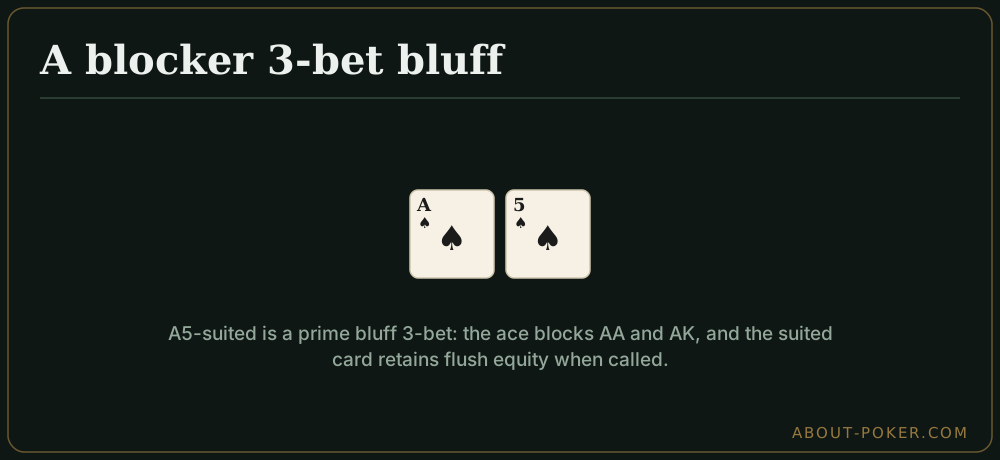
Bluff 3-bets (also called light 3-bets) use weaker hands to apply pressure. The best candidates are hands with blockers — suited aces like ace-five suited, which hold an ace and reduce the chance the opener has aces or ace-king. When called, these hands still make flushes and straights, so they are not pure air.
A balanced 3-betting range mixes both so opponents cannot simply fold whenever you re-raise.
Sizing a 3-Bet
Position drives sizing. When you are in position (acting after your opponent postflop), a 3-bet of roughly 3 times the original raise is standard. Out of position, size up to about 3.5 to 4 times, because you want to charge more when you will be at a positional disadvantage after the flop.
Example: a player opens to 3 big blinds. In position you might 3-bet to about 9 big blinds. From the blinds, out of position, you might make it 11 to 12 big blinds instead. Larger out-of-position sizing discourages loose calls that would otherwise punish you on later streets.
A Worked Example
You hold ace-king suited on the button. A solid player opens to 3 big blinds from the cutoff. You 3-bet to 9. Two things can happen and both are good.
If they fold, you win a 7.5 big-blind pot immediately with a hand that had no showdown value yet — pure profit. If they call, you take a strong, well-blocking hand to the flop with the initiative and position, which lets you continuation-bet a wide range of boards. Against a PFR-heavy opener who folds too often to 3-bets, this play prints money.
Common Mistakes
Beginners make two opposite errors. Some never 3-bet at all, flat-calling even aces, which lets opponents see cheap flops and hides the strength of their hand. Others 3-bet far too wide, turning good hands into bluffs and paying off the openers who wake up with a monster and 4-bet.
The fix is to start tight and value-heavy — big pairs and ace-king — then layer in a handful of blocker-based bluff 3-bets as you learn how specific opponents react.
How the 3-Bet Changes by Position and Opponent
Who opened, and from where, should shape your 3-betting decision. A raise from an early seat represents a stronger range, so you 3-bet it tighter and more for value. A raise from the button or cutoff can be much wider, so you can 3-bet it more liberally, adding bluffs because the opener is often defending light.
Opponent tendencies matter just as much. Against a player who folds too often to 3-bets, widen your bluffing range — you are printing chips every time they surrender the pot. Against a player who never folds, cut the bluffs entirely and 3-bet only for value, letting them pay off your premiums. The single number that flags a fold-happy opener is a high fold-to-3-bet percentage in your tracker.
Quick Checklist
- The 3-bet is the re-raise over the opening raise (the blind is bet one).
- Build the range from value hands plus a few blocker bluffs.
- Use about 3x in position, 3.5 to 4x out of position.
- 3-bet more against players who open loose and fold too much.
- Tighten your value 3-bets against early-position opens.
- Start tight if you are new, then widen deliberately.
Frequently asked
What is a 3-bet in poker?
A 3-bet is the third bet in a betting sequence. Preflop, the big blind counts as the first bet and the opening raise as the second, so the re-raise over that open is the third bet, or 3-bet. It applies most often before the flop but can occur on any street.
How big should a 3-bet be?
In position a common 3-bet is about 3 times the original raise. Out of position, size up to roughly 3.5 to 4 times, because you want to charge callers more when you will act first postflop. Against limpers or with antes in play, sizes shift larger.
What is the difference between a value 3-bet and a bluff 3-bet?
A value 3-bet is made with a strong hand you expect to be called by worse, such as queens or ace-king. A bluff 3-bet, often called a light 3-bet, uses a weaker hand to fold out the opener's medium holdings and win the pot preflop or set up a favorable flop.
Should beginners 3-bet?
Yes, but start with a tight, mostly value-based 3-betting range such as big pairs and ace-king. As you gain experience you can add bluff 3-bets with hands like suited aces and suited connectors that block strong holdings and play well when called.