What Is PFR in Poker?
PFR is the percentage of hands a player raises before the flop. Learn what PFR means, what a good number looks like, and how it pairs with VPIP.
On this page · 8 sections
PFR stands for Preflop Raise (or Preflop Raise percentage). It is the percentage of hands in which a player raises before the flop, measured against every hand dealt to them. If you are dealt 100 hands and raise 15 of them preflop, your PFR is 15 percent. Where VPIP tells you how many hands someone plays, PFR tells you how aggressively they play them.
PFR is the second half of the most important pair of stats in poker. On its own it is useful; read next to VPIP it becomes one of the sharpest reads available.
What Counts as a Preflop Raise
Only a genuine raise before the flop counts toward PFR. An open-raise counts. A three-bet counts. A four-bet counts. Anything that is not a raise does not: folding, checking your big blind, limping in, or flat-calling someone else’s raise all leave PFR untouched.
That precision is what makes PFR a pure aggression measure. A player who limps every hand can have a sky-high VPIP and a near-zero PFR, because limping is voluntary money but not a raise.
Reading the Number
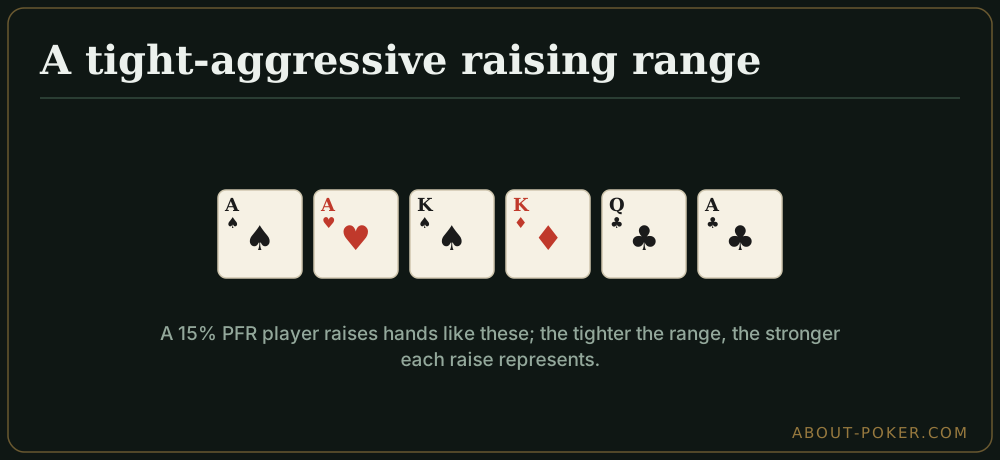
These are standard cash-game benchmarks:
- Under 10 percent (full ring): very passive, often a nit or a limper.
- 12 to 18 percent (full ring): the healthy tight-aggressive zone.
- 18 to 24 percent (six-max): the aggressive-but-solid range for shorter tables.
- 28 percent and up: hyper-aggressive; either a strong pro or a maniac, and the rest of their stats tell you which.
Higher numbers are correct at six-max for the same reason VPIP rises there: fewer opponents mean fewer strong hands to run into, so raising a wider range wins.
A Worked Example
You are tracking two opponents. Player A shows VPIP 20 / PFR 17. Player B shows VPIP 20 / PFR 5. Both play the same number of hands — but they could not be more different.
Player A raises almost everything they enter (the gap is only 3). They are applying pressure, taking initiative, and picking up pots uncontested. This is a textbook tight-aggressive regular, and you should respect their raises.
Player B enters just as many pots but raises almost none of them (a gap of 15). They are limping and calling their way in. Against Player B you raise larger to punish the limps, and you value-bet relentlessly postflop because they will call down with weak holdings. Same VPIP, opposite strategy — and PFR is the number that told you.
The VPIP–PFR Gap
Subtract PFR from VPIP and you get one of the most reliable single reads in the game:
- Gap of 0 to 4: aggressive, tough. Almost everything they play, they raise.
- Gap of 5 to 10: balanced, mixes some calling in. A normal solid player.
- Gap of 15 or more: passive, limp-and-call heavy. Usually a beatable recreational player.
The wider the gap, the more the opponent leans on calling — and calling ranges are far easier to exploit than raising ranges.
Why PFR Changes by Position
A single blended PFR number hides a lot. The same player should raise a very different share of hands depending on where they sit, and a good tracker lets you split PFR by seat.
From under the gun at a full-ring table you are raising into eight players still to act, so a disciplined regular opens only premium and strong hands — a positional PFR of maybe 8 to 12 percent. On the button, with only the two blinds left to act, that same regular correctly opens a much wider range: hands like K7 suited, Q9 suited, and small suited connectors all become profitable steals, pushing button PFR to 40 percent or higher.
So a blended PFR of 18 might come from a player raising 10 percent up front and 45 percent on the button — perfectly healthy — or from a player raising 18 percent from every seat, which means they are far too loose early and far too tight late. The blended number looks identical; the positional split tells you which player you are facing. When you can, read PFR by position before you decide how to attack an opponent’s opens.
PFR at Different Stack Depths
Stack depth quietly reshapes what a healthy PFR looks like. Deep-stacked cash play (100 big blinds or more) rewards a slightly tighter, more selective raising range, because postflop mistakes are expensive when there is a lot of money left to play for. Short-stacked play — a 20 to 40 big blind tournament stack, for instance — pushes correct PFR up, because raising to take the pot down preflop, or getting it in with a clear equity edge, matters more than fine postflop maneuvering.
This is why tournament regulars often show higher PFR than cash regulars at the same table size: as blinds rise and stacks shrink relative to the pot, open-raising and re-raising all-in become the dominant winning actions, and limping or flat-calling fades out. If you compare a cash player’s stats to a tournament player’s, adjust your benchmarks upward for the shorter stacks before you judge anyone as a maniac.
Common Mistakes
The first mistake is chasing PFR for its own sake. Raising more is not automatically better; raising the right hands from the right positions is what matters. A player who forces PFR up to 30 percent by opening trash from early position is bleeding chips, not printing them.
The second mistake, as with all preflop stats, is trusting a small sample. Over a few dozen hands PFR swings wildly with card luck. Give it a few hundred hands before you lean on it, and split it by position when your tracker allows — a player’s button PFR and their under-the-gun PFR describe two very different opponents.
Quick Checklist
- PFR counts only preflop raises, never limps, calls, or folds.
- PFR can equal VPIP but never exceed it.
- A small VPIP–PFR gap means aggressive; a large gap means passive.
- Expect higher PFR at six-max than at full ring.
- Judge whether the hands being raised are correct, not just the number.
Master the VPIP–PFR pairing and you can profile almost any opponent in a handful of orbits.
Frequently asked
What does PFR stand for?
PFR stands for Preflop Raise, or Preflop Raise percentage. It measures how often a player raises before the flop, shown as a percentage of hands dealt. It captures preflop aggression, the counterpart to the wider VPIP statistic.
What is a good PFR percentage?
In full-ring cash games a healthy PFR is roughly 12 to 18 percent. In six-handed games it runs higher, around 18 to 24 percent. Winning tight-aggressive players keep PFR close to their VPIP so most hands they play are raised, not just called.
Can PFR be higher than VPIP?
No. Every preflop raise is by definition a voluntary entry, so it also counts toward VPIP. That means PFR can equal VPIP at most but can never exceed it. If a tracker shows PFR above VPIP, the data sample is corrupted.
What does a big gap between VPIP and PFR mean?
A large gap means the player enters many pots by calling rather than raising. That is the passive, limp-and-call profile typical of weaker recreational players. A small gap signals an aggressive regular who raises almost everything they choose to play.