What Is Min-Cash in Poker?
Min-cash means finishing in the smallest paid spot of a tournament. Here's what the term means, why it barely covers your buy-in, and when chasing it costs.
On this page · 6 sections
Min-cash is poker shorthand for minimum cash — the smallest paid finishing position in a tournament. When a field of 500 players pays the top 70, the players who finish 70th, 69th, and just above the bubble all collect the min-cash: usually an amount barely larger than the buy-in they paid to sit down. You survived long enough to get paid, but the reward is small, and the mindset that chases it can quietly cost you money.
The exact definition
A tournament pays a shrinking pyramid of prizes. First place might take 20% of the whole pool, while the bottom paid spots split what’s left into small, nearly identical chunks. Those bottom spots are the min-cash. If a $100 tournament pays the last spots $180, that $180 is the min-cash — you’re up $80 on paper, but you already paid a registration fee (often $10 to $15 on top of the buy-in), so your true profit is thin.
The term is used two ways. As a noun: “I got a min-cash.” As a verb: “I was just min-cashing that whole run.” Either way it signals a result that avoided a loss without producing a real score.
A worked example
You register a $109 online tournament (that’s $100 to the prize pool plus $9 fee). The field is 1,000 players and the top 150 get paid. You grind for four hours and bust in 148th place. The payout for spots 141 through 150 is $165.
Do the math: you receive $165, but you paid $109 to enter. Your net profit is $56 for four hours of work — and that’s a winning result you’ll only hit a fraction of the time. Compare that to first place, which might pay $18,000. This is the core truth of tournament poker: the min-cash barely moves your bankroll, while a single deep run pays for dozens of buy-ins.
Why the min-cash warps decisions
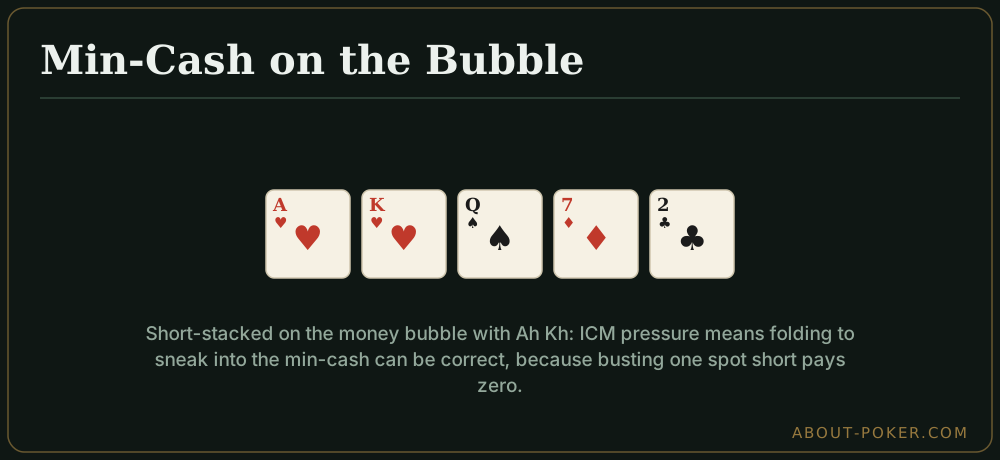
The bubble — the stretch just before the money — is the highest-pressure spot in any tournament. Bust one place before the min-cash and you win nothing after hours of play; survive one more elimination and you lock up a payout. That asymmetry makes short stacks fold hands they’d normally play, and it lets big stacks apply relentless pressure.
This is governed by ICM, the model that converts your chips into real-money equity. ICM explains why folding a decent hand near the bubble can be correct for a short stack: the risk of busting with zero payout outweighs the small chip gain from winning. But that same logic is what makes min-cashing a trap if you overdo it.
The min-cash trap
New tournament players often play the entire late game as if reaching the min-cash is the goal. They fold strong hands, refuse to gamble, and squeak into the money for a tiny profit again and again. It feels successful — you’re “cashing” — but it leaves the real money on the table.
Here’s the problem in numbers. Suppose you could either lock up min-cashes reliably or take more aggressive lines that bust you more often but occasionally run deep. Because the top three spots hold the overwhelming majority of the prize pool, one final-table run can be worth twenty or more min-cashes. A player who only min-cashes is winning the least valuable prize while avoiding the most valuable one.
When chasing the min-cash is actually right
Min-cash discipline isn’t always wrong. On a true bubble with a very short stack, folding to sneak into the money can be correct because the immediate jump from zero to a payout is large relative to your stack. Satellite tournaments — where every paid spot wins the same seat, similar to a freeroll into a bigger event — flip the logic entirely: there, min-cashing is the goal, because 1st place and the last paid spot win the exact same prize. Knowing which structure you’re in determines whether the min-cash matters.
A quick checklist
- Know the payout jumps. Look at how much each pay step is worth before the bubble; big jumps justify caution, flat jumps do not.
- Don’t fold your way to a min-cash with a healthy stack. If you have chips, keep accumulating — you’re playing for the top, not the bottom.
- Respect the bubble only when short. A short stack near the money can correctly fold hands a deep stack should play.
- In satellites, protect the min-cash. When every paid spot wins the same seat, survival is the entire strategy.
The min-cash is a floor, not a target. Treat it as insurance against a losing day, not as the reason you sat down. For more tournament terms, browse the full poker glossary.
Frequently asked
What does min-cash mean in poker?
Min-cash is short for minimum cash — finishing in the lowest-paying position in a tournament that still receives a payout. It usually returns roughly the same amount as your buy-in or slightly more, so you technically 'cash' but barely profit after accounting for the fee you paid to enter.
Is a min-cash good or bad?
It depends on your goal. A min-cash keeps you from losing money on the day, but tournament value comes overwhelmingly from the top few spots. Playing scared just to reach the min-cash usually costs you far more in missed top prizes than it saves.
How much is a typical min-cash?
In most tournaments the min-cash pays about 1.5 to 2 times the buy-in. After the fee you paid to register, your actual net profit on a min-cash is often close to zero or only a small amount.
Why do players fold near the min-cash?
Because of the money jump at the bubble. Just before the paid spots begin, busting means winning nothing, so short stacks tighten up dramatically to survive into the money — a pressure spot governed by ICM.