What Is Min-Defense in Poker?
Min-defense is the smallest fraction of your range you must continue with to stop a bettor auto-profiting on bluffs. Learn the MDF formula and a worked example.
On this page · 6 sections
Min-defense, usually written as minimum defense frequency or MDF, is the smallest share of your range you have to keep in the hand facing a bet so the bettor can’t print money by bluffing with any two cards. Fold more than that share and your opponent’s pure bluffs turn automatically profitable, whatever they’re holding.
The core idea behind min-defense
When someone bets, they’re risking a certain amount to win the pot. If you fold too often, their bluffs win the pot outright often enough that the specific cards in their hand stop mattering. Min-defense is the response frequency that makes a bluff break even, so a bettor gains nothing by choosing to bluff over checking.
Think of it as your side of a fairness deal. You’re not trying to beat the bettor’s value hands with junk. You’re trying to defend enough total combinations, calling or raising, that they can’t exploit you by firing air. The exact hands you keep should be your strongest continues: made hands, strong draws, and good bluff-catchers.
The MDF formula
The math is short. Min-defense frequency = pot ÷ (pot + bet).
- Against a pot-sized bet: 1 ÷ (1 + 1) = 50%. You must continue with half your range.
- Against a half-pot bet: 1 ÷ (1 + 0.5) ≈ 67%. You defend about two-thirds.
- Against a quarter-pot bet: 1 ÷ (1 + 0.25) = 80%. You defend four-fifths.
Notice the pattern: the smaller the bet, the more of your range you must keep. That’s intuitive once you see it. A tiny bet risks almost nothing to steal the pot, so you have to fight for it far more often. A big overbet risks a lot, so you’re allowed to fold plenty.
MDF is the mirror image of the bettor’s bluffing math. The bettor uses alpha — the fold percentage they need — to decide how often to bluff. Your MDF is simply one minus that number.
A worked example
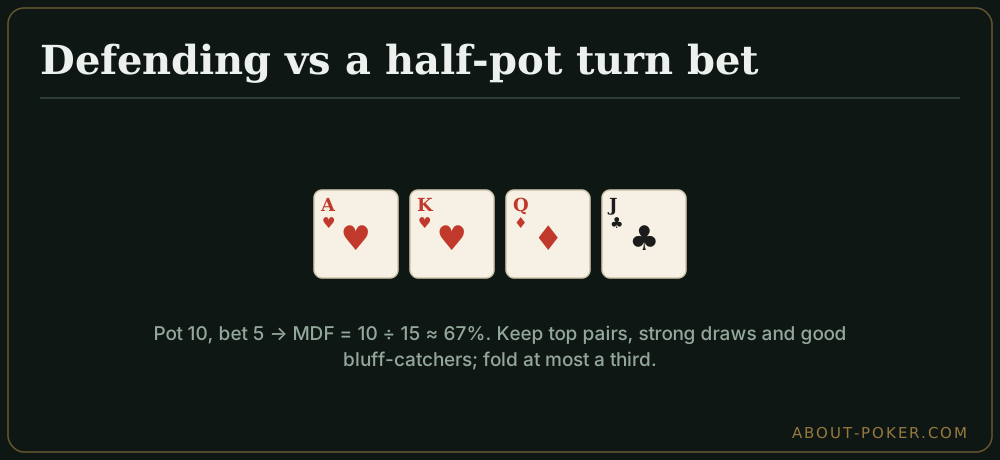
You raise pre-flop, get one caller, and the flop comes with a pot of 10 big blinds. Your opponent bets 5 bb on the turn, a half-pot bet.
MDF = 10 ÷ (10 + 5) = 10 ÷ 15 ≈ 0.67.
So you should continue with roughly 67% of the range you got to this spot with, and fold at most 33%. Suppose you arrived at the turn with 15 combinations. Folding more than about 5 of them lets your opponent bluff any card profitably. You’d keep your top pairs, your overpairs, your strong draws, and the better bluff-catchers, and let go of the truly hopeless holdings like busted low cards.
The 5 bb bluff risks 5 to win 10. It needs to work more than 5 ÷ 15 = 33% of the time. If you fold exactly 33%, the bluff breaks even and gains nothing. Fold 40% and every one of their bluffs is now profitable — that’s the leak MDF is designed to plug.
When min-defense matters most
MDF is a defensive tool against balanced or unknown opponents. Its whole logic assumes the bettor might be bluffing with any two cards. That’s why it shines against solid regulars and disappears against certain player types.
It also applies most cleanly when the bettor’s range is uncapped and could plausibly bluff a lot — big single bets, river spots, and against aggressive players. In multi-street situations, defending MDF on every street compounds, so you don’t need to hit the exact number on each one; you’re managing your range across the whole hand.
Common mistakes with MDF
- Treating it as a hard rule. MDF tells you the maximum you can fold without being exploited by pure bluffs. It does not force you to call bad hands when the opponent clearly under-bluffs.
- Applying it to short stacks or all-ins. When there are no future streets and no bluffs left to make, pot odds and your raw equity matter more than MDF.
- Defending with the wrong hands. Hitting 67% with your weakest 67% is a disaster. Keep the hands with the best equity and the best blockers, and fold the true air.
- Ignoring opponent tendencies. A player who never bluffs doesn’t earn your MDF. Fold more. A maniac earns extra defense.
Quick checklist for using min-defense
- Note the bet size relative to the pot.
- Compute MDF = pot ÷ (pot + bet).
- That’s the share of your range to keep — call or raise, not fold.
- Choose the specific hands from the top: made hands, strong draws, good blockers.
- Adjust: defend less versus under-bluffers, more versus over-bluffers.
Learn MDF cold, then learn when to break it. The number keeps you unexploitable; reading your opponent lets you profit.
Frequently asked
What is min-defense in poker?
Min-defense, short for minimum defense frequency (MDF), is the smallest portion of your range you must keep in play against a bet so that the bettor cannot profit by betting any two cards as a bluff. If you fold more often than MDF, pure bluffs become automatically profitable.
How do you calculate minimum defense frequency?
MDF equals pot ÷ (pot + bet). For a pot-sized bet the math is 1 ÷ (1 + 1) = 50%, so you defend half your range. A half-pot bet gives 1 ÷ (1 + 0.5) = about 67%.
Should I always defend at exactly MDF?
No. MDF is a defensive baseline against unknown or balanced opponents. Against players who under-bluff you can fold more, and against players who over-bluff you should defend more. It is a starting point, not a law.