Bad Bankroll Habits
The bad bankroll habits that quietly bust winning cash players — playing too high, no cash-out plan, mixing money, and chasing losses. Fix them here.
On this page · 6 sections
Most players who go broke at poker are not bad at poker. They are bad at protecting the money that lets them keep playing. You can beat 2/5 for a solid win rate and still bust if your bankroll habits are sloppy, because variance is brutal and a few bad decisions with money can undo months of good decisions with cards. This is the leak nobody sees on the felt.
Below are the bad bankroll habits that quietly destroy otherwise competent grinders, and the concrete fixes for each one.
Playing stakes that are too high for your roll
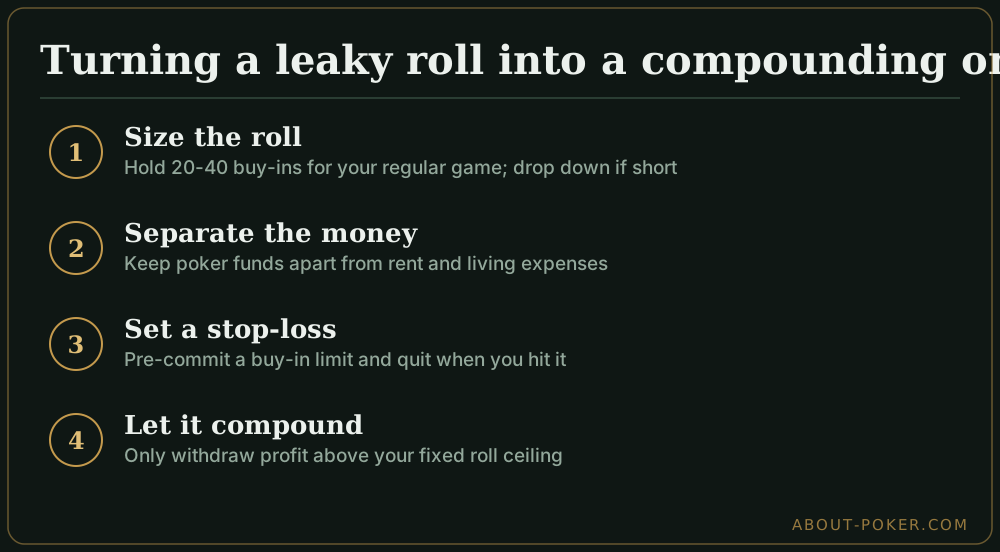
This is the mother of all bankroll leaks. A conservative rule for cash games is 20-40 buy-ins for the game you play regularly — closer to 40+ if you play deep, high-variance, or aggressive tables. If you have $4,000 and you sit down in a $2/5 game with a $500 buy-in, you are playing on eight buy-ins. That is not a bankroll; that is a coin flip with your poker life.
Here is why it matters. Even a strong winner in a soft game runs a real risk of a 10-15 buy-in downswing over a normal stretch. If your entire roll is only eight buy-ins, a completely normal cold streak busts you before your edge ever has time to show up. Proper sizing is covered in depth in our cash game bankroll management guide, and it is the single fastest habit to fix.
Having no cash-out or reload discipline
Two opposite bad habits live here. The first is the player who withdraws every winning session to spend it, so the bankroll never grows and they are stuck at 1/2 for years. The second is the player who has no separation between poker money and life money at all — rent, groceries, and buy-ins all come from the same account.
The fix is a fixed bankroll number that lives in a dedicated account or a clearly separated stack. You only withdraw money above that ceiling. If your roll target is $6,000 and you climb to $7,200, you can take out $1,200 guilt-free. Everything under $6,000 stays working. This turns poker into something that compounds instead of something that leaks.
Chasing losses and ignoring your stop-loss
The classic scene: a player is stuck three buy-ins, so they buy in for a fourth, then jump to the bigger game to “win it back faster.” This is where a losing night becomes a catastrophe. Chasing is an emotional response, not a strategic one, and it almost always coincides with your worst play of the session.
The fix is mechanical. Set a stop-loss in buy-ins before you sit down — say, three buy-ins — and quit when you hit it, full stop. A pre-committed rule removes the in-the-moment decision, which is exactly when your judgment is worst. If you find that stop-losses feel like giving up, remember that the money is still there tomorrow when you are playing your A-game. Understanding normal downswing length makes it much easier to stomach a losing session as noise rather than emergency.
Moving up too fast and refusing to move down
Ambition without discipline is a leak. Winning a couple of big sessions at your stake does not mean you are rolled for the next one up. A shot at higher stakes should be planned: a set number of buy-ins earmarked for the attempt, and a clear rule that if you lose that amount, you drop back down. The refusal to move back down when the roll shrinks is just as damaging as moving up too early.
The healthy version treats stakes as fluid. If your $8,000 roll for 2/5 drops to $4,500, you swallow your pride and play 1/2 until you rebuild. Ego costs more money in this game than any specific hand.
A worked example: two players, same win rate
Consider two winners at 1/2, both true 5 big-blind-per-100 winners over a large sample. Player A keeps a strict 30-buy-in roll ($6,000), stop-losses at three buy-ins, and only withdraws above $6,000. Player B plays on 8 buy-ins, chases losses, and withdraws every win.
Over a rough three-month stretch both hit a normal 12-buy-in downswing. Player A dips to 18 buy-ins, feels annoyed, and keeps grinding — completely fine. Player B is busted before the downswing even finishes, despite having the identical skill edge. Same cards, same win rate, wildly different outcomes. The difference is entirely bankroll habits. This is why variance planning is a skill in its own right.
A quick self-audit checklist
- Do you have at least 20-30 buy-ins for your regular game right now? If not, drop down.
- Is your poker money physically or mentally separated from your living expenses?
- Do you have a stop-loss number, and do you actually honor it?
- Do you have a written shot-taking plan with a move-down trigger?
- When you win, does your roll grow, or does it all get withdrawn?
If you answered “no” to two or more of these, your biggest edge this month is not in your postflop play — it is in fixing the money habits above. The felt rewards patience twice: once in how you play the cards, and once in how you protect the stack that lets you keep sitting down.
Frequently asked
What is the most common bad bankroll habit?
Playing stakes that are too high for your roll. A cash player wants at least 20-40 buy-ins for their normal game; risking a large chunk of your bankroll in one session turns normal variance into a genuine chance of going broke, even when you are a winning player.
Is it bad to keep taking money out of my bankroll?
Withdrawing every winning session prevents your roll from ever growing, so you stay stuck at the same stakes forever. Set a fixed roll size, only withdraw profit above that number, and let the rest compound so you can eventually take shots at higher games.
How do I stop chasing losses at the table?
Use a hard stop-loss — a set number of buy-ins that ends your session no matter what. Chasing losses is an emotional decision, not a strategic one, so removing the decision entirely with a pre-committed rule is the most reliable fix.