Beating $5/$10 Live Cash
$5/$10 live cash is deep, straddled, and full of loose-passive money. Beat it with disciplined preflop play, deep-stack pot control, and relentless value.
On this page · 7 sections
Live $5/$10 no-limit is one of the softest games relative to its stakes anywhere in poker. The blinds match online 200NL, but the similarity ends there. Live tables run deep — often 200 to 300+ big blinds — play slower, feature frequent straddles, and are packed with loose-passive recreationals who limp, call, and pay off big hands. To beat it you tighten up preflop, lean on your positional and deep-stack edge post-flop, and value bet relentlessly against players who cannot fold.
Understand the live $5/$10 ecosystem
Two structural facts define the game. First, it is deep: many rooms have no max buy-in, so you routinely play 250bb+ effective. Second, it is loose-passive: recreationals see too many flops, limp behind, and call down light while rarely bluffing or raising without a real hand. That combination is a gift. Deep stacks mean your positional edge compounds across streets, and passive opponents mean your value bets get paid while your bluffs are cheap to abandon.
Your job is to funnel money from the recreational players into your stack while avoiding coolers against the handful of competent regulars. If you are new to the live dynamic, start with the fundamentals in live cash game poker strategy before layering in the deep-stack adjustments below.
Tighten preflop, then punish the limpers
The single most common live leak is playing too many hands out of position. In a game where three or four players limp every hand, your discipline is a weapon.
- Isolate limpers aggressively. When two players limp, raise to 5–6bb plus one big blind per limper. A pot of $30–$60 preflop with position on a passive caller is exactly the setup you want.
- Play tight from early position. With deep money and multiway pots, dominated hands cost you far more than they do online. Fold your ace-rag and weak offsuit hands up front.
- Value your suited and connected hands. Deep stacks reward hands that flop big — suited aces, suited connectors, and pairs that can set-mine profitably against loose callers.
Handle the straddle
Straddles are everywhere at live $5/$10. A single $20 straddle doubles the effective blind and deepens everyone in big-blind terms, which loosens the game and increases variance. Do not straddle yourself out of habit — it is a losing bet that donates dead money and puts you out of position. When others straddle, treat the straddle as the new big blind: your opening sizes scale up, and you tighten slightly because you are effectively shallower in bb terms while the pots are bigger in dollars. The full mechanics are covered in handling straddles.
A worked deep-stack hand
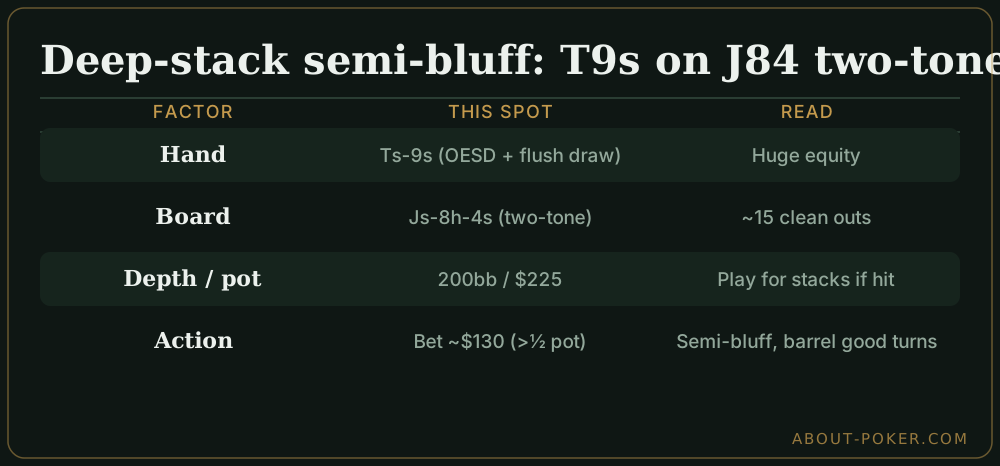
You have Ts-9s on the button with $2,000 effective (200bb). Two recreationals limp, you raise to $70, and both call — a $225 pot. The flop is Js-8h-4s: you have an open-ended straight flush draw with two overcards to the eight, roughly 15 clean outs and huge equity.
Both players check. Bet around $130 (a bit over half pot). You are semi-bluffing with enormous equity: you can win immediately, you improve to the nuts often, and you build a pot you want to play deep. If a spade or a seven or a queen lands on the turn, you barrel again for real value and can get stacks in with the deck in your favor. This is the heart of deep-stack cash game strategy — play hands that can win big pots, and apply pressure when your equity and your fold equity point the same direction.
Deep-stack pot control
Deep stacks cut both ways. The same depth that lets you win 250bb also lets you lose it. Discipline is essential:
- One pair is rarely worth stacks at 250bb. Top pair top kicker is a strong hand, not a get-it-all-in hand. Bet for value, but slow down when a passive player raises the turn or river — they almost never do it light.
- Respect the passive player’s aggression. When a limp-caller who has not raised all session suddenly check-raises, believe them. Folding a good-but-not-great hand there is where live mid-stakes profit is protected.
- Set-mine and draw with implied odds in mind. Deep money makes speculative hands more valuable because the payoff when you hit is enormous.
Common $5/$10 leaks
- Playing too loose from early position in multiway limped pots.
- Straddling for “action” and bleeding dead money out of position.
- Stacking off with one pair 250bb deep against a suddenly aggressive nit.
- Bluffing calling stations who have already shown they never fold.
- Skipping game selection when a whale is at another table.
Your live $5/$10 checklist
- Isolate limpers with position; fold weak, dominated hands up front.
- Treat straddles as the new big blind and don’t straddle yourself.
- Chase big pots with hands that flop big; set-mine and draw with the deep-stack payoff in mind.
- Cap one-pair hands when passive players wake up with aggression.
- Value bet relentlessly against loose-passive callers; bluff them rarely.
- Find and stay in the game with the softest recreational players.
Frequently asked
How deep are stacks in a $5/$10 live game?
Live $5/$10 games are typically played 100 to 300+ big blinds deep, far deeper than the 100bb online norm. Many rooms have no maximum buy-in, and straddles push effective stacks even deeper, so post-flop deep-stack skill matters enormously.
What win rate is realistic at live $5/$10?
Strong live mid-stakes winners make roughly 5–10 bb/hour, though live win rates are noisy over small samples. In dollar terms that is about $50–$100 an hour, driven mostly by the loose-passive recreational players who fund the game.
Is $5/$10 live easier than online 200NL?
The blinds match 200NL online, but live $5/$10 usually plays much softer and much deeper. The pace is slower, the fields are looser and more passive, and the money runs deeper, so it rewards patience and post-flop reads over raw preflop precision.