Bluffing Too Much
Over-bluffing burns money fast at low stakes. Learn how to pick bluffs with the right board, blockers, and opponents — and when the profitable play is simply.
On this page · 7 sections
Once a player learns that bluffing is a real weapon, the pendulum often swings too far. Over-bluffing feels bold and skillful, but at low stakes — where opponents call far too much — it’s one of the fastest ways to spew a stack. A bluff is only profitable when your opponent folds often enough to justify the risk, and that condition is rarer than most players think.
The one condition a bluff must meet
A bluff makes money for exactly one reason: your opponent folds a better hand often enough. The break-even math is simple. If you bet the size of the pot, your opponent must fold more than 50% of the time for the bluff to profit. Bet half the pot and they only need to fold about 33% of the time. Bet twice the pot and they need to fold about 67%.
So before you bluff, the real question is: will this specific opponent, on this specific board, fold often enough to clear that bar? If you’re firing a pot-sized river bet at a player who folds maybe 20% of the time, you’re lighting money on fire no matter how good the “story” feels. Bluffing frequency should be a response to fold equity, not a personality trait.
Never bluff a calling station
The most expensive over-bluffing happens against players who don’t fold. A calling station will look you up with bottom pair, ace-high, even king-high — so your bluffs simply don’t get through. Against these players, the winning strategy flips entirely: bet your value hands relentlessly and almost never bluff.
This is the single biggest adjustment at low stakes, because the tables are full of stations. If you find yourself bluffing a player who has called three streets light before, stop. Value bet them into oblivion instead — that’s the whole thesis of playing against calling stations. Ironically, the antidote to bluffing too much is often the same discipline as calling too much: read the specific opponent, not the textbook.
Pick boards that favor your range
Good bluffs happen on boards where you credibly could have the strong hands you’re representing. If you raised preflop and the flop comes A♦K♠7♣, you represent big aces and kings believably — a bluff here has weight. If the flop comes 8♥7♥6♣, a board that smashes the caller’s range far more than yours, your bluff is walking into a wall of made hands and draws that won’t fold.
A worked example: you open A♠5♠ and get one caller. The flop is Q♦7♣3♥ — dry, disconnected, and favoring your range because you have all the strong queens and overpairs. A continuation bet here is a strong bluff (with backup outs to a spade flush or a wheel). Compare that to the same hand on 9♥8♥6♣, where a bet runs into pairs, straights, and heavy draws. Same cards, completely different bluff. The cash game c-bet strategy guide details which flops to fire on.
Use blockers and backup equity
The best bluffs do double duty. Blockers are cards in your hand that reduce the chance your opponent holds a strong hand — for example, holding the A♠ on a three-spade board makes it far less likely your opponent has the nut flush, so a bluff is more likely to get through. Semi-bluffs add another layer: when you bluff with a draw, you can still win by hitting even if you get called.
Bluffing with a stone-cold nothing hand that has no blockers and no way to improve is the weakest form of the play. Whenever possible, choose bluffs that either block your opponent’s calling hands or can back into a winner. This makes your aggression far more efficient than bluffing with random air.
Multiway pots kill bluffs
Bluffing into multiple players is one of the clearest over-bluffing mistakes. With three or four opponents, the chance that at least one of them has a hand strong enough to call skyrockets, so your fold equity collapses. A bluff that works heads-up 60% of the time might get through only 20% of the time three-way.
The rule is simple: bluff far less, or not at all, in multiway pots. Save your aggression for heads-up situations where you only have to get one player to fold. If two or more opponents are still in, lean toward value betting your genuinely strong hands and giving up your air.
Bluffing on tilt or out of boredom
The last, most human leak: bluffing for the wrong reasons. After a bad beat, or during a card-dead stretch, players start firing bluffs to “make something happen.” These bluffs aren’t chosen for board, blockers, or opponent — they’re emotional, and they’re consistently unprofitable. If you catch yourself bluffing because you’re frustrated or bored rather than because the spot is right, that’s your cue to check and fold.
The stop-over-bluffing checklist
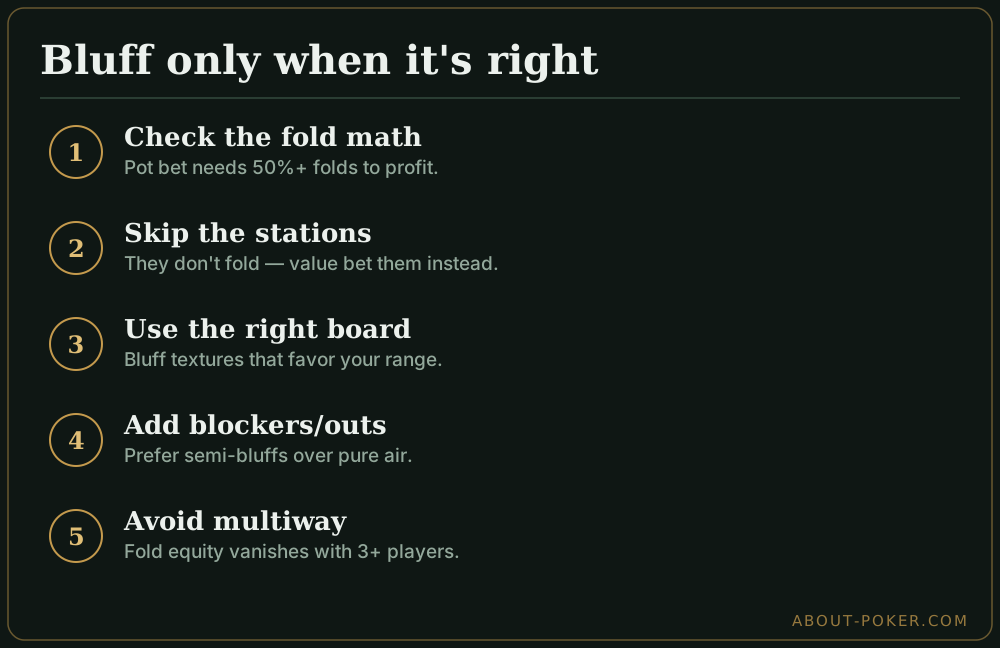
- Confirm the opponent folds often enough to beat the break-even math.
- Never bluff calling stations — value bet them instead.
- Bluff on boards that favor your range, not your opponent’s.
- Choose bluffs with blockers or backup outs over pure air.
- Bluff far less, or never, in multiway pots.
- Never bluff out of tilt, boredom, or frustration.
Bluffing is a scalpel, not a hammer. Used selectively it wins pots; used constantly it hands your stack away.
Frequently asked
Is bluffing too much a common poker leak?
Yes, especially among improving players who have learned that bluffing is 'part of the game' and overdo it. At low stakes, where opponents call too much, over-bluffing is one of the fastest ways to lose money. Bluffs only work when opponents fold enough.
When should I bluff in poker?
Bluff when your opponent can realistically fold, the board favors your range, you hold blockers to their strong hands, and your bluff can improve if called. Avoid bluffing calling stations, multiway pots, and boards that hit your opponent's range hard.
How do I know if I'm bluffing too much?
If your bluffs keep getting called, if you're firing at players who never fold, or if you bluff mainly out of frustration or boredom, you're over-bluffing. Track how often your river bluffs actually take the pot; too many showdowns after big bets is the tell.