Cash Game Bluff Frequencies
Correct bluff frequencies for cash games: bluff-to-value ratios by street, how bet size sets the ratio, MDF, and a worked river example with the math.
On this page · 6 sections
Most losing players either bluff far too much or never bluff at all. Winning players bluff at roughly the right frequency for the situation — and that frequency is not a feeling, it is a number tied to your bet size. This guide covers the bluff-to-value ratios that keep you unexploitable by street, why bet sizing drives them, and when to throw balance out the window.
The core idea: bluffs are priced by your bet size
When you bet, you offer your opponent a price to call. That price determines how often you are allowed to be bluffing before calling becomes automatically profitable or automatically losing for them. The bigger you bet, the worse the price you lay, and the more bluffs you can include while remaining balanced.
The river math is clean because there are no more cards to come. For a bet of size B into a pot of size P, the balanced fraction of bluffs in your betting range is B divided by (P + 2B) — but you do not need to memorize the formula. Just anchor on three numbers: a pot-sized bet is about one-third bluffs, a half-pot bet is about one-quarter bluffs, and an overbet climbs above a third. Everything else interpolates.
Bluff-to-value ratios by street
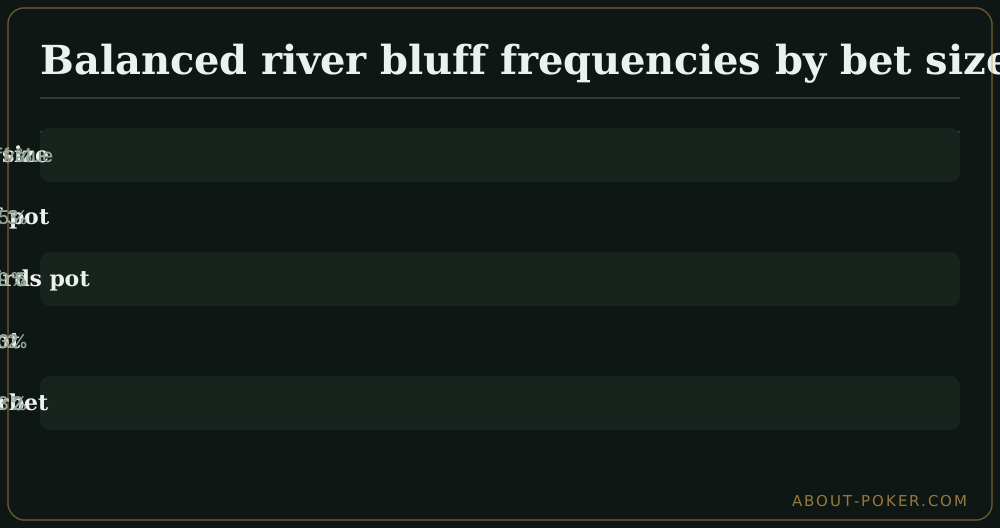
On the river, express it as a ratio. A pot-sized bet should be about 1 bluff for every 2 value bets (33% bluffs). A half-pot bet should be about 1 bluff for every 3 value bets (25% bluffs). These are the numbers that make your opponent indifferent to calling with a bluff-catcher.
Earlier streets carry more bluffs, not fewer. On the flop and turn you have extra bluffs because many of them are semi-bluffs — draws with real equity that can improve to the best hand. A flop continuation-betting range is often 40-50% bluffs, and it narrows toward the river number as draws either complete or die. The practical takeaway: fire your draws and backdoor equity earlier, then give up the ones that bricked rather than barreling every one to the river. Barreling everything is the classic route to bluffing too much.
MDF: the other side of the coin
Frequencies work both ways. When you face a bet, Minimum Defense Frequency (MDF) tells you how often you must continue so your opponent cannot profitably bluff any two cards. MDF equals pot divided by (pot plus bet). Against a pot-sized bet, MDF is 1 ÷ 2 = 50%, so you defend half your range. Against a half-pot bet, MDF is 2 ÷ 3 = about 67%.
MDF and bluff frequency are mirror images: your bluffing frequency is built to punish an opponent who defends less than MDF, and their MDF is built to stop your bluffs from auto-profiting. Understanding both is central to solid cash game river play, where the stakes of getting the ratio wrong are highest.
A worked river example
The pot is 100 on the river and you bet 100 (pot-sized). To stay balanced you want about one-third of that betting range to be bluffs — roughly 1 bluff for every 2 value bets. Say you have 6 value combos you are betting; you add about 3 bluff combos, giving 9 total: 6 value, 3 bluffs.
Now check the opponent’s side. You are laying them 2-to-1 (they risk 100 to win 200). They need to be right 33% of the time to break even. With your range at one-third bluffs, exactly one-third of the time they win — so they are indifferent, and you cannot be exploited whether they call or fold. If you had instead added 6 bluffs (9 value… no, 6 value and 6 bluffs, a 50/50 range), you would be bluffing too often; a thinking opponent snap-calls every bluff-catcher and prints against you.
When to abandon balance
Balanced frequencies assume a competent opponent who folds correctly. Most cash-game villains do not. Against a calling station who never folds, cut your bluffs toward zero and bet almost purely for value — bluffing a player who does not fold is lighting money on fire. Against a nit who over-folds, do the opposite: bluff far more than the balanced number, because every fold is free money.
Balance is your default when you have no read or you face a strong regular. Against everyone else, deviate toward the exploit. This is why disciplined players pair correct bluff frequencies with relentless thin value betting — bluffing where it works, value-betting where it works, and never confusing the two.
Quick reference checklist
- Pot-sized river bet: about 33% bluffs (1 bluff : 2 value).
- Half-pot river bet: about 25% bluffs (1 bluff : 3 value).
- Flop/turn: more bluffs, mostly semi-bluffs with equity — then give up bricked draws.
- Facing a bet: defend at MDF = pot ÷ (pot + bet).
- Vs calling stations: slash bluffs toward zero. Vs nits: bluff more than balanced.
Get the ratio roughly right and your bets become unreadable; ignore it and you either bleed chips into calls or leave value on the table. Frequencies are the scaffolding — reads tell you when to bend them.
Frequently asked
What is the correct bluff-to-value ratio on the river?
It depends on your bet size. A pot-sized river bet should be roughly half bluffs and half value (1 bluff for every 2 value bets). A half-pot bet uses fewer bluffs — about 1 bluff for every 3 value bets. Bigger bets lay your opponent worse odds, so they justify more bluffs.
How does bet size change bluffing frequency?
Bigger bets give the caller worse pot odds, which lets you bluff more often while staying balanced. A pot-sized bet supports about 33% bluffs, a half-pot bet about 25%, and an overbet more than a third. Size and bluff frequency move together.
Should I bluff less against calling stations?
Yes. Balanced frequencies assume a thinking opponent who folds correctly. Against a calling station who never folds, you should slash your bluffs toward zero and bet almost purely for value. Balance is a default; exploiting bad players beats it.