Cash Game Preflop Charts
Position-by-position preflop charts for 100bb cash games: opening ranges, 3-bet ranges, and blind defense — plus how to actually use them at the table.
On this page · 7 sections
Preflop is where the majority of small-stakes mistakes happen, and it is the easiest street to fix with study. A good set of charts tells you which hands to open, 3-bet, call, and fold from every seat. Get these decisions right and you enter far more pots with the range advantage that makes postflop play easy.
Why charts matter more than any postflop tip
Every hand starts preflop, so a preflop error compounds on every later street. If you open a dominated hand from early position, no amount of clever river play rescues the spot. Charts give you a repeatable, solver-informed baseline so you stop guessing. They are the foundation the rest of your game is built on, which is why the cash game preflop strategy guide treats them as step one.
The charts below assume a 6-max 100bb cash game with a standard 2.5bb open. Six-handed is the most common online format; full-ring simply tightens the early seats.
Opening (RFI) ranges by position
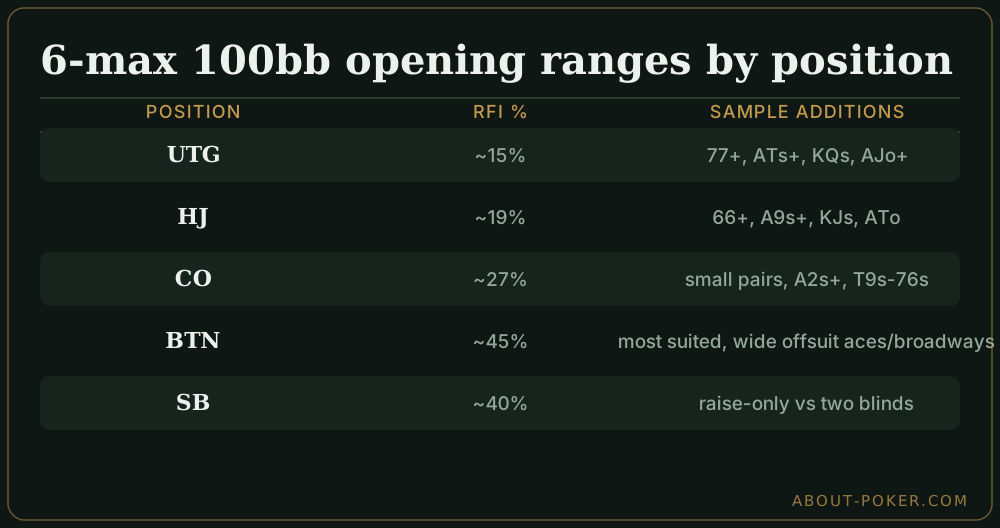
Raise-first-in ranges widen as you move closer to the button. Here is the rough hand-count percentage most winning ranges use:
- UTG: ~15% — 77+, ATs+, KQs, AJo+, KQo, plus a few suited connectors
- HJ (MP): ~19% — add 66+, A9s+, KJs, QJs, ATo
- CO: ~27% — add small pairs, A2s+, most suited broadways, T9s-76s, KTo+
- BTN: ~45% — most suited hands, all pairs, wide offsuit broadways and aces
- SB: ~40% (raise-only strategy) — wide, because you’re stealing against two blinds
Notice the jump from cutoff to button. That single seat of position roughly doubles your opening range, which is why late-position play drives most of your win rate.
3-bet ranges
Your 3-betting range is split into two parts: linear (strong hands for value) and polarized (value plus bluffs). Against an early open, 3-bet tighter and more linearly — QQ+, AK for value, with a few suited blockers like A5s and KJs as bluffs. Against a late-position steal, widen considerably: add JJ-99, AQ, and more suited-ace and suited-connector bluffs.
A useful anchor number: against a button open you can 3-bet roughly 10-13% of hands from the blinds, mixing value and bluffs. For the full logic on sizing and frequency, see 3-betting in cash games.
A worked example of chart use
You’re in the cutoff with A5s. The under-the-gun player opens to 2.5bb. Do you 3-bet, call, or fold?
Consult the chart. A5s is not a flatting hand against a tight UTG range — flatting invites the button and blinds to squeeze and you’re often dominated. But A5s is a premium 3-bet bluff: it blocks AA and AK, has the nut flush and wheel potential, and folds out worse. So the chart says 3-bet. You make it 8bb, UTG folds, and you pick up the pot with zero postflop risk — exactly the outcome a good chart is engineering.
Now flip it: same A5s, but you’re in the big blind and the button opens. Here the chart says call is fine and 3-bet is a fine mix — the price is good, you close the action, and A5s realizes equity well against a wide button range.
Blind defense
The big blind gets a discount because you’ve already posted, so your defense range is very wide against late-position steals — often 40%+ of hands versus a button min-raise. But “defend” doesn’t mean “call everything.” Offsuit trash still folds, and your strongest defends should 3-bet rather than flat to avoid playing a passive, capped range out of position.
The small blind is the trickiest seat. Playing a raise-or-fold strategy (no flatting) keeps you out of dominated, out-of-position messes. For a printable grid you can memorize, the poker cash game hand chart lays these out visually.
Common charting mistakes
- Treating charts as gospel. They are a baseline for a “reg-heavy” pool. Against weak, passive players, tighten your bluffs and widen your value.
- Ignoring the raiser’s position. 3-betting AJo is fine versus a button steal and a leak versus a UTG open.
- Flatting too much from the small blind. Out of position against the big blind, calls bleed money; raise or fold.
- Not adjusting for stack depth. Charts assume 100bb. Deeper, tighten offsuit aces and add suited connectors; shorter, drop implied-odds hands.
- Memorizing 3-bet charts before opening charts. Learn to open correctly first — it’s where most volume and most leaks live.
How to actually learn them
Don’t try to swallow every chart at once. Master one opening range per position group, drill it until it’s automatic, then add 3-bet and defense layers. Review your played hands weekly against the charts to catch drift. Within a few weeks the grids move from a printout beside your screen to instinct — and your preflop leaks disappear.
Frequently asked
What is a preflop chart in poker?
A preflop chart is a grid or table that tells you which starting hands to open-raise, 3-bet, call, or fold from each position. It converts solver-approved ranges into a reference you can memorize and apply consistently at the table.
Are cash game preflop charts different from tournament charts?
Yes. Cash charts assume roughly 100bb effective stacks and no antes, so they favor raise-or-fold play with wider late-position opens. Tournament charts change constantly with stack depth and ICM, and include push-fold ranges that cash games rarely need.
How wide should you open from the button?
In a 6-max 100bb game, a solid button opening range is around 40-50% of hands — most suited hands, all pairs, most offsuit broadways, and many offsuit connectors. The button is the most profitable seat precisely because you can open this wide with position.
Should beginners memorize preflop charts?
Yes, but start simple. Learn one opening chart per position group first, then layer in 3-bet and defense charts. Charts remove the biggest early leaks — playing too many hands from early position and defending blinds incorrectly.