How to Beat 200NL Cash Games
200NL ($1/$2 online) is where casual leaks stop paying. Beat it with a solid range-based default, disciplined 3-bet pots, and ruthless table selection.
On this page · 7 sections
To beat 200NL — $1/$2 no-limit hold’em online with a $200 buy-in — you need a genuinely solid, range-based default and the discipline to apply it while still hunting relentlessly for the weakest players at the table. This is the first mid-stakes level where the “just value bet the calling stations” plan from the micros stops carrying you. Most regulars here have studied, so your edge comes from small, repeated advantages: cleaner preflop ranges, better 3-bet-pot play, and picking games where at least one recreational is dumping chips.
Why 200NL is a real step up
At 2NL through 50NL you print money mostly by out-valuing opponents who never fold. By 200NL the population has thinned out the worst leaks. Regs open sensible ranges, defend their big blind, barrel turns with equity, and punish your mistakes. You can no longer bluff never and value bet always — that plan gets exploited by players who fold correctly and float you in position.
Your profit now comes from two places: the recreational players who still fund the ecosystem, and the small technical edges you hold over the weaker regulars. The single biggest lever is still game selection, which matters more here than any individual hand you play. If you want a deeper framework for that, read table selection and seat selection — it is the highest-EV skill at this level, full stop.
Build a solid, range-based default
You cannot wing 200NL. Adopt a modern, positionally aware opening scheme and stick to it:
- Open around 2.2–2.5bb from most positions, tightening as you move earlier. UTG at a 6-max table opens roughly the top 15–18% of hands; the button opens 45%+.
- 3-bet a linear-to-polar mix depending on the opener. Against a tight UTG raiser your 3-bet range is value-heavy (JJ+, AQ+, plus a few suited bluffs). Against a loose button open you widen considerably.
- Defend your big blind with the correct price. Facing a 2.5bb open getting better than 3.5-to-1, you continue with a wide range because you only need about 22% equity to call profitably before rake.
The point of a default is that it frees your attention. When your baseline is automatic, you can spend your energy noticing who is deviating and how to punish them.
A worked hand: a 3-bet pot out of position
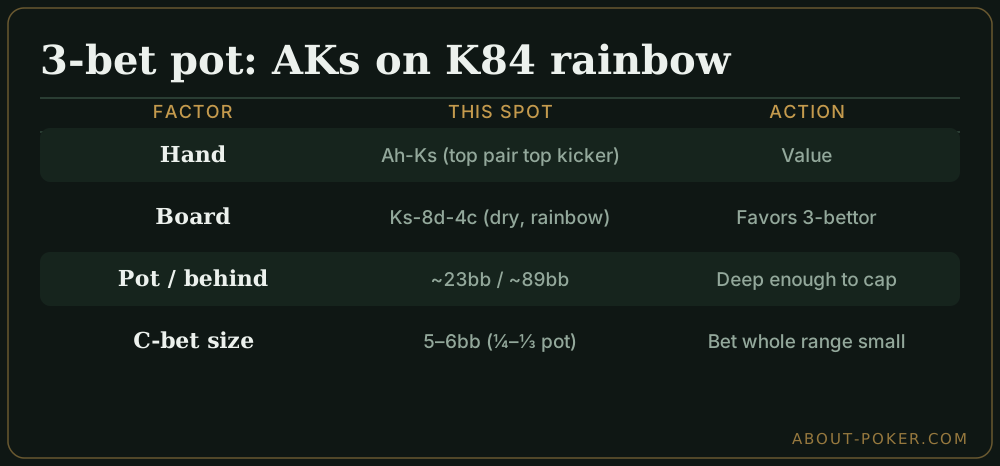
You defend the big blind with Ah-Ks after a cutoff reg opens to 2.5bb and you 3-bet to 11bb; they call. The flop comes Ks-8d-4c and the pot is roughly 23bb with about 89bb behind. You have top pair, top kicker on a dry board.
Bet small — around 5–6bb, a quarter-pot to third-pot c-bet. On this dry king-high texture you can bet your entire range for a small size because your opponent has very few strong hands and cannot profitably raise. The small sizing keeps their weak pairs and floats in, denies equity to overcards, and sets up a turn barrel. If you fire a large bet instead, you fold out exactly the hands you beat and only get called by better. This is the core of good 3-bet pot play in cash games: match your size to the board, not to your hand’s absolute strength.
Adjust to opponent types
- vs. tight-passive regs: attack their over-folding. They fold too much to 3-bets and to double barrels on scary turns. Bluff more than your baseline.
- vs. loose-aggressive regs: tighten your bluff-catchers, let them barrel into you, and call down more when the board favors your range. Do not get into leveling wars — pick spots where you clearly have the range advantage.
- vs. recreationals: revert to the micro plan. Value bet bigger, bluff less, and isolate them in position whenever you can. These players are why the game is beatable; do not let a reg’s aggression distract you from the fish.
Common 200NL leaks
- Overplaying top pair in 3-bet pots. Stacks are deep enough that one pair is rarely worth 200bb. When the money goes in on a coordinated board, a lone top pair is usually behind.
- Auto-continuation-betting. Regs check-raise and float. Check back more of your medium-strength hands and give up on boards that smash their range.
- Ignoring rake on multiway limped pots. Even at 200NL, cap-per-pot rake shaves your edge in small multiway pots. Raise to thin the field rather than limping along.
- Playing every table the same. Your win rate is dominated by which seats you take. Leave games with no recreational player.
Bankroll and mindset
Mid-stakes variance is deeper than the micros because opponents fight back and pots get contested to the river. Keep at least 30 buy-ins ($6,000) and treat 50+ ($10,000) as the comfortable professional number. Review the fundamentals in cash game bankroll management before you take a shot. Move down without ego if you dip below your threshold — protecting your roll is part of the edge.
Your 200NL checklist
- Play a studied, position-based opening and 3-betting scheme by default.
- Size c-bets to the board texture, not to how strong you feel.
- Cap your top pairs when deep money goes in on wet boards.
- Punish tight regs’ over-folding; respect loose regs’ aggression.
- Never sit or stay in a game without a clear recreational target.
- Keep 30+ buy-ins and move down before variance forces you to.
Frequently asked
What stakes is 200NL?
200NL is a no-limit hold'em cash game with a $200 maximum buy-in, played at $1/$2 blinds online. It sits in the mid-stakes bracket above 100NL and is the first level where a large share of regulars have a competent, range-based baseline strategy.
What win rate is realistic at 200NL?
A strong winner at 200NL earns roughly 3–6 bb/100 over a large sample, which is about $6 to $12 per 100 hands. Anything above that over tens of thousands of hands is exceptional and usually means excellent table selection rather than raw edge.
How big a bankroll do I need for 200NL?
Plan for at least 30 buy-ins ($6,000) as a working minimum and 50+ buy-ins ($10,000) if you play professionally. Mid-stakes swings are deeper than micros because opponents fight back, so the extra cushion matters.