How to Beat 50NL Cash Games
Beat 50NL where regs are competent: tighten ranges, balance your lines, attack limps and weak regs. Opening chart, a worked turn hand, and the leaks that stall you.
On this page · 7 sections
To beat 50NL — the $0.25/$0.50 online cash level — you play a tight, aggressive, and genuinely balanced game against a field of competent regulars, while still ruthlessly attacking the recreationals who float through. This is low stakes proper: most opponents have a plan, so your edge comes from cleaner ranges, better balance, and superior hand-reading rather than the raw value-betting that carried you through the micros.
The 50NL field is real
Unlike the micros, the majority of your 50NL opponents are thinking regulars who c-bet with a plan, defend their blinds, and punish predictable play. There are still fish — and they remain the biggest source of profit — but you can no longer autopilot a value-only strategy. Carrying forward the “two games at one table” mindset from beating 25NL is essential, but now the reg game demands more precision.
Opening ranges for 50NL
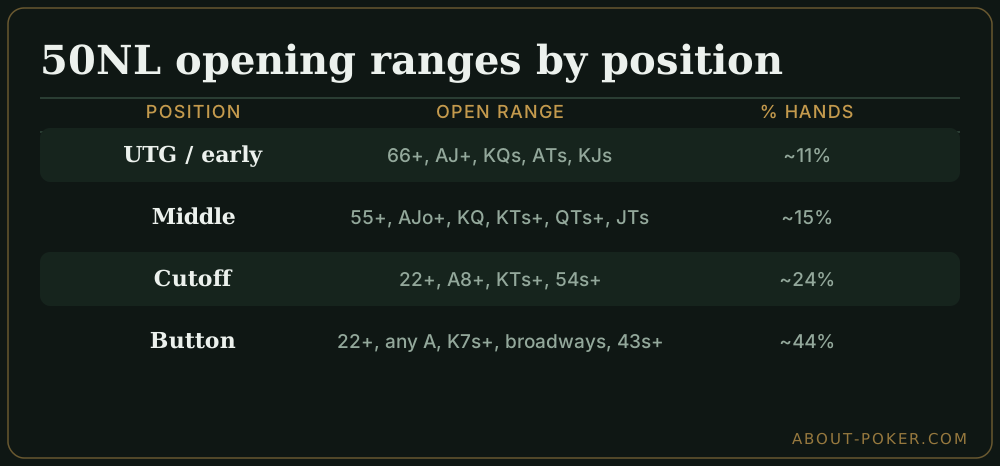
Tight, disciplined, position-driven:
| Position | Open range (approx.) | % of hands |
|---|---|---|
| UTG / early | 66+, AJ+, KQs, ATs, KJs | ~11% |
| Middle | 55+, AJo+, KQ, KTs+, QTs+, JTs | ~15% |
| Cutoff | 22+, A8+, KTs+, suited connectors 54s+ | ~24% |
| Button | 22+, any A, K7s+, most broadways, 43s+ | ~44% |
Against a table of solid regs, respect their blind defense — they won’t fold as much to steals — and don’t over-widen out of position.
Balance is now mandatory vs regs
At 50NL your lines must hold up against opponents who track your tendencies. C-bet a mix of value and bluffs on boards that favor your range. Barrel turns with real semi-bluffs, not just made hands. 3-bet a range that includes value hands and blocker bluffs. When a reg starts fighting back hard, you’ll need to adjust to aggressive regs — tightening your value thresholds and letting them bluff into your traps. The one constant: against a recreational caller, drop balance entirely and revert to pure value.
A worked hand
A reg opens the hijack to 2.5bb. You call on the button with 9h8h (a strong, disguised hand versus a wide opener). The reg is a competent player. Pot ~6.5bb, plus blinds.
- Flop: Th 7c 2h. You flop a flush draw plus an open-ended straight draw (a jack or six gives a straight; any heart gives a flush) — a massive combo draw. The reg c-bets 3bb. You call, keeping bluffs and worse in and preserving your equity.
- Turn: Qs. The reg bets 8bb. You still have a flush draw and a gutshot to the nut straight (a jack). With a raise you can fold out some of the reg’s air; with a call you realize equity in position. Calling is clean and low-variance here.
- River: 6d. You rivered a straight (T-9-8-7-6). The reg checks. You value bet 12bb — a reg will pay off a straight with two pair, sets, and busted draws that decided to bluff-catch.
The point: you played a big draw in position, controlled the pot, and got paid when you hit. Against a reg you don’t need to bluff every draw — realizing equity in position is already profitable.
Attack the weak spots
Even in a competent field, 50NL regs have exploitable tendencies, and finding them is where your edge grows. Some c-bet 100% of flops — float them wide and take the pot away on turns they can’t continue. Some never triple-barrel bluff — so when they fire three streets, believe them and fold your bluff-catchers. Some over-fold the big blind to steals — so open wider from the button against them. Keep simple notes on the players you see repeatedly; a single reliable read (like “reg X gives up on the turn without a hand”) is worth more than any generic line.
Common 50NL leaks
- Autopiloting a micro-stakes value-only game against thinking regs.
- Failing to defend blinds enough and getting run over by steals.
- Bluffing with no plan — firing streets without equity or fold equity.
- Over-folding to reg aggression, paying off value while folding bluff-catchers.
- Skipping table selection and grinding reg-heavy games for scraps.
Your 50NL checklist
- Tighten and clean up your opening ranges.
- Play balanced c-bet, barrel, and 3-bet ranges vs regs.
- Defend blinds appropriately versus competent stealers.
- Revert to pure value against recreationals.
- Adjust down your value thresholds against hyper-aggressive regs.
- Keep 40–50 buy-ins and table-select relentlessly.
50NL is the real start of the grind. Balance your reg game, keep exploiting the fish, and 100NL comes into view.
Frequently asked
What is a good winrate at 50NL?
A strong 50NL regular typically runs 4–7bb/100 ($0.25/$0.50 blinds), around $20–$35 per hundred hands. The field is meaningfully tougher than the micros, so winrates compress and consistency matters more than any single flashy line.
Is 50NL considered low stakes?
Yes, 50NL sits in the low-stakes tier just above the micros. It's the first level where most opponents have a real strategy, so you need balanced ranges against regs while still finding and punishing the recreationals who show up.
How many buy-ins should I have for 50NL?
Forty to fifty buy-ins ($2,000–$2,500) is a sensible cushion at 50NL given the increased competition and swings. A larger roll lets you play fearlessly and take a shot back down only by choice, not necessity.