How to Beat 5NL Cash Games
Beat 5NL by iso-raising limpers, value betting hard, and starting to punish the tighter regs. Opening chart, a worked hand, and the leaks that stall you at micro.
On this page · 7 sections
To beat 5NL — the $0.02/$0.05 online cash level — you keep doing what wins at 2NL (value bet hard, bluff rarely, dodge the rake) while sharpening your reads on the handful of regulars who show up. The pool is still soft and station-heavy, but at 5NL you’ll start seeing players who fold to aggression, and learning to tell them apart from the callers is the next step in your development.
The field: mostly stations, a few regs
Most 5NL opponents are the same limping, calling recreationals you crushed at 2NL. Sprinkled in are a few tight-ish regulars who c-bet, fold to raises, and try to play “real” poker. Your default game — value bet everything against the callers — still prints money, but you now adjust when a reg shows up: bluff the ones who fold, value bet the ones who don’t. If you’re just arriving from the bottom rung, the value-first habits from beating 2NL transfer almost perfectly.
Opening ranges for 5NL
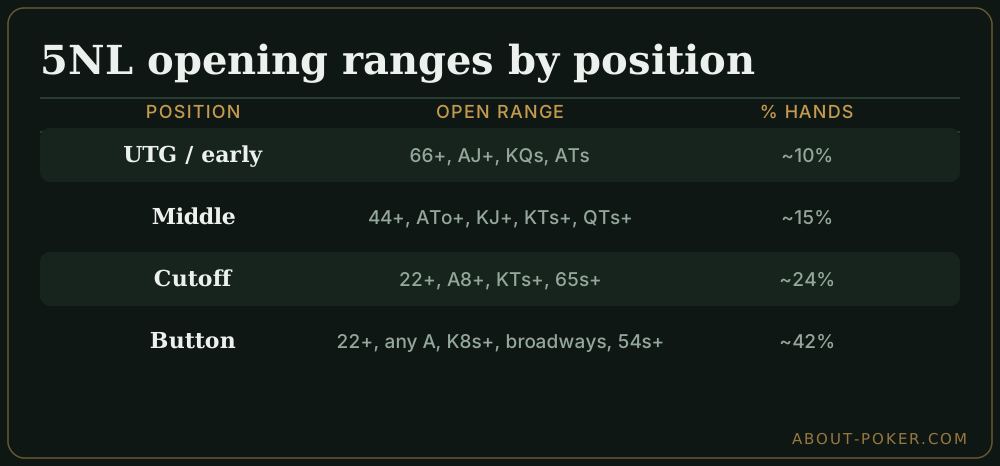
Raise-first-in, isolate limpers, and use position. Open to 3bb, plus 1bb per limper:
| Position | Open range (approx.) | % of hands |
|---|---|---|
| UTG / early | 66+, AJ+, KQs, ATs | ~10% |
| Middle | 44+, ATo+, KJ+, KTs+, QTs+ | ~15% |
| Cutoff | 22+, A8+, KTs+, suited connectors 65s+ | ~24% |
| Button | 22+, any A, K8s+, most broadways, 54s+ | ~42% |
Isolating limpers is your bread and butter. When a recreational limps, raise to about 4–5bb to play a heads-up pot in position against a capped, weak range.
Keep value betting — but read the caller
The core edge is unchanged: bet your good hands for value, sized large, against players who won’t fold. Top pair is still a three-street value hand versus a station. What changes at 5NL is that you start noticing when the caller is actually a reg who will fold — and against those players you can add a well-timed bluff. Building the muscle for thin value betting here pays off for every stake above.
A worked hand
You open AdTd on the button to 3bb after one limper folds. A loose big blind calls. Pot is about 7.5bb.
- Flop: Th 6s 3c. Top pair, top-ish kicker. You bet 5bb. Villain calls.
- Turn: 8d. You pick up a backdoor flush draw and keep top pair. You bet 11bb. Villain calls — likely a worse ten, a pair like 66/33 that’s really a set (rare), or a draw.
- River: 2s. Board bricked out. You bet 22bb for value. A 5NL station snaps with Tx, 88, or a busted draw that “can’t fold.”
Three streets of value with top pair, no bluff required. If the caller had instead check-raised the turn, you’d slow down — at 5NL a check-raise from a passive player is almost always a big hand, and folding one pair is correct.
Watch the rake and your volume
5NL rake still bites, though less than 2NL as a share of a full buy-in. The same rule holds: avoid grinding tiny limped pots and steer toward bigger pots where your value edge dwarfs the rake. Don’t over-table; two to four tables you can actually read beats eight tables of autopilot. The habits described in beating micro-stakes — position, isolation, discipline — are exactly what carry a winrate through the rake.
Common 5NL leaks
- Treating every caller like a reg and bluffing into stations.
- Under-sizing value bets out of fear — stations pay full pot, so charge them.
- Playing offsuit trash (KJo, QTo, A8o) from early position.
- Autopiloting across too many tables and missing profitable value spots.
- Spewing in 3-bet pots with hands that can’t stand heat.
Your 5NL checklist
- Raise first in; isolate every limper.
- Value bet top pair and better for three streets versus callers.
- Size up — stations don’t fold to big bets.
- Bluff only the regs who actually fold.
- Keep tables low enough to read opponents.
- Protect a 30-buy-in roll and move up when you’re beating it.
5NL is where you learn to separate the callers from the folders. Nail that read, keep the value engine running, and 10NL is next.
Frequently asked
What is a good winrate at 5NL?
A strong regular can hold 7–12bb/100 at 5NL, which is a couple of dollars per hundred hands at $0.02/$0.05 blinds. The field is still soft, so a disciplined value-heavy game beats it comfortably over volume.
Is 5NL harder than 2NL?
Slightly. You'll see a few more thinking regulars and marginally less spew, but the pool is still dominated by recreational players who call too much. The winning formula — value bet, rarely bluff, respect the rake — barely changes from 2NL.
How many buy-ins should I have for 5NL?
Around 30 buy-ins, or $150, is a comfortable cushion. Micro variance is real over tens of thousands of hands, and keeping a full roll lets you play your best without fear of a normal downswing.