How to Play Against a Solid Reg
A solid reg makes few mistakes, so avoid marginal spots and hunt small edges. Learn to sidestep tough regs, stay balanced, and pick better games.
On this page · 7 sections
A solid reg is a competent, thinking regular who plays a tight-aggressive, reasonably balanced game and rarely makes large mistakes. Against loose players you win by value betting; against maniacs you win by trapping. Against a solid reg you often win the least, because he simply does not spill chips. The core insight is that your edge in a game does not come from the tough regular — it comes from the weak players at the table. Your plan against a solid reg is therefore mostly about damage control: avoid marginal wars, take the tiny edges you can, and aim your firepower elsewhere.
Accept that the edge is small
The first mental adjustment is to stop trying to “get” the reg. When two competent players tangle, the pots tend to be close to break-even, and the variance is high. A good regular calls with the right frequency, folds when your line is credible, and value bets thin himself. Fighting him for stacks in marginal spots is a coin flip that burns your bankroll and your focus. Recognize that in a soft game with one solid reg and three weak players, you make almost all your money from the weak players, so protect that profit by keeping reg confrontations small and clean. This is the through-line in playing against regs.
Use position ruthlessly
The one persistent edge you always have over a reg is position, so treat it as your primary weapon. Enter far more pots when you are on his left and can act after him, and fold more readily when he has position on you. In position you realize your equity better, control the pot size, and can apply pressure with the initiative. Out of position against a reg, your marginal hands lose a great deal of value, so simply play tighter. Seat selection is not a nicety here — putting the tough regs on your left, as discussed in table selection and seat selection, directly determines how often you hold the positional edge.
Stay balanced and unreadable
A solid reg is watching for patterns. If you only three-bet with premiums, he folds and reraises correctly against you. If you only continuation bet when you connect, he floats and takes the pot away. So mix your play: three-bet a balanced range that includes some bluffs, continuation bet a sensible mix of value and air, and do not let your bet sizing telegraph your hand. You do not need game-theory perfection, but you do need to deny him easy reads. The moment a reg solves your tendencies, your small edge evaporates and turns negative.
A worked example
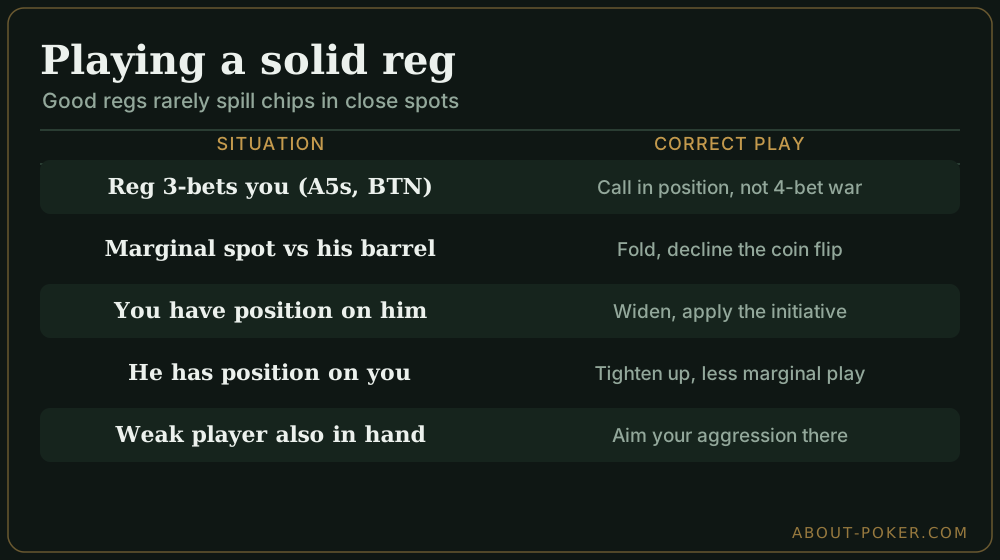
You open the button with A♠ 5♠ and a solid reg in the big blind three-bets. Against a weak player you might four-bet or call wide, but against a reg you know his three-betting range is credible and his post-flop play is sharp. You call in position rather than escalating. The flop comes K♥ 9♦ 4♣, he continuation bets, and you have a backdoor flush draw and an ace. Against a fish you might float and barrel; against a reg who barrels turns accurately, you simply fold, because the spot is marginal and he plays it well. You surrendered a small pot rather than building a large one where his skill matters most. That discipline — declining close, high-variance battles with a strong player — is how you preserve your win rate.
Know when a reg turns aggressive
Some regs are straightforwardly tight-aggressive; others apply relentless, well-constructed pressure with wide three-bets and constant barreling. Against the aggressive variety you must widen your calling and four-betting ranges enough that he cannot simply run you over, without spewing into his value. Recognizing that a reg has shifted into a high-aggression gear, and calibrating your defense, is a distinct skill covered in adjusting to aggressive regs. Fail to adjust and a good aggressive reg will chip away at you relentlessly from position.
Common mistakes against solid regs
The classic error is ego — deciding to prove you can outplay the best player at the table and firing three barrels into his accurate call-downs. A second mistake is playing too many hands out of position against him, where your edge is smallest and his is largest. A third is becoming readable, letting him exploit a betting-size tell or a one-dimensional three-betting range. Finally, many players ignore the obvious solution: if the game is not soft enough to justify battling a tough reg, leave. Game selection beats every in-game adjustment.
Checklist for a solid reg
Accept a thin edge and refuse marginal, high-variance pots with him. Use position aggressively and tighten up when he has it on you. Keep your ranges balanced enough that he cannot read you. Direct your real aggression at the weak players and treat the reg as an obstacle to route around. Adjust upward if he plays a hyper-aggressive style. And remember the simplest edge of all: sit to his left, put the fish on your right, and let the table do half the work for you.
Frequently asked
How do you beat a solid reg in poker?
You rarely beat a solid reg for much, so the real win is avoiding big pots with him and directing your action at weaker players. Play tight and positionally sound against a reg, take the small edges position gives you, and stay balanced so he cannot exploit a pattern. The money comes from the fish, not from the good regular.
Should you bluff a solid reg?
Only in balanced, well-chosen spots, never on a whim. A solid reg calls down accurately and folds when the story does not add up, so random bluffs fail. Bluff at the frequencies a strong hand range would justify, and stop trying to outplay him in marginal spots.
Where should you sit relative to a solid reg?
Directly to his left, so you act after him and can use position on every hand you play together. Sitting to his right hands him the same edge over you. Better still, arrange your seat so the weak players are on your right and the tough regs are on your left.