What Is Effective Stack in Poker?
The effective stack is the most either player can actually win or lose in a hand — the smaller of the two stacks. Learn why it drives every decision.
On this page · 7 sections
The effective stack is the largest amount of money that can actually change hands between two players in a pot — and it is simply the smaller of the two stacks. If you sit with 500 big blinds and your opponent has 40, only 40 can ever move between you. The extra 460 in front of you is irrelevant to that particular confrontation. This single idea quietly governs bet sizing, hand selection, and every all-in decision in No-Limit poker.
Why the Smaller Stack Rules
Poker is a zero-sum battle between the chips at risk. You cannot win chips your opponent does not have, and they cannot win chips beyond their own stack from you in a single pot. So the “real” stack for planning purposes is always the shorter one. A player with a monster stack facing a short opponent must think like a short-stacked player for that hand, because the depth advantage they hold over the rest of the table means nothing against this specific opponent.
A Worked Example
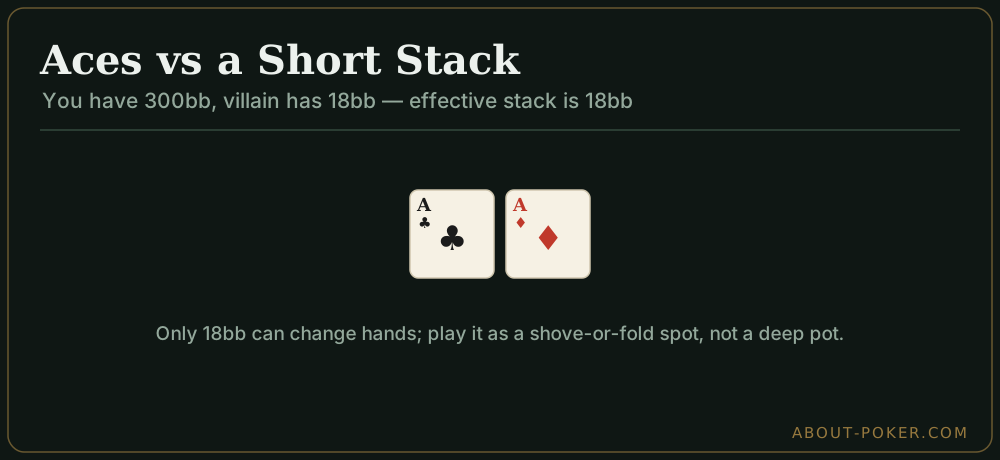
You have Ac-Ad on the button with 300 big blinds. The big blind, who has only 18 big blinds, raises. You may be deep-stacked at the table, but the effective stack here is 18 big blinds. That changes everything: there is no room for tricky deep-stack maneuvering, no reason to worry about being outplayed on later streets, and no future implied odds for your opponent. The correct play is to get the money in — you are essentially in a shove-or-fold world dictated entirely by the short stack across from you.
Contrast that with holding the same aces when both of you have 300 big blinds. Now the effective stack is 300, and a single misplayed street can cost a fortune. Same hand, wildly different game, all because of the effective stack.
Effective Stack in Multiway Pots
When three or more players see a flop, you have a separate effective stack against each opponent. If you cover everyone, your effective stack against each is their stack. If one player is short and another is deep, you are simultaneously playing a short-stacked hand against one and a deep hand against the other. Side pots form precisely because effective stacks differ: the short player can only contest the main pot up to their chips, while the deeper players continue building a side pot beyond that.
How It Shapes Your Decisions
- Bet sizing: Plan your bets across streets so the money gets in smoothly by the river if you want stacks in. With a short effective stack, a single raise may already commit both players.
- Hand selection: Speculative hands like small pairs and suited connectors need a deep effective stack to justify chasing sets and flushes for the big payday. Against a short stack, their implied odds collapse.
- Pot commitment: The effective stack determines when you become pot-committed. Once you have put in a large fraction of the shorter stack, folding is usually a mistake.
- All-in math: When the effective stack is small relative to the pot, going all-in is often the cleanest play — there is little left to maneuver with.
Effective Stack Versus SPR
The stack-to-pot ratio, or SPR, is built directly on the effective stack: you divide the effective stack by the current pot. A low SPR means the effective stack is small compared to the pot, so committing is easy and postflop play is simple. A high SPR means there is a lot of maneuvering room. So the effective stack is the raw ingredient; SPR turns it into a ratio that tells you how much room you have to play.
Common Mistakes
- Using your own stack for sizing. A big stack against a short opponent still plays short — do not size bets as if all your chips are live.
- Chasing implied odds that do not exist. Small pairs stop being profitable set-mines when the effective stack is thin, because the payoff when you hit is capped.
- Forgetting side pots. In multiway all-ins, track which chips are contestable against whom.
- Panicking when covered. Being covered by a monster stack does not increase your risk beyond your own stack in any single hand.
Quick Checklist
Before you act, find the shorter of the two stacks — that is your true stack for the hand. Size your bets, choose your hands, and judge commitment against that number, not against the pile of chips you personally hold.
Frequently asked
What is the effective stack in poker?
The effective stack is the smaller of the two stacks in a heads-up pot, because that is the most either player can win or lose. If you have 500 and your opponent has 200, the effective stack is 200 — the extra 300 you hold can never come into play against them.
How do you calculate effective stack?
Compare the two stacks and take the smaller number. In a multiway pot, the effective stack against each specific opponent is the smaller of your stack and theirs. Your biggest stack does not matter if the player you are in with is short.
Why does effective stack matter more than your own stack?
You can only win what your opponent can lose. Planning bet sizes, deciding whether to set-mine, and judging pot commitment all depend on the effective stack, not your total chips. A huge stack against a short opponent plays like a short-stacked hand.
What is the difference between effective stack and SPR?
Effective stack is a chip amount — the smaller of the two stacks. SPR, the stack-to-pot ratio, divides that effective stack by the size of the pot to describe how deep the money is relative to what is already in the middle.