Squeezing in Cash Games
How to squeeze in cash games: exploiting the open-plus-caller spot, correct sizing with dead money, range construction, and a worked A5s squeeze example.
On this page · 7 sections
The squeeze is one of the most profitable preflop plays in cash games because it attacks a weak, predictable pattern: someone opens, someone flat-calls, and both players are now capped and passive. Re-raising into that spot picks up dead money often and sets up big pots when you are called light. This guide shows when to squeeze, how much, and which hands to pick.
What makes a squeeze different from a normal 3-bet
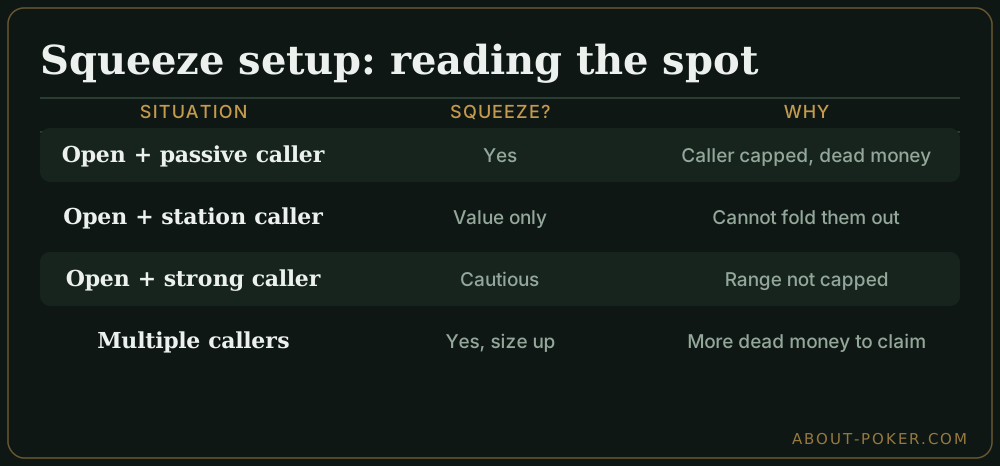
A squeeze is simply a 3-bet made after an open-raise and one or more callers. The difference is the context, and that context is gold. When a player just calls an open instead of 3-betting, they are usually saying “I have a hand worth playing but not worth re-raising” — a capped range of small pairs, suited connectors, and medium broadways. They rarely have aces or kings, because those hands almost always 3-bet.
That capped caller, plus the extra chips already in the middle, is what you squeeze. You are applying pressure to two players who each need a strong hand to continue, while collecting more dead money than a heads-up 3-bet would offer. It is a natural piece of a disciplined cash game preflop strategy.
Why the math favors the squeezer
The key ingredient is dead money. Say the cutoff opens to 3bb and the button calls. There is now 3 + 3 + 0.5 + 1 = 7.5bb in the pot before you act from the big blind. If you squeeze to 12bb and both players fold, you win 4.5bb of chips that were never yours, risking only your re-raise. Because two players must each pass to a big raise, the fold rate is high — you do not need a strong hand to profit immediately.
When you are called, you still hold the initiative and usually position over at least one opponent. That combination — high fold equity plus a strong postflop position — is exactly why squeezing is so effective against passive lineups.
Sizing: bigger than a heads-up 3-bet
Squeeze sizes need to be larger than a standard 3-bet because there is more dead money to claim and more players to fold out. A reliable rule is about 3x the open plus one big blind for each caller when you are in position, and roughly 4x plus a big blind per caller when you are out of position. So against a 3bb open with one caller from the blinds, a squeeze to about 13bb is reasonable.
Undersizing is the classic error: a small squeeze invites calls, defeats the fold-equity engine, and drags you into a bloated multiway pot from a bad seat. If you get called by two players, you are now navigating a big multiway pot, which is exactly what a proper size is designed to avoid. For a fuller sizing framework, see bet sizing in cash games.
Range construction: value plus targeted bluffs
Your value squeezes are the same premium hands you would 3-bet — QQ+, AK, and often JJ and AQs. The bluff portion is where squeezing shines, because the caller’s capped range means your bluffs have huge fold equity. Choose bluffs with blockers and playability: suited aces (A5s-A2s) block the opener’s AA/AK, and suited broadways like KQs and QJs flop well when called and unblock the folding range.
Avoid squeezing with hands that flop poorly and block nothing, such as offsuit gappers. And tighten up sharply if either player in the pot is a station who never folds — against a caller who will not release, squeeze for value only.
Worked example: squeezing A5s from the big blind
You hold Ah5h in the big blind at 100bb. A loose cutoff opens to 3bb and a recreational button flat-calls. The pot is 7.5bb before you act.
A5s is an ideal bluff squeeze. You make it 13bb (about 4x plus a blind per caller, sized up because you are out of position). The ace blocks the opener’s AA and AK combos, so those premium continuing hands are less likely. If both fold — the common outcome against this lineup — you scoop 7.5bb of dead money. When called, you still have the nut-flush blocker, a wheel draw, and initiative. This is far stronger than flat-calling A5s and playing a passive three-way pot out of position. If your squeeze gets 4-bet by a tight opener, you fold cheaply and lose nothing more.
Common squeezing mistakes
Do not squeeze into a raiser plus a caller who both have uncapped or sticky ranges — the whole point is exploiting a capped, passive caller. Do not undersize; a small squeeze kills fold equity. Do not squeeze junk with no blockers. And do not repeatedly squeeze the same observant regular, who will start flatting and 4-betting to punish you — mix in flats and let the play breathe.
Quick squeeze checklist
- Look for open + at least one flat caller, especially a capped, passive one.
- Size ~3x the open + 1bb per caller in position, ~4x + 1bb out of position.
- Value: QQ+, AK, JJ/AQs. Bluffs: suited aces and suited broadways.
- Never squeeze small — fold equity is the whole engine.
- Tighten to value only against callers who never fold.
Frequently asked
What is a squeeze in poker?
A squeeze is a 3-bet made after an original raise and at least one caller. You are re-raising into two or more players at once, using the dead money in the pot and the caller's usually capped range to apply maximum pressure.
How big should a squeeze bet be?
Squeeze larger than a normal 3-bet because there is more dead money and more players to fold out. A common formula is about 3x the open plus one big blind for each caller; out of position, lean toward 4x plus a big blind per caller.
What hands are best for squeezing?
Value squeezes use QQ+, AK, and often JJ/AQs. Bluff squeezes work best with suited aces and suited broadways that block the raiser's premiums and retain playability if you get called.