Top Preflop Leaks
The preflop leaks that quietly wreck win rates — limping, cold-calling, playing out of position, and flat opening sizes — and the disciplined fixes for each.
On this page · 6 sections
Most players obsess over postflop play, but preflop is where the biggest, most fixable leaks live. Every hand starts here, and a bad preflop decision compounds into a difficult postflop spot you never should have been in. Plug these leaks and everything downstream gets easier.
Limping into pots
Open-limping — calling the big blind instead of raising — is the signature move of a losing player. It has three problems. First, it caps your hand: strong hands want to raise for value, so your limp advertises weakness. Second, it invites everyone behind to come along cheaply, creating multiway pots where your equity plummets. Third, it surrenders the initiative you’d get from being the preflop raiser.
The fix is simple and absolute: raise or fold. If a hand is worth playing, raise it to build a pot and take control. If it isn’t, muck it. When someone else limps in front of you, don’t limp behind — raise to isolate them. That skill has its own guide, isolating limpers in cash.
Cold-calling raises out of position
The second big leak is flat-calling an open raise, especially from the blinds or with players still to act behind you. Calling a raise out of position with a hand like A♠T♣ or K♥J♦ feels reasonable, but you’ll be check-folding a huge share of flops and getting squeezed by players behind.
A cleaner strategy is to 3-bet or fold in many of these spots. Strong hands 3-bet for value; some hands 3-bet as bluffs; marginal hands that can’t do either usually fold. Calling is reserved for hands that play well multiway and flop big — small and medium pocket pairs (for set value) and suited connectors when you have position and good implied odds. The 3-betting in cash games guide breaks down which hands belong in each bucket.
Playing the same range from every seat
Beginners often have one starting range they use everywhere. That’s a leak in both directions: too loose under the gun, too tight on the button. Position dictates how many players can still wake up with a hand behind you and how often you’ll get to act last postflop.
Here’s the concrete progression for a 6-max game. Under the gun you might open around the top 15% of hands. From the cutoff, roughly 25–28%. On the button, you can open 40% or more, including hands like Q♦8♦, K♣5♣, and 9♠7♠ that would be trash from early seats. If your range isn’t visibly widening as you approach the button, you’re leaving money on the table — see the full cash game preflop strategy.
Flat, predictable open sizing
Another quiet leak is using a raise size that doesn’t fit the game. Online, a small 2.2–2.5bb open is efficient because players fold appropriately. Live, where the table calls three or four ways no matter what, a 2bb open just builds a bloated multiway pot with the worst positional player (you, if out of position) at a disadvantage.
Live, size up. A 4–5bb open, plus one extra big blind per limper, thins the field to one or two callers and lets your strong hands play heads-up. Adjust to the table: against callers, bigger; against a tight, aggressive lineup, smaller. A worked example: at $1/$2 live with two limpers, raising to $15 ($5 base plus $5 per limper, roughly) isolates far better than a robotic $6.
Defending the big blind incorrectly
The big blind is a special seat: you’re getting a discount because you already have money in the pot, so you can defend wider than anywhere else. The leak cuts both ways. Some players over-defend, calling raises with hands like J♦4♦ that flop nothing playable; others under-defend, folding hands that are clearly profitable calls given the price.
Against a single raise from a late position, you can defend a wide range because you only need a small amount of equity to justify the call. But defend by folding the true junk and 3-betting your best hands rather than calling everything face-up.
The preflop leak checklist
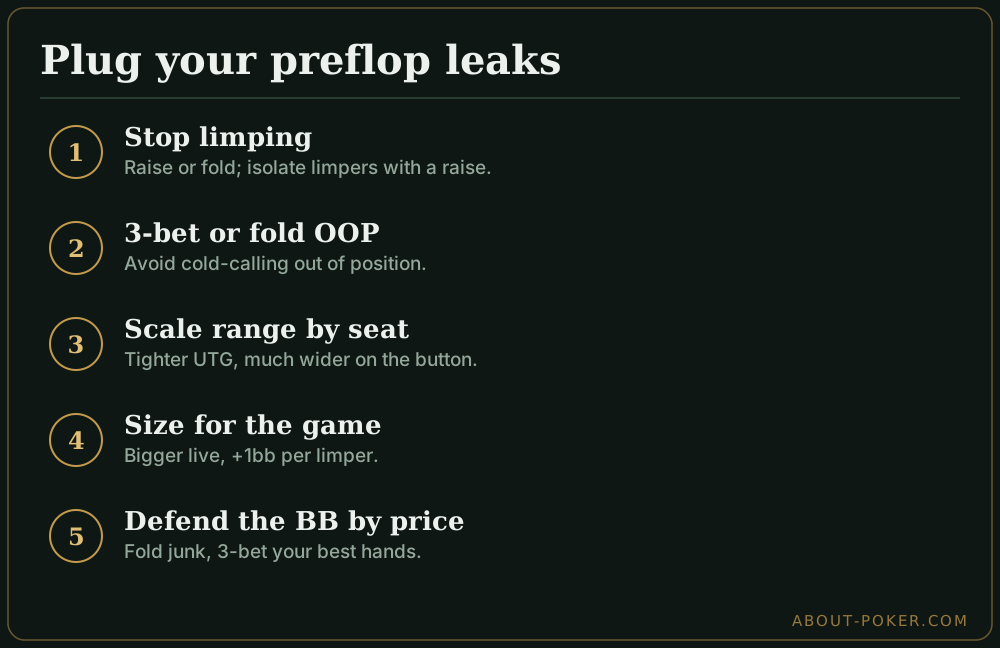
- Never open-limp; raise or fold.
- 3-bet or fold most hands out of position instead of cold-calling.
- Widen your opening range as you move toward the button.
- Size your opens for the game — bigger live, plus one blind per limper.
- Defend the big blind by price, folding junk and 3-betting your best.
Preflop discipline is unglamorous, but it’s the highest-leverage work in poker. Get the first decision right and the rest of the hand almost plays itself.
Frequently asked
What is the worst preflop leak in poker?
Limping — entering the pot by just calling the big blind — is the classic losing-player leak. It caps your hand strength, invites multiway pots, and surrenders initiative. Raising or folding is almost always better than limping.
Should I ever open-limp in a cash game?
Almost never. The only defensible limp is in the small blind versus the big blind at very specific frequencies, and even that is optional. In every other spot, if a hand is good enough to play, it's good enough to raise; if it isn't, fold.
How much should I open-raise preflop?
Online, 2.2 to 2.5 big blinds is standard. Live, where players call more, 3 to 5 big blinds is common, plus one extra blind for each limper already in the pot. The goal is a size that isolates weak players and builds a pot you want to play.